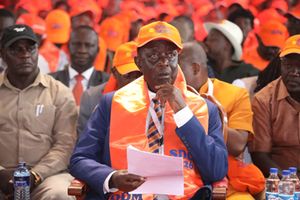
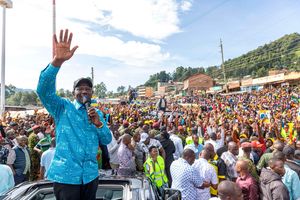
It started with quiet meetings and symbolic gestures, then came Cabinet appointments, followed by shared platforms.
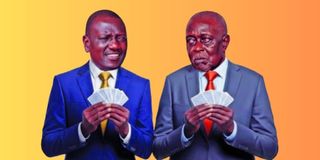
Now, Orange Democratic Movement (ODM) party finds itself confronting an uncomfortable question: did it walk willingly into a political trap set by its longtime rival?
For decades, ODM was Kenya’s most formidable opposition machine anchored by the late founder Raila Odinga’s singular authority.
Today, that legacy is under strain, as the party grapples with the consequences of a political embrace that critics say has drawn it into President William Ruto’s carefully laid trap.
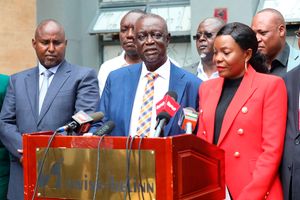
On Thursday, the party’s Central Committee came out guns blazing, demanding for “respect,” signaling that all was not well in the nascent cooperation.
“Regarding our engagement with our broad-based partner, the UDA party, the Central Committee has expressed concern over recent developments and statements by some senior UDA officials, which have unsettled our members. As a party grounded in firm principles and ideology, we insist on mutual respect in this partnership,” the party said.
But long before ODM and the ruling United Democratic Alliance (UDA) party formally opened the door to a 2027 coalition, the two outfits had begun a quiet but deliberate rapprochement.
This emanated from a series of discreet engagements, culminating in a high-profile ODM founders’ dinner in Mombasa last year—an event widely understood within political circles to have enjoyed State House backing.
Soon after, a new political chant began to ripple through ODM ranks: “Tutam”—a rallying call for Dr Ruto’s re-election, long before commencement for any formal 2027 coalition talks.
President William Ruto during the ODM Founders' dinner at Sarova Whitesands in Mombasa on November 15, 2025.
Photo credit: Wachira Mwangi | Nation Media Group
Political analysts say that for a party built on resistance politics, the optics were jarring.
Siaya Governor James Orengo was among the first to sound the alarm. Speaking at a funeral in Siaya in early 2025, Mr Orengo cautioned against what he termed “blind praise-singing,” warning that ODM risked losing its ideological compass.
“A political party must never surrender its identity for temporary comfort. Praise songs will not build a movement,” he said at the time.
But even as dissenting voices emerged, the gravitational pull toward State House only intensified.
The real turning point came when President Ruto began systematically incorporating key ODM figures into government.
High-profile names—Hassan Joho, Wycliffe Oparanya, Opiyo Wandayi, John Mbadi and Beatrice Askul—found their way into the Cabinet, while other members rose to occupy senior state positions.
What was initially framed as a “broad-based government” soon took on a different meaning within ODM ranks: co-opting.
Analysts now argue that this was the first decisive move in what appears, in hindsight, to have been a long political game.
“Ruto understood that to neutralise ODM, you don’t fight it head-on—you absorb it,” says political analyst Prof Gitile Naituli.
If the Cabinet appointments marked the beginning, the death of Raila Odinga accelerated everything.
Without its unifying figure, ODM’s internal contradictions—long managed through Odinga’s authority—burst into the open.
Leadership of the party fell to his elder brother, Oburu Oginga, but the transition exposed deep fissures.
ODM activities—particularly those branded “Linda Ground”—began receiving logistical and financial backing.
Party events saw an increased presence of State-linked facilitation, while key leaders enjoyed enhanced security arrangements.
ODM Party leader Dr Oburu Oginga (left), President William Ruto and ODM Chairperson Gladys Wanga share a cake during ODM@20 celebrations at Sarova Whitesands in Mombasa on November 16, 2025
In one striking incident, ODM activist Oketch Salah printed party T-shirts emblazoned not with the party’s traditional symbols—but with President Ruto’s image, long before delegates approved the ODM-UDA coalition talks.
At one time, ODM Director of Elections Junet Mohamed, the latest senior party figure to declare the party was not short of 2027 options amid UDA threat, cautioned against Mr Salah’s move.
In an exclusive interview with the Nation last year, Dr Oginga initially struck a hardline stance, declaring that ODM would settle for nothing less than the deputy presidency in any coalition deal.
“We cannot be in a coalition and not have a share at the top. The deputy president position is critical for us,” he said.
But in a dramatic shift, he later softened his tone during a meeting with Deputy President Prof Kithure Kindiki in Kisumu.
“We are not fighting for anyone’s seat. We are open to discussions,” he said.
The climb down triggered backlash within ODM, forcing yet another reversal.
“Some people misinterpreted my statement… that deputy president post is our main target. That’s what we are aiming at,” Dr Oginga later clarified at a party meeting in Mombasa.
To observers, the oscillation was emblematic of a party unsure of its footing.
Mr Mohamed has been one of the most vocal defenders of the ODM-UDA rapprochement—but even he has sounded the alarm.
“There are people in government who are fighting this union,” he said.
“We are not in government by mistake. We joined to foster unity and inclusivity… but we do not lack options.”
His comments laid bare the growing unease within ODM: that the partnership may not be as mutual as it appears.
Faced with mounting tensions, President Ruto has publicly defended the cooperation between UDA and ODM.
“The underhand forces driving division between our two parties will not succeed. Our country is better when UDA and ODM are together,” said Dr Ruto said in Nyamira this week.
UDA Secretary-General Hassan Omar has been more blunt, perhaps the senior UDA leader ODM party alluded to on Thursday.
Rejecting ODM’s push for zoning, Mr Omar has argued that political strength must be tested at the ballot—not negotiated in boardrooms.
“If ODM believes it is strong, let it face the people. Democracy is about competition, not protection,” he said.
UDA party secretary general Omar Hassan.
Photo credit: File | Nation Media Group
On Friday, Embakasi East MP Babu Owino, a member of the ODM splinter group – Linda Mwananchi launched yet another scathing attack on the party’s current leadership, accusing it of abandoning the people’s agenda.
“They are on a similar mission to eat Kenyans. For us we are on a vision, to fight for Kenyans,” he said, adding: “We warned them but they refused to hear us… it’s now time for them to hand over the party to us.”
His Saboti counterpart Caleb Amisi said the latest outbursts by the Dr Oburu Oginga-led faction was a testament to their vindication.
“We are vindicated… there is nothing left from a weak ODM to negotiate with Ruto,” he said. “he convinced a sitting president Uhuru Kenyatta to fold his party TNA to form Jubilee, what about Oburu?”
Former Deputy President Rigathi Gachagua has claimed he had foreseen ODM’s predicament, warning that President Ruto had a long-term strategy to dismantle the party.
“I warned you that Kasongo will finish ODM… he wants to confine it in Luo Nyanza. ODM will be lucky to have 20 MPs,” he said.
At the heart of the current standoff is the question of zoning—whether coalition partners should avoid fielding candidates against each other in certain regions.
For ODM, zoning is existential.
Without Raila, its grip on traditional bastions—Nyanza, Western, Coast—is no longer guaranteed.
For UDA, as put Mr Mr Omar, zoning is unacceptable.
Dr Ruto’s entire political project hinges on building a national party capable of penetrating opposition strongholds.
“I am disappointed in my Speaker and the UDA Secretary General who are ungrateful to ODM which made them governor, senator and ministers. I respect President Ruto but he should discipline his UDA officials who have been disrespectful to ODM,” he said.
Even as ODM leaders insist their zones are “non-negotiable,” insiders say, UDA has quietly begun laying the groundwork for parallel candidates.
“Nowhere is this contradiction more visible than in Homa Bay. Governor Gladys Wanga—a key ODM figure—finds herself facing a political paradox of her own making because it was in Homa Bay that Ruto launched his landing pad into Nyanza, aided in part by ODM’s openness to engagement,” a source from the party told Nation .
Today, that same opening has produced formidable challengers, with immediate former deputy governor Oyugi Magwanga, linked with pro-Ruto camp.
Homa Bay Governor Gladys Wanga speaks during the Orange Democratic Movement (ODM) Special Delegates Convention at the ASK Dome, Jamhuri Expo Centre in Nairobi.
Photo credit: Bonface Bogita | Nation Media Group
For Ms Wanga, analysts say, the threat is deeply personal.
“She helped roll out the red carpet. Now, the guest is rearranging the house,” argues advocate Chris Omore.
Internally, ODM is increasingly fractured.
Two rival factions — “Linda Ground” and “Linda Mwananchi”— have emerged, each claiming to represent the party’s true grassroots base.
At the same time, an intense struggle is underway for control of the powerful Secretary General position, with Nairobi Senator Edwin Sifuna under pressure.
Even whispers of external interference—some pointing to former President Uhuru Kenyatta—have deepened mistrust.
As coalition talks gather pace, the battle lines are shifting to the deputy presidency.
ODM’s insistence on the position places Prof Kindiki—and by extension Dr Ruto’s Mt Kenya strategy—under pressure.
“The probability of Ruto sacrificing a core ally is almost zero,” says Prof Naituli.
To many observers, the unfolding drama bears the hallmarks of a carefully executed political strategy.
By drawing ODM closer—through appointments, resources, and symbolic gestures— president Ruto has achieved multiple objectives.
“He has neutralised a historically powerful opposition, fragmented its internal cohesion and expanded UDA’s footprint into new regions, all without conceding significant ground.”
“Ruto is playing chess, not checkers,” says analyst Chris Omore. “And ODM is reacting move by move.”
As the 2027 election approaches, ODM finds itself at a crossroads, whether to continue down the path of cooperation, or does it pull back—at the cost of losing access to state power?