Members of the National Assembly are considering a suggestion to grant the National Council for Nomadic Education in Kenya (NACONEK) greater autonomy in a bid to fix the chronic underfunding that threatens the school feeding programme for millions of vulnerable learners.
The MPs sitting at the National Assembly Committee on Governance and Education now say ring-fencing NACONEK from the Ministry of Education bottlenecks could help shield the programme from repeated budget cuts that have left it gasping for funds year after year.
The proposal comes as the school feeding programme stares at a Sh3.1 billion funding gap, despite a proposed additional allocation of Sh1.75 billion under the Supplementary Budget.
The agency needs Sh8.3 billion to feed 2.6 million learners for 151 school days, but had initially been allocated only Sh3 billion.
“We have a serious funding gap in the school feeding programme where we are dealing with 2.6 million learners and require Sh8.3 billion to feed them for 151 days, but were initially provided with Sh3 billion,” NACONEK chief executive officer Harun Yussuf told MPs.
NACONEK is currently a Semi-Autonomous Government Agency under the Ministry of Education and is mandated to bridge education disparities in nomadic regions, pockets of poverty in ASAL areas and urban informal settlements.
But MPs now argue that its current status may be weakening its ability to fight for and protect critical allocations for school meals.
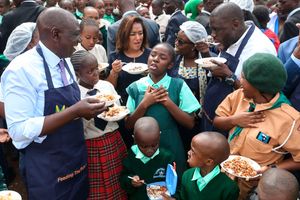
President William Ruto, Nairobi Governor Johnson Sakaja and Nairobi Women Representative Esther Passaris during the Launch of Nairobi County School Feeding Programme at Roysambu Primary School on June 20, 2023.
Photo credit: PCS
Bomachoge Chache MP Alfah Ondieki Miruka noted that granting the agency autonomy could give it more leverage in planning and protecting the school feeding programme.
“We understand that that’s a budget issue but if they could be given autonomy so that they are independent, perhaps that would help,” he said.
Narok Woman Representative Rebecca Tonkei said the agency’s budget needs are often trimmed in the wider government allocation chain, leaving vulnerable children exposed.
“With budgetary allocations and ceilings it becomes very difficult to give NACONEK what they need. We need give some recommendation to the Budget Appropriations Committee so that our proposed budgetary allocations to NACONEK are not altered at the next level,” she said.
Kilome MP Nzambia Kithua said NACONEK may be suffocating under a structure that limits its ability to operate independently.
“Because this agency is not independent and works under someone, they may not have room to breathe. We need to have the Cabinet Secretary come and shed more light so we can understand how we can assist as a committee,” he said.
Committee session chair Boyd Were, the Kasipul MP, noted that although the pressure on public resources is widespread, lawmakers still have room to push for stronger protection of NACONEK’s budget.
“The issue of resources is an issue all over but as a committee we can give recommendations for NACONEK to be allocated more resources,” he said.
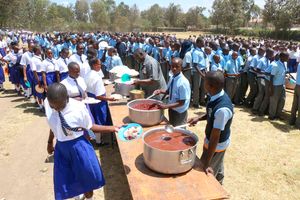
School feeding programme in a school in Turkana County.
Photo credit: File | Nation Media Group
The MPs are now considering inviting senior officials from the Ministry of Education to share their views on how the agency can be better supported.
The development comes at a time when the school feeding programme is once again fighting for survival, despite being widely seen as one of the most critical learner retention interventions in fragile and food-insecure regions.
The programme, which serves children in ASALs, urban slums and other marginalised areas, requires around Sh8 billion annually to run effectively but has continued to receive erratic and inadequate funding.
The National Assembly Committee on Education has proposed an additional Sh1.75 billion under Supplementary Estimates I for the 2025/26 financial year to cushion the programme.
But even with this proposed top-up, the programme remains deep in the red.
Budget records show the school feeding programme was allocated Sh2.3 billion in 2021/22, before dropping to Sh1.9 billion in 2022/23. The allocation then rose to Sh4.9 billion in 2023/24, before falling to Sh3.6 billion in 2024/25 and sliding further to Sh3 billion in the current 2025/26 financial year.
The inconsistency has raised fresh concerns over the sustainability of a programme that, in many hardship-hit areas, doubles up as both a nutrition intervention and a school attendance lifeline.
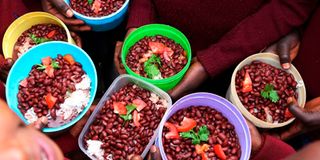
Students enjoy a meal provided through a school feeding programme.
Photo credit: File | Nation Media Group
In fact, in the 2024/25 financial year, the programme had initially been left out of the national budget altogether before MPs stepped in and pushed for a Sh3.6 billion allocation.
Basic Education Principal Secretary Julius Bitok warned that at least 2.6 million learners could be affected if the programme is not fully financed this financial year.