An incumbent president seeking re-election, procurement of poll materials and low public confidence in the electoral commission are among the major factors driving up the cost of elections in Kenya, a new study shows.
With Kenya’s elections ranked among the most expensive in Africa and globally, the study, “Cost of Elections in Kenya 2026”, suggests that the Independent Electoral and Boundaries Commission (IEBC) spends more when an incumbent is seeking re-election.
In the 2017 General Election, when President Uhuru Kenyatta was seeking a second term, the cost per registered voter was approximately Sh2,124, with IEBC spending a total of Sh65 billion. The commission attributed the spike to the one-off procurement of the Kenya Integrated Election Management System (Kiems) kits, as well as the repeat presidential election.
The cost per registered voter fell to about Sh1,649 in the 2022 election, when there was a succession contest. Cumulatively, IEBC spent Sh47 billion.
For the 2027 General Election, in which President William Ruto is seeking a second term, IEBC initially projected a budget of Sh61.7 billion. Parliament, however, reduced the allocation to Sh57.3 billion.
Globally, the cost of an election is estimated at roughly Sh645 per registered voter, meaning Kenya’s cost is about three to four times the international benchmark. The report says the trend could worsen in 2027.
“It is instructive to note that over the period reviewed for this report, the highest cost of electoral processes occurred in 2017, with a similar scenario projected in 2027. This would tend to suggest that electoral costs are highest when an incumbent is seeking re-election, rather than when a constitutionally mandated handover is in the offing,” the report states.
The study was conducted under the Promoting Inclusive Electoral Reforms in Kenya programme and funded by the Netherlands Institute for Multiparty Democracy and prepared by Prof Karuti Kanyinga and Tom Mboya on behalf of South Consulting Africa Limited.
In 2002, the cost of the election was Sh4.57 billion according to IEBC. The figure jumped significantly in 2007, when then-President Mwai Kibaki sought a second term, with the electoral agency spending Sh19.4 billion.
The study identifies deeper structural problems, including repeated technology replacement cycles, weak asset amortisation and limited incentives for IEBC to reduce costs.
“The data suggests that Kenya’s electoral system remains locked into a high-cost equilibrium in which each election triggers a new round of major procurement rather than building on durable, depreciated infrastructure,” the report states.
The cost of elections, the report, adds, will only fall when public trust in electoral institutions improves. It also calls on the political class to trust the electoral process even when the results do not favour them.
Claims of rigged elections have long characterised Kenya’s polls, with opposition candidates frequently alleging manipulation in favour of incumbents. Most of the disputed presidential results have ended up before the Supreme Court.
The late former Prime Minister Raila Odinga challenged the results of the 2013, 2017 and 2022 presidential elections in court. In 2017, the Supreme Court, then led by Chief Justice David Maraga, nullified Mr Kenyatta’s re-election and ordered a repeat. His petitions challenging the 2013 and 2022 results were dismissed.
The report notes that the politics of mistrust, fear of rigging and limited transparency force electoral institutions to over-invest in reassurance mechanisms.
“Kenya’s election bill is inflated not only by logistics and technology, but by deficits of trust in institutions. When parties and citizens fear rigging or biased administration, the system responds with costly assurances, heavier securitisation, more layers of technology, parallel results channels and high-volume litigation,” it states.
Reducing the high cost, the report suggests, requires political and institutional reforms that lower contestation and the perceived risk of manipulation, so that the system does not have to “buy” credibility through expensive controls.
Low trust also depresses voter turnout. More than one-third of registered voters did not turn out to vote in the 2022 election.
“This increased the cost per voter, especially because preparations and election materials are done on the assumption that almost all registered voters in polling stations will turn out to vote.”
In 2022, about 22 per cent of IEBC’s approved budget was not spent, with actual election expenditure standing at approximately Sh36 billion against an approved budget of Sh47 billion.
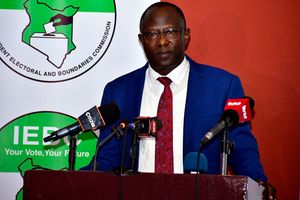
Independent Electoral and Boundaries Commission (IEBC) chairperson Erastus Edung Ethekon.
Photo credit: Wilfred Nyangaresi | Nation Media Group
IEBC Chairperson Erastus Ethekon recently told the Nation that the lack of trust among Kenyans is one of the reasons the country’s elections are expensive. He, however, cautioned against comparisons that do not take into account differences in geography, population, electoral architecture and the number of offices contested.
“Kenya’s electoral model is unique. We conduct six elections on a single day: presidential, National Assembly, Senate, county governor, county assembly and county woman representative to the National Assembly. The logistical requirements are equally unique. Transportation cannot be premised solely on government vehicles, and the thousands of temporary election officials engaged, many of them young Kenyans, are not volunteers. They must be remunerated,” Mr Ethekon said.
The commission also cited the substantial costs associated with voter registration, technology, ballot production, personnel, transportation, voter education, security coordination and logistics.
Mr Ethekon said the commission had no interest in unnecessary expenditure, arguing that there was always a desire to obtain value for money and maintain competitive procurement.
“A cheaper election is not necessarily a better election. Our elections are also heavily regulated and require substantial investment in technology, ballot materials, personnel, voter education, security coordination and nationwide logistics,” he said.
The commission recruits and trains tens of thousands of temporary officials during each electoral cycle, including presiding officers and clerks. This is in addition to its permanent staff. Salaries, training and allowances for the temporary workforce constitute a substantial budget outlay.
The printing of secure ballot papers, result forms, voter registers and other sensitive materials also adds to the cost of conducting elections. In recent elections, printing has been outsourced to international firms, contributing to the expenditure.
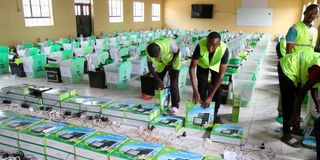
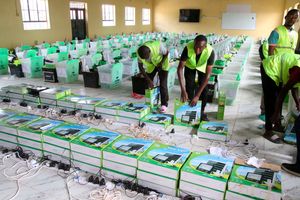
The commission has also cited the cost of moving election materials securely to and from polling stations across the country as a major budget item. This involves hiring vehicles, aircraft and, in remote areas, boats. IEBC also spends millions of shillings setting up storage and distribution centres across the country.
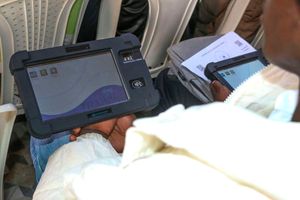
Under its Sh61 billion budget projection, IEBC planned to spend a huge proportion on the procurement of at least 46,000 Kiems kits and the printing of “more secure” ballot papers.
An IEBC official displays a KIEMS kit during a simulation process in the past.
Photo credit: File | Nation
The latest report identifies operations and logistics as the single largest expenditure component, covering the recruitment and remuneration of more than 300,000 temporary election officials.
Other major budget items include the printing, warehousing and transportation of materials to more than 46,000 polling stations, as well as the management of national and county tallying centres.
Information and communication technology systems are also cited as major cost drivers, involving heavy investment in biometric voter registration, electronic transmission of results and cybersecurity. In the 2017/18 financial year, voter registration and electoral operations consumed Sh20 billion, while ICT-related programmes accounted for Sh6 billion.
The report recommends greater financial independence for IEBC. To achieve this, it says Parliament should institutionalise funding for the entire electoral cycle by adopting a multi-year budget framework to spread costs and avoid fiscal spikes during election years.
“A multi-year funding approach would enable IEBC, the Judiciary and oversight bodies to build sustainable capacities to address election-related issues over time, rather than only having funding available during an election year. IEBC can only be truly independent when it is assured of funding over a full electoral cycle (five years),” states the report.
It notes that IEBC has, in some instances, been forced to implement activities only to rush them during an election year when funds become available. This, it says, undermines the commission’s institutional capacity and prevents it from undertaking key reforms between elections.
The report further observes that the first step towards reducing costs is restoring trust in electoral institutions, particularly IEBC and related oversight bodies.
It says that when political actors believe the system is impartial, the demand for redundant safeguards such as multiple verification systems, excessive security deployment and repeated training declines notably.
“Building trust requires transparent and inclusive approaches to everyday activities in the electoral process. It also requires public accountability frameworks that make electoral operations open to scrutiny,” it states.”