A high-stakes consultative Thursday meeting between the Orange Democratic Movement (ODM) and President William Ruto’s United Democratic Alliance (UDA) exposed deep-seated tensions over political turf, with sharp disagreements emerging over zoning and grassroots expansion despite a public show of unity.
President Ruto’s camp’s push to expand UDA’s footprint into opposition strongholds, Nation was told, collided with ODM’s demand for political safeguards of its perceived territories ahead of the 2027 coalition talks.
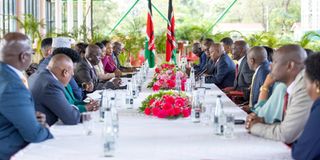
President William Ruto, ODM Party Leader Oburu Oginga and members of the Orange Democratic Movement (ODM) Central Management Committee and the United Democratic Alliance (UDA) Steering Committee during a joint consultative meeting at State House, Nairobi, on Thursday, April 23, 2026.
Photo credit: PCS
While the joint statement co-signed by President Ruto and ODM leader Dr Oburu Oginga projected unity and a shared vision, insiders say sharp differences emerged over political zoning and control of traditional strongholds.
At the heart of the friction was a push by ODM party for informal zoning arrangements that would see each party respect the other’s political bases as talks toward a possible coalition progressed.
Sources indicate that ODM leaders warned that UDA’s aggressive grassroots expansion, particularly in Nyanza, risks eroding trust and could undermine the fragile relationship the two parties are trying to build.
“The meeting focused on strengthening collaboration and exploring areas of mutual interest between the two parties,” President Ruto and Dr Oginga said in the joint statement.
In a key resolution, the meeting mandated the respective party chairpersons – Cecily Mbarire (UDA) and Gladys Wanga (ODM) to continue structured and regular consultations across party organs.
“These ongoing engagements are intended to build consensus on priority issues and lay the foundation for a formal coalition of equals between UDA and ODM,” read the statement from the joint consultative meeting that brought together the UDA Steering Committee and the ODM Central Management Committee.
Sources at the meeting intimated to Nation that the presence and initial hardline stance of UDA Secretary General Hassan Omar further inflamed the situation.
President William Ruto, ODM Party Leader Oburu Oginga and members of the Orange Democratic Movement (ODM) Central Management Committee and the United Democratic Alliance (UDA) Steering Committee during a joint consultative meeting at State House, Nairobi, on Thursday, April 23, 2026.
Photo credit: PCS
Mr Omar has been outspoken in insisting that UDA will field candidates in every corner of the country, including perceived ODM strongholds—a position that clashes with ODM’s call for mutual restraint.
Some within ODM reportedly questioned whether such hardline messaging is compatible with ongoing cooperation talks.
The tensions come just days after ODM leader Dr Oginga publicly accused UDA figures, including Mr Omar and Senate Speaker Amason Kingi, of showing disrespect to the party.
Although allies of President William Ruto defended UDA’s right to expand nationally, the meeting exposed the delicate balancing act both sides face as they pursue cooperation while competing for the same political ground.
In their joint statement, the parties emphasised “constructive dialogue,” unity of purpose, and a shared commitment to national development.
They also announced plans to establish a Broad-based Management Committee to coordinate legislative and executive priorities.
“…the two party leaders agreed to establish a Broad-based Management Committee comprising the party leaders, selected Cabinet Ministers, and the Majority and Minority Leaders in Parliament.”
The committee will be tasked with coordinating and synchronising the legislative and executive agenda of the government to ensure coherence, efficiency, and effective service delivery.
But behind the carefully crafted language, insiders paint a different picture—one of guarded exchanges, strategic mistrust, and unresolved questions about the future of the relationship.
Multiple participants told the Nation that discussions veered sharply into the question of political territory, with ODM pressing for assurances that UDA would not aggressively move into its traditional strongholds as negotiations continue.
Having dominated Nyanza, Coast and Western for decades, the party fears that UDA’s sustained grassroots mobilisation—backed by the advantages of incumbency—could gradually chip away at its base.
“This is not just about elections; it is about survival,” said a senior ODM official familiar with the talks. “If we open the door too wide without safeguards, we risk losing the very ground that defines us.”
Another source within the UDA camp confided to Nation that President Ruto, the UDA party leader, appeared open to the idea of zoning, particularly in the Nyanza region, while making exceptions for the Coast and Western regions.
UDA, however, sees the matter differently. Party strategists argue that as the ruling party, it has a constitutional and political obligation to organise nationwide and cannot be restricted by informal arrangements.
President William Ruto, ODM Party Leader Oburu Oginga and members of the Orange Democratic Movement (ODM) Central Management Committee and the United Democratic Alliance (UDA) Steering Committee during a joint consultative meeting at State House, Nairobi, on Thursday, April 23, 2026.
Photo credit: PCS
According to sources within UDA, attempts to impose zoning were firmly resisted, with some leaders insisting that competition is a fundamental pillar of democracy.
That position has been most forcefully articulated publicly by Mr Omar, whose remarks in recent weeks have become a lightning rod for controversy within the talks.
As UDA Secretary General, he has maintained that the party will field candidates across the country without exception—a stance that has unsettled ODM leaders seeking a more cautious approach to coexistence.
The friction reflects bigger ideological and strategic differences between the two parties. ODM, long accustomed to operating as a dominant opposition force in specific regions, is wary of dilution.
UDA, on the other hand, is pursuing an expansive strategy aimed at consolidating national dominance ahead of the 2027 elections, especially after losing a huge chunk of support to other Mt Kenya based parties.
President Ruto’s UDA on Thursday, April 23, rolled out repeat Phase II grassroots elections across 18 counties, including key ODM bastions in Nyanza – Kisumu, Siaya and Migori counties.
The exercise spread across Kisumu, Siaya, Migori, Kisii, Bungoma, Makueni, Machakos, Kitui, Isiolo, Marsabit and Taita Taveta Counties.
Others are; Lamu, Tana River, Kilifi, Kwale, Mombasa and Turkana County, with Kajiado County scheduled to hold its vote separately on Saturday, April 25.
While officially described as an internal exercise, the scale and reach of the polls point to a deliberate effort to entrench the party at the lowest levels of political organisation.
According to party officials, hundreds of thousands of candidates registered to contest positions at the polling station level, with millions of voters expected to participate.
The exercise is designed to build a robust grassroots network capable of mobilising support and identifying future leaders.
In Nyanza, the move has been interpreted as a direct challenge to ODM’s dominance.
Reports indicate growing interest in the UDA process, with residents earlier attending sensitisation meetings and expressing willingness to participate.
For UDA, this is evidence that the region’s political landscape is more dynamic than previously assumed.
For ODM, however, the developments are alarming.
Party leaders have stepped up mobilisation efforts, organising youth conventions and grassroots engagements aimed at reinforcing loyalty and countering UDA’s advances.
The message from the party’s top leadership has been clear that cooperation must not come at the expense of political identity.
ODM Central Committee’s recent resolution demanding “respect” from UDA underscores the sensitivity of the moment.
By publicly calling out Mr Omar and Mr Kingi, Dr Oginga, the ODM leader, signalled that the party is prepared to push back against what it perceives as encroachment and dismissiveness.
UDA leaders have sought to downplay the tensions, framing them as natural disagreements within a growing partnership.
Party chairperson Cecily Mbarire indicated that discussions on zoning and other contentious issues are ongoing and will be resolved through established party structures.
Analysts say the unfolding dynamics reflect a broader strategy by President Ruto to reshape Kenya’s political landscape.
By engaging ODM while simultaneously expanding UDA’s reach into its strongholds, the President appears to be pursuing a dual approach—cooperation at the top, competition at the grassroots.
This strategy, they argue, could yield significant dividends if successful.
“By blurring the lines between government and opposition, UDA could weaken ODM’s ability to function as a distinct political force, effectively absorbing parts of its base over time,” argues advocate Chris Omore.
For ODM, he says, the danger lies in being gradually edged out of its traditional strongholds.
“For UDA, the risk is that overreach could trigger backlash and derail the fragile cooperation that has been carefully cultivated and affect president Ruto’s 2027 re-election campaigns.”
But UDA and ODM officials agree that the proposed Broad-based Management Committee may offer a mechanism for managing these tensions.
Comprising party leaders, Cabinet ministers, and parliamentary leadership, the committee is expected to coordinate policy and legislative priorities while also serving as a forum for resolving political disputes.
Analysts say that while UDA grassroots elections are officially framed as an internal party exercise, the scale and geography of the elections point to a more calculated political objective of testing whether the ruling party can build functional grassroots structures in areas where ODM and other parties have historically maintained near-total dominance.
“We wanted to demonstrate that this party is building its grassroots needs and tomorrow (today) the party will have on boarded another, the repeats that will follow, the party will have on boarded 580,000 grassroots leaders across the country,” Mr Omar, the UDA Secretary General, said on Wednesday.
He also said the party is going to strengthen its grassroots across the country ahead of the 2027 elections.
“The party continues to pursue its strategy of strengthening the parties in all parts of the country and it is part of the democratic processes of party building to build an institution. The institution then produces for us leaders,”
In Nyanza, the decision by UDA marks its most aggressive attempt yet to crack the region’s ODM party dominance.
On Monday, the ruling party held meetings with its members and candidates across the three Nyanza counties.
“We are painting Siaya County yellow ahead of the upcoming grassroots elections scheduled for Thursday, 23rd April 2026. Our team sensitised Party members and candidates for the Repeat Phase II Grassroots Elections at Ramba Holly Hall on the election procedures, including the use of electronic gadgets. Leading the exercise from the Party Secretariat were James Losikany, Connie Kaptuya, and Bethwel Koech.’