Interim ODM party leader Oburu Oginga has moved with speed to forestall a potential schism, bringing on board party rebels and a restive youth league that has grown impatient in the last few months.
In what insiders see as a strategic reset for Kenya’s largest opposition outfit, the Siaya Senator has in recent weeks embarked on a series of behind-the-scenes engagements with youthful and senior figures alike, aiming to project an image of inclusivity and stability at a time of visible internal jostling.
ODM Secretary-General Edwin Sifuna has been leading a youth movement dubbed Kenya Moja, bringing together not only a section of ODM youthful leaders but also members from other parties including President William Ruto’s United Democratic Alliance (UDA).
The leaders include MPs Babu Owino (Embakasi East), Caleb Amisi (Saboti), Anthony Kibagendi (Kitutu Chache South) all from ODM, and Githunguri legislator Gathoni wa Muchomba (UDA), among others.
The team is positioning itself as the country’s potential Third Force—distinct from the broad-based framework and the united opposition camp steered by former deputy president Rigathi Gachagua and Wiper leader Kalonzo Musyoka. The team says its mission is to champion the welfare of Kenyan youth and other vulnerable groups.
In a bid seen as a move to recast the 2027 election as a generational contest, they have promised to turn around Kenya’s entrenched political order and usher in what they call a “generational change” in leadership.
But Dr Oginga has been reaching out to members of the team, particularly from the ODM party, in a bid to whip them back to the Orange Party main fold.
“I have held an official meeting with Hon. Babu Owino. Our discussion centred on strengthening unity and inclusivity within ODM,” Dr Oginga told the Nation in an exclusive interview. “Hon. Babu Owino symbolises the vibrant energy and determination of our youth. He has a promising future, and we are together. Imara (strong).”
Dr Oginga, the elder brother to the late Raila Odinga , finds himself at the centre of a delicate balancing act—to steady ODM after the passing of its founding leader while keeping the restless youthful base, within the fold.
Acting ODM party leader Oburu Oginga (centre, in grey suit) with other party members during a memorial service for Raila Odinga in Homa Bay Town on November 5, 2025.
Photo credit: George Odiwuor | Nation
He confirmed that his meeting with Mr Owino was part of a broader outreach initiative that also includes engagements with Mr Sifuna and co-deputy party leader Godfrey Osotsi, both of whom have recently expressed reservations about being in President Ruto’s broad-based government.
“These discussions are not about positions or factions,” Dr Oginga said. “They are about unity—about bringing everyone back to the same table. We must not allow small differences to divide us at a time when the party needs to move forward together.”
Dr Oginga admitted that the battle for the “soul of ODM” has been evident in recent months, with public disagreements and factional manoeuvring within the party’s ranks, particularly around the issue of succession and the party’s future direction.
“It appears to be a battle between the traditional leadership of ODM and a new group of leaders who want to rise,” he said. “But personally, I believe in the youth. I believe the youth should take over, and that’s why I’m called a youth leader.”
Dr Oginga dismissed suggestions of a generational rift within ODM, saying the so-called “old guard” has no intention of sidelining younger leaders.
“I don’t see any reason why there should be isolation,” he said. “If you look at people like Babu Owino, George Aladwa and others, they are already taking over the party. We are not discriminating against the youth. We want them to come up and lead.”
He, however, admitted that the perceived divisions have been amplified by political theatrics and rival camps seeking advantage in the upcoming party realignments. “Some of these things emanate from opponents fighting here and there,” he said. “I intend to bring them together.”
His remarks come after weeks of speculation about tensions between ODM MPs during public events, including the late Odinga’s funeral in Bondo and earlier memorial services in Nairobi, where groups of supporters were seen chanting names of certain youthful MPs, particularly Mr Owino.
Some MPs accused their colleagues of hiring crowds to appear popular—a charge Dr Oginga dismisses as “misplaced”.
“I don’t think anyone would disrespect Raila Odinga’s final moment,” he said. “If people shouted ‘Babu, Babu’ during the funeral, maybe that happened. But you know, when people feel someone is being discriminated against, they sympathise with him. The wananchi always sympathise with the one being vilified.”
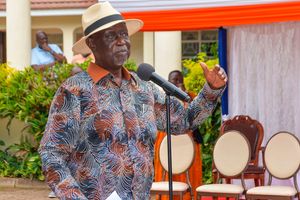
ODM acting party leader Oburu Oginga speaks during a memorial service for his brother Raila Odinga in Homa Bay Town on November 5, 2025.
Photo credit: George Odiwuor | Nation
The Siaya Senator called for restraint and maturity within ODM ranks, urging members to shift from personality-driven contests to ideological engagement. “Within our party we must allow democracy so that people can express themselves freely,” he said. “But when the party gives direction, leaders must also respect it.”
Beyond reconciling internal factions, Dr Oginga has taken a firm stand on ODM’s strategy for Nairobi—declaring that the party will not cede the capital city to coalition partners again.
“We lost Nairobi seats to UDA because, as we were campaigning, Jubilee told us they were giving us the presidency and that Nairobi should be given to them,” he recalled. “They then appointed a candidate who was not a politician (Polycarp Igathe) and we were supposed to support him. That is how we lost Nairobi.”
Dr Oginga, who was referring to ODM’s 2022 decision to withdraw Westlands MP Tim Wanyonyi in favour of Jubilee’s Igathe, said the move was a “strategic blunder” that cost the party dearly.
“Otherwise, if we had chosen our own candidate as ODM, we would have taken the city,” he said. “Nairobi is our home, and we will not surrender it again.”
In that election, UDA’s Johnson Sakaja garnered 699,392 votes (54.9 percent) against Mr Igathe’s 573,516 (45 percent). ODM insiders have long blamed the loss on coalition arrangements that undermined grassroots loyalty and confused supporters.
“I don’t expect that to happen again,” Dr Oginga said firmly. “We made that mistake in the last election, and we lost. We will not make it again.”
As 2027 approaches, the battle for the ODM ticket in Nairobi is already shaping up. Several figures, including Babu Owino and Makadara MP George Aladwa, are eyeing the gubernatorial seat.
ODM Deputy Party Leader and Mombasa Governor Abdulswamad Nassir, Party Leader Oburu Oginga and Kilifi Senator Stewart Madzayo after meeting delegates in Mombasa on November 1, 2025.
Photo credit: Wachira Mwangi | Nation
But Dr Oginga insists that the party will not anoint anyone prematurely. “The general principle of the party is that it does not dish out positions,” he said. “We have two methods of nominations—consensus and elections. If consensus fails, then members will decide through nominations.”
“As a matter of principle, no one should tell our members not to contest or not to vote for a particular candidate unless that decision comes from the party’s democratic process.”
His comments appeared to address speculation that ODM could endorse Governor Sakaja for re-election, following his recent overtures to the Odinga family and the role both Mr Odinga and President Ruto played in quelling his impeachment attempt.
“If such a situation arises again, it will be handled in line with party principles and constitutionalism,” Dr Oginga said. “ODM should not be taken for granted in Nairobi.”
On the question of ODM’s future beyond the Odinga dynasty, Dr Oginga dismissed claims that the party risks shrinking into a regional outfit.
“Those who say ODM is a Luo party are spreading propaganda,” he said. “ODM is the only political party in Kenya with structures across all 47 counties. We have officials, offices, and systems that go down to the polling station level.”
He added that ODM remains Kenya’s most enduring political machine in the post-multiparty era. “This is not a machinery that can be dismantled overnight,” he said. “We don’t intend to divide it or dismember it.”
Dr Oginga warned those within the party seeking to undermine unity that they would be asked to step aside. “If anyone wants to spoil the party, we’ll find a way of asking them to leave so that ODM can continue to fight for the people,” he said.
The Siaya Senator outlined a three-pronged plan to restore ODM’s dominance: reconciliation, grassroots revitalisation, and financial strengthening.
“We want to maintain unity by strengthening our branches, making the party more visible, and giving clear policy direction so that ODM can grow from strength to strength,” he said. “We are also fighting to get the money we are owed from the Political Parties Fund—more than Sh13 million—to strengthen our offices across the country.”
He emphasised that reconciliation among leaders was central to the renewal effort. “We must build bridges among our leaders while consolidating our support on the ground,” he said. “We intend to bring everyone together so that the party can move on stronger.”
In many ways, Dr Oginga’s approach mirrors the philosophy that his late brother embodied—political resilience through unity. By reaching out to both established leaders and outspoken youth, he hopes to sustain ODM as a living legacy of the Odinga brand, but also as an evolving, self-sustaining movement.
“We must give clear directions in terms of policy,” he said. “That is how the party will remain relevant—by addressing national issues such as the economy, governance, and equity, not just politics.”
Dr Oginga however, dismissed claims that differing publicly with party leadership was a sign of democracy.
“Contradicting party position is not democracy but chaos,” he said firmly. “We can differ in opinion because that’s democracy, but what has been agreed on, everybody should adhere to. Speaking differently only confuses our supporters and Kenyans.”
With key strongholds like Nairobi, Mombasa and Kisumu defining ODM’s identity, Dr Oginga’s focus on reclaiming the capital carries both symbolic and strategic weight. It signals a return to grassroots mobilisation and ideological clarity.
“ODM is still firm and united,” he said. “We may differ on ideas, but we remain one family. Our mission is to keep the party united, youthful, and strong—ready for 2027 and beyond.”
Speaking during the first ecumenical memorial service for Odinga in Homa Bay town on Wednesday, Dr Oginga asserted that the outfit must “form government come 2027, or be firmly in government”.
“We are sure that we shall this time round capture power as ODM or capture it under a coalition. But being in the opposition is a thing of the past—ODM will not be there again,” he declared.