As it marks two decades since its founding, ODM is embarking on a sweeping rebranding strategy aimed at rejuvenating its image, tightening internal structures, and rallying its support base ahead of the 2027 General Election.
The Orange Democratic Movement’s Central Committee last week adopted a programme of activities that will culminate in nationwide celebrations dubbed “ODM@20”, as well as a National Delegates Convention (NDC) slated for October 2025.
The anniversary events will take place in all 47 counties, with the party’s leadership expected to reflect on ODM’s political journey, showcase its achievements, and unveil a new ideological path tailored for a changing political landscape.
On Friday, July 25, Mr Raila Odinga led the party in the first of such engagements in Kakamega.
ODM party leader Raila Odinga speaks with Kakamega Governor Fernandes Barasa during delegates meeting at Golf Hotel in Kakamega County on July 25, 2025.
Photo credit: Isaac Wale | Nation Media Group
“These celebrations will take place across all counties, culminating in a major national event in October 2025, which will reflect on the Party’s journey, achievements, and future direction,” the ODM party leader said in Kakamega on Friday.
“The NDC will, among other matters, consider reports from party organs, review and adopt policy positions, elect national officials, and chart the path forward in readiness for the 2027 General Elections,” ODM secretary-general Edwin Sifuna said.
Mr Odinga says that the 20th anniversary will not just be a celebration but a strategic moment of renewal and reorientation.
“We are 20, and we want to go across Kenya meeting all our delegates before we meet for an NDC to elect new officials and celebrate our journey so far,” Mr Odinga told delegates in Kakamega.
The planned rebrand is part of a broader strategy to prepare the party for a vigorous campaign ahead of the 2027 polls. At the heart of this is the rebuilding of the party from the ground up through grassroots elections that began in April and will continue in August in select areas where the process faced irregularities.
The rebranding effort appears designed to tackle several challenges that have emerged since the party's 2022 election loss and its waning momentum due to its association with President William Ruto’s United Democratic Alliance (UDA).
After years of top-heavy politics, the party says it is now focusing on the grassroots to rebuild loyalty and participation from the bottom up.
Insiders say ODM wants to move from reactionary opposition politics to a more policy-driven and proactive outfit. By allowing competitive but organised internal elections, the party is signalling a new chapter in transparency and inclusivity.
Political observers note that while ODM’s history of reinvention is well known—from the Pentagon era to the Handshake and BBI years—its biggest challenge remains cohesion and credible internal leadership.
“This is ODM’s moment of truth,” says political analyst Dismas Mokua. “The rebranding will only succeed if it produces authentic leadership, not just recycled loyalty.”
In an interview with the Daily Nation last weekend, Mr Odinga said ODM was not short of youthful leaders to take over leadership. He claimed to have spent years nurturing youthful talent across party ranks—from Parliament to the grassroots—many of whom are now emerging as national players.
“Yes, so many youthful leaders are around me in ODM,” Raila said. “You can see them — they are there even in my party.”
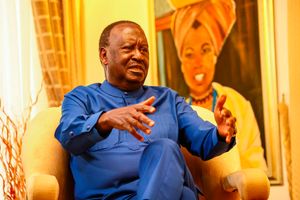
Former Prime Minister and ODM leader Raila Odinga during an interview at his home in Karen, Nairobi on July 19, 2025.
Photo credit: Wilfred Nyangaresi | Nation Media Group
The former Prime Minister listed several prominent ODM figures he described as part of the next generation of leadership. These include Mr Sifuna, Treasury Cabinet Secretary John Mbadi, Blue Economy Cabinet Secretary Hassan Joho, ODM National Chairperson Gladys Wanga, and Mombasa Governor Abdulswamad Nassir.
“I have people like Sifuna, Mbadi, Joho, Oparanya, Wanga, and Nassir. I also have younger leaders in Parliament and MCAs all over the country,” he said.
He emphasised that ODM has consistently given young leaders room to grow and remains committed to youth inclusion as it enters a new era of political realignment.
His comments come amid speculation over whether he will run again in 2027 or hand over the reins to a younger cohort. While he has not ruled out a presidential bid, Mr Odinga has sought to highlight his role as a mentor and statesman.
“I have not said that I’m running. I don’t have to run. I can support someone else, but I can also run if I want to. Right now, I’m focused on strengthening ODM.”
He confirmed ODM will conclude grassroots elections next month and hold the NDC in October to chart its political course, including decisions on the 2027 race.
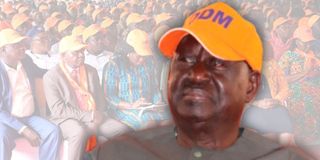
ODM delegates follow proceedings during the delegates meeting at Golf Hotel in Kakamega County on July 25, 2025.
Photo credit: Isaac Wale | Nation Media Group
“As to whether I will defend my party leadership position in the upcoming NDC, it is the members who will make that decision,” he said.
The success of the rebrand may hinge on how the party positions itself amid shifting national dynamics—particularly the UDA juggernaut and growing disaffection in opposition zones.
Mr Odinga has stated that ODM will continue working with President Ruto until 2027, before reviewing the broad-based framework depending on the decision of party members.
He dismissed speculation about President Ruto’s re-election chances, saying only Kenyans can determine that outcome through the ballot.
“It’s not a matter of one term or two. The real question is—who decides? It is the people who hold that power at the ballot,” said Mr Odinga.
He emphasised that re-election is earned, not guaranteed.
“It can be one term, it can be two terms, or even half a term. Ultimately, it is the people who will decide through elections.”
On Wednesday, President Ruto pushed back against the growing 'Ruto Must Go' and 'Wantam' campaigns—expressed in street protests and online—that seek to paint him as a one-term president.
Critics, including Deputy President turned opposition figure Rigathi Gachagua , have vowed to vote him out in 2027, labelling him "Wantam," shorthand for "one term."
But Dr Ruto dismissed the chants as “empty sloganeering,” saying:
“Maybe you don’t agree with the policies and plans I have for our nation, which is okay. But please, would you kindly favour us with your alternative plan?”
During his Nation interview, and without naming names, Mr Odinga appeared to caution those already laying 2027 groundwork, urging leaders to deliver on their promises instead of engaging in premature politicking.
“Leadership is not a personal entitlement. One may be elected for a single term, and that’s it. Whether they return depends on their performance and the will of voters.”
“No individual has the authority to determine how long a president serves. That mandate belongs solely to the people.”
“Let him now focus on fulfilling promises to the people. Because come election time, he cannot claim sabotage. Do your job. Serve the people. Let your performance speak. That is what earns you an election term.”
Mr Odinga’s remarks come as political temperatures rise, with both ruling and opposition camps sharpening their focus on 2027.
Mr Gachagua on Monday declared himself the front-runner for the opposition coalition’s presidential ticket but said a united opposition line-up will be crafted.
“Government is huge and there is space for everybody. We will agree on who takes what position, provided we come up with a formula for good governance and to get rid of corruption, killings and abductions. That we must do,” Mr Gachagua said.
“We have not settled on anybody. The only thing agreed on is: one term. As to who will replace him [Ruto], not yet. But most Kenyans don’t even want to know who replaces him—so long as he leaves.”
Mr Gachagua, also leader of the Democracy for the Citizens Party (DCP), made the remarks while on a month-long tour of the United States.
The emerging “United Opposition” now comprises DCP, Kalonzo Musyoka’s Wiper, Martha Karua’s People’s Liberation Party (PLP), Eugene Wamalwa’s Democratic Action Party (DAP-K), the Democratic Party (DP) under Justin Muturi, and the Jubilee Party, represented by national chairperson Torome Saitoti and former Interior CS Fred Matiang’i.
The group has coined the slogan “Wantam” to rally anti-Ruto sentiment, while Ruto’s allies have responded with “Tutam”—a two-term counter-slogan.
PLP leader Martha Karua, Mr Odinga’s 2022 running mate, also disclosed that she privately called him to urge reconsideration of his cooperation with President Ruto.
“I called Raila and asked him to think carefully about what message it sends when he associates with a regime that continues to trample on the rights of Kenyans,” she said.
“We may have differences in strategy, but we must remain united in principle.”