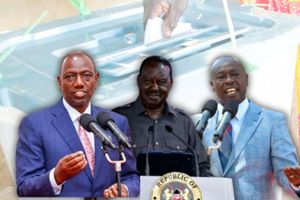
President William Ruto’s United Democratic Alliance (UDA) has rolled out a sh180 million grassroots elections plan that will culminate in a National Delegates Convention (NDC) in April 2026.
The ruling party warned its elected members who have since openly declared support for former Deputy President and Democracy for the Citizens Party leader Rigathi Gachagua against running for UDA positions.
In an interview with Daily Nation , the party’s National Elections Board (NEB) Chairman Anthony Mwaura said they have no intention of blocking members from contesting for various seats, but noted that they do not expect those who have publicly declared support for Mr Gachagua to seek UDA party positions.
UDA national elections board’s Chairman Anthony Mwaura.
Photo credit: File | Nation Media Group
Some of the UDA leaders currently backing Mr Gachagua had, before his impeachment in October 2024, indicated plans to run for top party positions. Embakasi North MP James Gakuya, who had declared interest in running for Nairobi branch chairperson, are one of the perceived allies of Mr Gachagua.
“Those associating with other political parties should do the honourable thing and resign from the party. They should not try to run for UDA positions,” said Mr Mwaura.
The board has announced January 10 as the new date for the final phase of the grassroots polls, with a plan to install new national officials by April.
Current political realignments
The decision to have the exercise concluded is part of President Ruto’s re-election game plan as he seeks to have the party’s national leadership reflect the current political realignments before embarking on the 2027 campaigns.
Mr Mwaura said the party has since dispatched officials to the ruling party’s political bastions of Rift Valley and Mt Kenya to carry out sensitisation ahead of the elections that are promising to be competitive.
“We have embarked on a comprehensive sensitisation programme to prepare our members for the elections. The President has instructed us to conclude the exercise so that we can have officials elected by the people in office.”
UDA started its ambitious grassroots elections in April 2024, but was forced to abandon the polls following the June nationwide Gen Z protests after concluding the exercise in only two counties, Busia and Homa Bay, out of the initial five that were scheduled in the first phase.
In April this year, the party conducted grassroots elections in another 22 counties, bringing the total so far to 27.
In this final phase, polling centre elections will be conducted on January 10 in Embu, Kiambu, Kirinyaga, Laikipia, Meru, Murang’a, Nyandarua, Nyeri and Tharaka Nithi counties.
A voter casts his ballot during the UDA grassroot elections.
Photo credit: File | Nation Media Group
In Rift Valley, the polls will be held in Baringo, Bomet, Elgeyo Marakwet, Kericho, Nakuru, Nandi, Trans Nzoia, Uasin Gishu and Samburu. In Western, the polls will be in Kakamega and Vihiga counties.
“It was resolved that the party conduct grassroots elections in the remaining twenty (20) counties where the polls have not been held. Polling centre elections will be held on Saturday, January 10, 2026,” said Mr Mwaura.
He explained that once the polling centre elections are concluded, party members will have 14 days to resolve any dispute arising from the exercise before the polls progress to the ward level. Mr Mwaura said the plan is to have the polls run up to the county level in all 47 counties before convening the NDC to elect national officials.
At the polling centre level, the ruling party seeks to elect a total of 20 officials. According to Mr Mwaura, a total of 246,000 officials will be elected at the polling centre level in the 20 counties
A document prepared by the party titled ‘Grassroot Election Guide’ shows that at the polling centre level, party members will elect three representatives of religious groups, four representatives of traders, three representatives of professionals, four representatives of youth, a representative for Special Interest Groups, three individuals to represent farmers as well as two party members – a woman and a man.
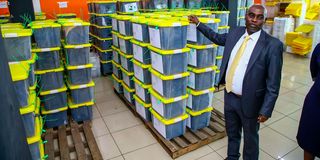
Mr Mwaura estimated the cost of conducting the elections from the polling centre level all the way to the county at Sh180 million. He said the money would be used in procurement materials for the exercise, as well as to take care of transport and logistics. He said the fund would be drawn from the Political Parties Fund, while others, he said, would come from well-wishers.
The party was initially seen to be avoiding holding the elections in Mt Kenya following the bitter fallout between the President and Mr Gachagua.
But following the win in Mbeere North by-election , the party seems to be confident of its support in the region, initially perceived to be drifting away from President Ruto.
The by-election win is a major boost in sustaining perception and popularity narratives, seen as crucial for President Ruto’s re-election bid.
United Democratic Alliance Secretary-General Hassan Omar addressing the press at the party’s headquarters in Nairobi, on November 28, 2025.
Photo credit: Wilfred Nyangaresi | Nation Media Group
The November 27 mini-polls were largely seen as a referendum on Dr Ruto’s administration, which has been struggling for support following the nationwide June, 2024 protests by the Gen Zs.
The contest was also meant to gauge political realignments, especially in the populous Mt Kenya, following the bitter political fallout between the President and Mr Gachagua.
“There is a lot of interest in the party. We anticipate a fierce competition for party positions in both Mt Kenya and Rift Valley,” said Mr Mwaura.
By moving to hold the party's grassroots elections, the President is seen to be keen to have the region as one of his support bases.
The 10 Mt Kenya counties and the seven from the North Rift collectively handed him 4.5 million votes, which translated to 63 per cent of his total votes.
Laikipia, Tharaka-Nithi, Murang’a, Kiambu, Nyeri, Kirinyaga, Nyandarua, Embu, Meru and Nakuru collectively gave Dr Ruto nearly three million votes.
With 2,938, 309 votes from the 10 Mt Kenya counties, Dr Ruto topped up with 1.6 million votes from seven North Rift counties.
Party elections have, in the past, turned divisive and chaotic, resulting in major fallouts, a scenario that has made many outfits in the country avoid holding party elections.