In 2013, Jeremiah Kioni dared to imagine himself as Kenya’s first Deputy President under the 2010 Constitution.
Picked as running mate by then presidential hopeful Musalia Mudavadi, the seasoned Nyandarua politician found himself on a national ticket that promised history but delivered heartbreak.
Thirteen years later as Jubilee Party restructures its leadership and Mr Kioni, now 62, takes up the role of second Deputy Party Leader in charge of mobilisation, legal affairs and negotiations, his political journey once again sits at the crossroads between renewal and déjà vu.
For Mr Kioni, political reversals are not unfamiliar. His demotion from the powerful Jubilee party Secretary General’s position taken over by Moitalel Ole Kenta and deputised by Kigumo politician Zack Kinuthia has stirred emotions within Jubilee ranks.
Among the loudest voices is politician-turned-blogger Wambugu Ngunjiri, who publicly lamented what he termed Kioni’s unfair treatment.
“As a founder member of Jubilee, I am disappointed by what has been done to Kioni after he protected the party with blood, sweat and tears. This is not a promotion,” Mr Ngunjiri wrote.
Mr Kioni himself has remained characteristically tight-lipped despite having built a reputation as one of Jubilee’s most loyal foot soldiers and a fierce defender of party leader Uhuru Kenyatta.
Since 2022, he stood firmly with Mr Kenyatta through internal rebellion, particularly during the attempted party takeover by a faction led by Sabina Chege and Kanini Kega an effort ultimately quashed by the courts.
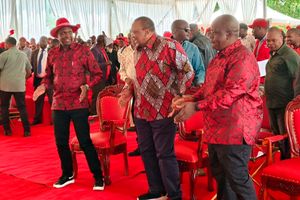
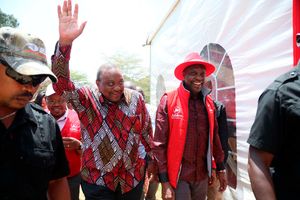
Former President and Jubilee Party leader Uhuru Kenyatta (left) with party Secretary-General Jeremiah Kioni during Special National Delegates Conference at Ngong Racecourse in Nairobi on September 26, 2025.
Photo credit: Bonface Bogita | Nation
Following the impeachment of Rigathi Gachagua as Deputy President in October 2024, Mr Kioni boldly declared himself Mt Kenya’s chief negotiatorarguing that the region had lost its official protector within government.
He positioned Jubilee as the political vehicle through which Mt Kenya’s interests would be safeguarded.
Yet his political fortunes have often followed a familiar pattern ofrising to national prominence only to fall short at critical moments.
The 2013 election remains the clearest example. The Mudavadi-Kioni ticket garnered just 483,000 votes, 3.9 per cent of the national tally. Even in his home county of Nyandarua, support was dismal. It was a crushing blow for Mr Kioni, who had been elected Ndaragwa MP in 2007 and like Rigathi Gachagua years later, attempted a meteoric leap from a single parliamentary term to the deputy presidency.
What followed was controversy. Media reports suggested Mr Kioni had not even voted for his own ticket, claims he strongly disputed.
After the defeat, Mr Kioni retreated to constituency politics reclaiming his parliamentary seat in 2017, only to lose it again in 2022. His reaction to that loss and Raila Odinga’s defeat was raw and combative. He accused clergy of poisoning national cohesion, warned Mt Kenya voters they would regret backing President Ruto and alleged electoral manipulation using face masks to influence voters—claims that drew both ridicule and criticism.
Over time, however, the firebrand politician appeared to mellow. Today, Mr Kioni is actively campaigning for former Interior CS Fred Matiang’i as the United Opposition’s preferred presidential candidate, while pushing to re-establish Jubilee as Mt Kenya’s anchor party.
Former President and Jubilee Party leader Uhuru Kenyatta (left) with former Interior Cabinet Secretary Dr Fred Matiang’i during Jubilee Party Special National Delegates Conference at Ngong Racecourse in Nairobi on September 26, 2025.
Photo credit: Bonface Bogita | Nation Media Group
He has sharply rejected claims by Mr Gachagua that any party outside the Democracy for Citizens Party (DCP) is a proxy of President Ruto.
“Jubilee has a right of belonging in Mt Kenya and nationally. We are not a regional party run by myopic minds,” Mr Kioni said in January.
Despite his recent demotion, some analysts believe Mr Kioni’s story may yet come full circle. Murang’a-based political commentator Mixson Gitau suggests Jubilee’s restructuring could be strategic rather than punitive.
“I see this differently. Kioni could be getting positioned for another shot at what slipped away in 2013. If Jubilee fronts Dr Matiang’i in 2027, Kioni’s elevation as deputy party leader may be laying the groundwork for that ticket,” Mr Gitau said.
With Mr Kenyatta unlikely to seek elective office again, the argument goes, Jubilee’s centre of gravity has shifted—and Mr Kioni could once more find himself within touching distance of the deputy presidency.
Armed with including a Bachelor of Arts in Land Economics (1987), a Master of Arts degree in Housing Administration (1990), and a Bachelor of Laws (2006), all from the University of Nairobi besides being a Presbyterian Church elder, Kioni remains a study in persistence.
Whether 2027 finally delivers the breakthrough he once dreamed of, or merely adds another chapter of near-misses, will depend on how Kenya’s ever-shifting political chessboard unfolds.