Formed in September 2016 after the merger of 12 parties, Jubilee became a political behemoth commanding majorities in both Houses of Parliament, besides bagging the presidency in 2017.
But as former President Uhuru Kenyatta convened a Special National Delegates Convention (SNDC) on Friday for the former ruling party, the once vibrant outfit has become a pale shadow of its former self, with a handful elected members in the National Assembly and the Senate.
Former Interior Cabinet Secretary Fred Matiang’i was present during the delegates’ convention but was not unveiled as part of the new party leadership despite earlier speculation.
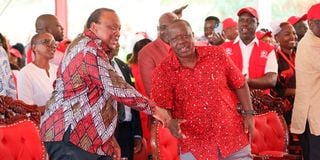
Former President and Jubilee Party leader Uhuru Kenyatta dances with youths during Jubilee Party Special National Delegates Conference at Ngong Racecourse in Nairobi on September 26, 2025.
Photo credit: Bonface Bogita | Nation
Formed as a loose coalition between Mr Kenyatta’s TNA and Mr William Ruto’s URP ahead of the March 2013 elections, the 2016 transition into a supposed juggernaut was initially projected to outlive its founders by following in the footsteps of South Africa’s African National Congress and the Chinese Communists Party. But Jubilee limped through the 2022 General Election, bagging a paltry 29 members in the National Assembly, five senators and one governor.
In the run-up to the 2017 polls, the newly-minted political party created a wave that swept across the country, with significant presence in Mt Kenya and Rift Valley, the political bastions of Mr Kenyatta and William Ruto.
When the polls were called, it won 171 seats in the National Assembly –140 in the 290 constituencies, 25 of the country’s 47 Woman Representatives and six of the 12 nominated MPs – coming just 62 shy of a two-thirds majority.
The party also won 25 governor seats, and 34 of the 67 senator seats, 25 of them elected, cementing its position as Kenya’s largest political party.
The audited accounts of the Office of the Registrar of Political Parties show that in the 2017/18 financial year – the first after the 2017 election – some Sh371.2 million was given to the Political Parties Fund.
Of the amount, Jubilee received Sh240.37 million while the Orange Democratic Movement (ODM) was given Sh112.23 million.
In the following fiscal year, some Sh671.2 million was allocated to the fund, out of which Sh434.6 million went to Jubilee and Sh203 million to ODM. In the 2019/20 financial year, Jubilee got Sh564.2 million.
The dominance ended at the ballot in 2022. A bitter political fall-out between Mr Kenyatta and his then deputy, Dr Ruto, saw the party dramatically disintegrate, and subsequently lose its mojo.
The outcome of the 2022 elections showed that Jubilee was completely decimated in Mt Kenya – its political bastion – where President William Ruto dominated the presidential vote and secured nearly all parliamentary seats through his United Democratic Alliance (UDA).
Mr Kenyatta’s supporters were defeated in his stronghold, and his contribution to the votes garnered by Azimio la Umoja coalition presidential candidate Raila Odinga fell far below expectations.
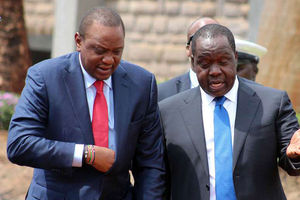
Former President and Jubilee Party leader Uhuru Kenyatta (left) with former Interior Cabinet Secretary Dr Fred Matiang’i during Jubilee Party Special National Delegates Conference at Ngong Racecourse in Nairobi on September 26, 2025.
Photo credit: Bonface Bogita | Nation
In February 2023, the party quietly relocated its headquarters from its imposing Thika Road building to a more modest address in Kileleshwa, reflecting its diminished influence.
A faction led by nominated MP Sabina Chege and East African Legislative Assembly (Eala) Kanini Kega would later stage a coup in the party against Mr Kenyatta. Mr Kenyatta, however, managed to secure a win in the battle for control of the party in October 2024.
Nation reached out to both Mr Kega and Ms Chege if they would be attending the NDC. Ms Chege did not respond to our inquiries by the time of going to press, but Mr Kega told Daily Nation that he will not attend since he had not been invited.
“I have not been invited, therefore, will not attend. I heard Mr Kioni say that only those invited should attend. I don’t know which criteria was used to invite people for the meeting,” said Mr Kega.
He revealed that a majority of members of Parliament have not been invited to the convention. He noted that he remains a member of Jubilee for now.
Eldas MP Aden Keynan, who is also part of the rebel team, could also not confirm if he would be attending. He requested time to consult his colleagues about the meeting, but did not provide a response by the time of going to press.
With the 2027 General Election in sight, the party has, however, initiated a fresh attempt to revive its lost glory and grassroots networks.
Today’s SNDC is part of Mr Kenyatta’s broader plan to breathe life into the dying political juggernaut. Party stalwarts, most of whom were floored in the last elections, have since designed several strategies in resuscitating the party, including fronting a candidate for the 2027 presidential race.
“Further to our notice of a Special National Delegates Convention dated August 5, 2025 and pursuant to Article 8.1 and 10.1 of the Jubilee Party constitution, a notice is hereby issued for a Special National Delegates Convention to be held at the Jockey Club, Ngong Racecourse, Nairobi, Kenya on September 26, 2025,” Mr Kenyatta said in a notice dated September 3, 2025.
In the notice, Mr Kenyatta said the delegates would ‘receive status report from the National Executive Committee.’ The NDC would further ‘review, formulate and approve’ the party’s constitution, organs, policies and programmes.
Dr Matiang’i on Tuesday held a consultative meeting with a section of Jubilee leaders, in a move lending credence to the talks that he would take charge of the party.
Mr Kioni described the meeting as part of the party’s rejuvenation strategy ahead of the next poll. Jubilee seeks to exploit Dr Matiang’i’s interest in the presidency to revive its old grassroots networks across the country.
“The meeting welcomed former legislators, county leaders, and opinion leaders to discuss strategies, share ideas, and strengthen the party’s vision, with Fred Matiang’i also participating in the discussions,” said Mr Kioni.
“The discussions promise to shape the political landscape permanently at this pivotal moment in Kenya. As the government in waiting, looking towards 2027, we are confident that Kenyans will give us the opportunity to faithfully serve them,” he said.
Former President and Jubilee Party leader Uhuru Kenyatta (left) with party Secretary-General Jeremiah Kioni during Special National Delegates Conference at Ngong Racecourse in Nairobi on September 26, 2025.
Photo credit: Bonface Bogita | Nation
Former Nyeri Town MP Ngunjiri Wambugu, who recently ditched former Deputy President Rigathi Gachagua, said the meeting marked the first phase of the party’s strategy to bounce back to power through the ballot.
“Remember Matiang’i was the primary technical implementer of the Jubilee manifesto for 10 years. In fact, I doubt we have anyone today in the party outside Uhuru who understands more about what Jubilee stands for, and plans to do for Kenyans, than him,” Mr Wambugu said.
He added, “So now that the court cases that had threatened to disorganize us as a party are behind us, the party leadership is focused on planning for the next phase of service to the Kenyan people.”
But Prof David Monda – a US-based university lecturer and political analyst – notes that it would be a tall order for Mr Kenyatta to revive the party, describing the outfit as yesterday's party.
Prof Monda, however, notes that Jubilee stands to benefit if Dr Matiang’i decides to join it.
“However, Jubilee will also be a burden to Brand Matiang’i because it comes with the indelible historical baggage of Uhuru Kenyatta. Matiang’i doesn't want to be seen as a project, and Jubilee pigeon-holes him as such,” he explains.
“I think Matiang’i is better off associating with a Gusii centered party. Alternatively, Matiang’i forming his own party to which he has full ownership rights and a direct access to the presidential ticket. Jubilee hurts Matiang’i more than it helps him,” he notes.
The predicament facing Jubilee is not unique as former ruling parties have also walked the journey to their graveyards.
Kanu was the first to go into terminal decline after its 40-year grip on power ended in 2002 when Mwai Kibaki won the presidency flying the National Rainbow Coalition (Narc) banner.
Narc lasted just one term before President Kibaki in 2007 secured a second and final term through a newly-minted outfit, the Party of National Unity. His previous outfit was discarded.
In 2013, Mr Kenyatta won the presidency through yet another new outfit, the Jubilee coalition made up of his The National Alliance (TNA) and Dr Ruto’s United Republican Party.
As the Jubilee duo sought re-election in 2017, they formerly merged TNA and URP to form the Jubilee Party, which also brought in another dozen or so smaller parties.
Jubilee sought to create a Kanu-style monolith that would secure Mr Kenyatta a second term, Dr Ruto his own two terms, and continue to reign in a landscape littered with many outfits still built around one domineering personality and his impregnable such, such as Mr Odinga’s ODM.
Then it all fell apart when Mr Kenyatta and Dr Ruto’s famous bromance turned out to have been based more on infatuation and immediate pursuit of power than a compatible meeting of minds, ideas and interests.