Attorney-General Dorcas Oduor has urged the High Court not to overturn the impeachment of Rigathi Gachagua as Deputy President, arguing that judges have no mandate to sit on appeal over Parliament’s political decisions.
The AG also defended President William Ruto’s nomination of Prof Kithure Kindiki to replace Mr Gachagua after the October 2024 ouster, insisting it was purely a constitutional presidential prerogative requiring only the National Assembly’s approval, and not clearance from the Independent Electoral and Boundaries Commission (IEBC).
This was in response to petitioners’ contention that Prof Kindiki’s rise to the Deputy President position was irregular and unlawful because the IEBC had no commissioners to verify his eligibility at the time of his nomination and appointment. Petitioners argued that Parliament violated constitutional safeguards on public participation, fair hearing and due process during the impeachment proceedings.
The AG’s advocate, Prof Githu Muigai, said that only two actors are required in the replacement process of a DP: the President and the National Assembly. “The President nominates and Parliament can say yes or no. Those are the only two actors,” he said, adding that any consultation with the IEBC is optional due diligence rather than a constitutional requirement.
Senior Counsel Professor Githu Muigai at the Milimani High Court during a hearing case challenging the removal of the impeached DP Rigathi Gachagua and appointment of Kithure Kindiki.
Photo credit: File | Nation
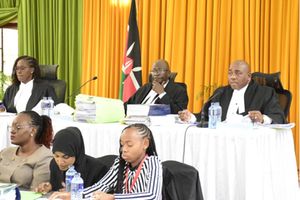
Prof Muigai spoke when he appeared before a three-judge bench hearing consolidated petitions challenging Mr Gachagua’s removal.
He argued that the court’s role was limited to determining whether Mr Gachagua’s constitutional rights were violated during the impeachment process.
“You must resist the invitation to turn these proceedings into a merit review of the impeachment,” Prof Muigai told the Constitutional and Human Rights Division bench. “This court is called upon only to evaluate whether the first petitioner’s constitutional rights to due process were compromised, and nothing more.”
The former Attorney-General argued that the Judiciary cannot question the merits of Parliament’s decision or reassess evidence presented during impeachment.
The submissions came as lawyers representing the National Assembly and Prof Kindiki signalled plans to cross-examine cardiologist, Dr Daniel Gikonyo, over his affidavit detailing Mr Gachagua’s hospitalisation during the Senate impeachment proceedings.
Deputy President Kithure Kindiki.
Photo credit: File | Nation
Respondents strongly opposed the affidavit, arguing that it was filed late and introduced new evidence after hearings had substantially progressed. They told the court that the respondents intended to challenge both the contents and authenticity of the medical records annexed to the affidavit.
Prof Kindiki's lawyer also alleged inconsistencies in timestamps and admission records attached to the affidavit and argued that respondents would suffer prejudice if denied a chance to interrogate the evidence.
The court nevertheless admitted the affidavit in the “wider interest of justice”. If cross-examination proceeds, the cardiologist will appear physically before the court on May 13.
The medical evidence has become central to Mr Gachagua’s challenge because petitioners argue that the Senate proceeded with impeachment proceedings despite knowing that he was in hospital and unable to defend himself.
But Prof Muigai insisted that the court could not reopen or rehear Parliament’s decisions merely because petitioners disagreed with the outcome.
“The petitioners ask you to reopen and re-examine the impeachment proceedings. You have no jurisdiction. He (Gachagua) asks you to reevaluate the evidence placed before the National Assembly and Senate. You have no jurisdiction to do that,” he said.
Prof Muigai described impeachment proceedings as “sui generis” constitutional processes intended to protect the State from official misconduct and political instability. He said that globally, impeachment proceedings are inherently political and courts should not transform themselves into appellate bodies over Parliament’s decisions.
“These are deliberate constitutional choices that vest the impeachment power firmly and finally in the hands of Parliament,” Prof Muigai said.
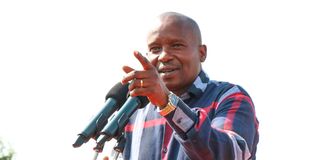
Former Deputy President Rigathi Gachagua.
Photo credit: File | Nation Media Group
He defended the National Assembly and Senate votes that removed Mr Gachagua from office, noting that MPs voted 281 against 44 in favour of impeachment before senators upheld several charges by 54-13. “That is not a partisan split. That is a constitutional supermajority.”
In response to the petitioners’ claim that there was inadequate public participation, Prof Muigai said that public participation in impeachment proceedings is intended to inform citizens of the political process, not to determine the outcome.
He argued that the Constitution deliberately imposed strict thresholds, including bicameral supermajority votes, to ensure impeachment remains firmly within Parliament’s mandate.
Prof Muigai further argued that Article 145 of the Constitution gives finality to the Senate’s decision once senators vote to impeach. “On the night that the Senate carried out its vote, your petitioner stood impeached. It did not await any other action by any other body or forum.”
Prof Muigai further invoked the political question doctrine, arguing that some disputes are not amenable to judicial determination because they are fundamentally political controversies. He maintained that courts are restricted by the doctrine of separation of powers from reviewing the merits of impeachment proceedings. He also opposed petitioners’ attempts to challenge the Senate’s decision to hear the impeachment in plenary instead of appointing an 11-member special committee.
Petitioners have argued that the Constitution required the Senate to establish the committee before debating or voting on the charges.
But Prof Muigai insisted that the Constitution intentionally uses the word “may” rather than “shall”, meaning senators retained discretion on how to structure its proceedings. He warned that allowing courts to overturn parliamentary impeachment decisions would amount to judicial overreach and destabilise separation of powers. “What your petitioners are asking you to do is to recognise a judicial veto to impeachment,” he said.
Regarding President Ruto’s nomination of Prof Kindiki, the advocate said that the Constitution grants the President the sole authority to nominate a replacement of a Deputy President within 14 days of a vacancy.
“The appointment of a new deputy president to replace an impeached one is not an election. It is the sole prerogative of the President,” Prof Muigai argued.
The hearing resumes on May 13 when the court is expected to continue receiving oral submissions and potentially hear arguments relating to cross-examination of Dr Gikonyo.