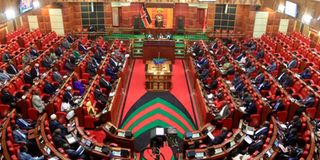
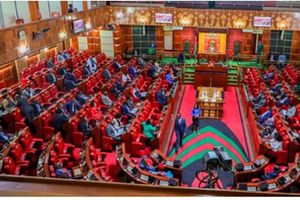
Individuals who lose an election including presidential, deputy presidential candidates, will now have a fallback route to parliament after MPs voted to delete a provision in the Elections Act barring them from nomination.
The MPs made the decision as they voted to pass the Elections (Amendment) Bill 2024, by deleting Section 34 (9) of the Elections Act to align with the Court of Appeal judgment which declared the provision unconstitutional.
The impugned section provided that “the party list shall not contain a name of a candidate nominated for an election.”
However, a three-judge Court of Appeal bench struck out the provision in the law with the MPs left with the task of a ‘cleanup’ exercise to ensure the provision is amended to align with the court judgment.
“The upshot is that this appeal succeeds and we declare Section 34 (9) of the Elections Act to be invalid and void,” ruled the three Court of Appeal Justices in a judgment delivered on June 4, 2013.
The Milimani Law Courts in Nairobi.
Photo credit: File | Nation Media Group
The Court of Appeal decision effectively overturned the High Court decision, which had found the provision constitutional.
“Having arrived at that conclusion, we are satisfied that the learned judge misdirected himself in his interpretation and treatment of the question of “special interests” as captured in the five grounds of appeal filed and argued before us,” the Court of Appeal Judge ruled.
The MPs’ decision and the court judgment now reshapes the rules of political succession after the court found that the constitutional provisions governing special seats under Article 97 (1) (c) do not bar top-tier executive contenders from securing these legislative safety nets.
The Article provides that the National Assembly shall have 12 members nominated by parliamentary political parties according to their proportion of members of the National Assembly.
This nomination is meant to represent special interests, including the youth, persons with disabilities and workers.
The deletion of the provision also provides an opportunity for losers in elections to be included in the party lists for nomination in the Senate as well as the 47 County Assemblies.
The election of members for the National Assembly, Senate and county assemblies for party list seats is specified under Articles 97 (1) (c) and 98 (1) (b) (c) and (d) and Article 177 (1) (b) and (c) of the constitution.
The Constitution states that the nomination shall be on the basis of proportional representation and in accordance with Article 90 of the Constitution.
Article 98 (1) (b) (c) provides the nominative slots in Senate shall consist of 16 women members who shall be nominated by political parties according to their proportion of members of the Senate elected and two members, being one man and one woman, representing the youth.
The nomination slots in the Senate also include two members, being one man and one woman, representing persons with disabilities.
Article 177 (1) (b) and (c) of the constitution states that a county assembly consists of nominative slots that include special seat members necessary to ensure that no more than two-thirds of the membership of the assembly are of the same gender.
It also includes the number of members of marginalized groups, including persons with disabilities and the youth, “prescribed by an Act of Parliament.”
Safety net for the executive
The Commission for the Implementation of the Constitution (CIC) had challenged the inclusion, arguing that allowing mainstream executive candidates to secure safety-net nomination slots subverted the constitutional purpose of party lists.
CIC had also noted that allowing the Presidential and Deputy Presidential candidates to be included in the list of nominated members, was undermining one of the key pillars of the constitution- to protect and promote the rights of minorities and vulnerable people deserving of protection and representation.
This argument was made on the presumption that it has the effect of limiting or diluting the representation of special or vulnerable groups.
Article 100 of the constitution defines special interest groups to include women, persons with disabilities, the youth, ethnic and other minorities and the marginalized communities.