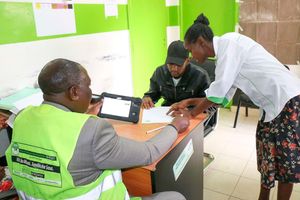
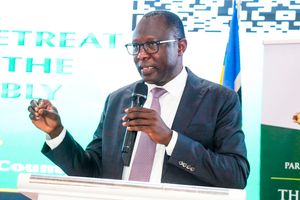
The Independent Electoral and Boundaries Commission (IEBC) and a crucial National Assembly committee are heading for a three-day retreat to set new rules for next year's General Election.
The meeting will also come up with key time-lines ahead of the elections.
IEBC chairman Erastus Ethekon will lead his team in the meeting with the Justice and Legal Affairs Committee in Mombasa from March 31 to April 3.
They will establish the ground rules for what is expected to be a pivotal election, in which President William Ruto is seeking a second and final term in office.
Budget constraints, legislative proposals to govern the elections, the purchase of elections technology for voter identification and results transmission, and the sensitive recall clause for MPs will be key topics of discussion.
The IEBC has already prepared a raft of proposed legislation touching on various aspects of the 2027 polls, which will be considered by the committee before being transmitted to the House.
The commission is expected to present a proposal to remove Section 11 of the Elections Campaign Financing Act, with the aim of restricting contributions and donations to election campaigns, and clarifying permissible donors.
The IEBC also wants Parliament to amend Section 14 of the Act to prohibit donations to election campaigns from foreign governments.
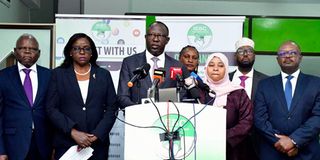
The Independent Electoral and Boundaries Commission (IEBC) chairperson Erastus Edung Ethekon.
Photo credit: File | Nation Media Group
The proposed bills resulting from the meeting will be refined later, and the committee will determine their adoption or rejection in the full plenary.
During the MPs' annual retreat, the commission urged them to pass all election-related laws at least one year before the polls to aid transparent and credible elections.
Regarding election laws, the commission will urge the committee to review the definitions of nominations and candidate registration, as well as providing a clear definition of a forensic image to clarify the scrutiny of election technology.
Another contentious agenda that will feature prominently during the retreat is the capping of financial spending by candidates eyeing various elective seats.
The 12th Parliament rejected proposals from the previous commission that had presented various financial cap.
Among the proposals that MPs rejected ahead of the 2022 polls include the capping of financial spending for candidates in all elective seats, including that of President, which had been proposed by IEBC to be Sh4.4 billion.
The National Assembly Committee on Delegated Legislation termed the legal notice that the electoral agency used to gazette the financing cap as null and void since it was published without parliamentary approval as required by law.
The MPs also faulted the commission, then under the leadership of the late Wafula Chebukati, for publishing the regulations without public participation as required by the constitution.
The annulled rules had limited spending by candidates for governor, women representatives and senator seats to between Sh21 million and sh117 million depending on the size and population of the devolved units.
On the purchase of 45,000 Kenya Integrated Elections Management System (Kiems) kits at a cost of Sh6.1 billion, the committee had directed the commission to produce an audit report from an independent firm that declared them obsolete.
The Kiems kits anchors the elections technology used to identify voters and transmit elections results, two critical elements in an election and which could make or break the exercise.
The committee had given the commission three weeks to submit the report but when the agency appeared before the committee last week, they asked for 14 more days.
The committee’s chairman George Murugara said the report should be ready by the time of the retreat for deliberation.
During the consideration of the Budget Policy Statement (BPS), the committee raised questions regarding the commission’s Sh6.1 billion request to purchase new 45,000 Kiems Kits.
According to the commission, the 45,000 Kiems Kits that were bought in 2017 have become obsolete and needed to be replaced while the 14,000 bought in 2022 are up for upgrade.
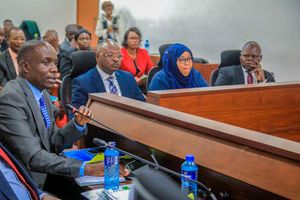
Independent Electoral and Boundaries Commission Acting CEO and Secretary Moses Sunkuli (left) appears before the National Assembly Committee on Justice, Legal Affairs and Human Rights at Bunge Tower, Nairobi, on March 11, 2026.
Photo credit: Dennis Onsongo | Nation Media Group
The committee however insisted that before approving any new budget for the kits, there has to be proof that the ones available have indeed become obsolete. Ironically, it emerged during the meeting that taxpayers will spend Sh175, 000 to upgrade one Kit while one new kit goes for Sh133, 000.
National Assembly Speaker Moses Wetang’ula had directed that all election related laws should be concluded by the House before June.
Regarding the recall clause for MPs, the commission are expected to urge Parliament to anchor sections 27, 28 and 29 of the County Government Act on the recall of Members of County Assemblies, in order to establish a clear legal framework for the recall of MPs.
The commission feels that the public has been accusing it for all the wrong reasons. It said Kenyans are accusing it of blocking them from recalling their MPs, when in fact it is Parliament that has not enacted the law.
Without this legislation, the commission cannot initiate the lengthy process of recalling an MP. Article 104 of the Constitution states that Parliament must enact legislation providing the grounds upon which a member may be recalled and the procedure to be followed.
In 2017, the court declared section 45(2) of the Election Act, which provided grounds for removal, to be unconstitutional; therefore, it cannot be applied for recall purposes.
Without such grounds for the removal of a member through recall, the process remains unfounded in law.
During the retreat, IEBC is also expected to table a list of all law firms that are owed Sh4.2 billion as was directed by the committee in their last meeting in parliament.
The National Assembly in a past session.
Photo credit: File | Nation Media Group
The committee wants to know what the commission owes each of the law firms and when the bill was incurred.
During a meeting with the commission over supplementary budget, the agency told the lawmakers that it has since reconciled its pending bills and the figure has now come down from the initial Sh5.6 billion to 4.9 billion with the legal fees alone reducing by Sh402 million.
The commission acting Chief Executive Officer Moses Sunkuli told the committee that the total pending bills, as at January 19, 2026, stood at Sh4,987,566,493 with the legal fees claims alone standing at Sh4,273,853,019 while other goods and services fee is at Sh713,713,473
The Sh4.2 billion stem from various cases dating back to 2013 with the committee signalling that the firms owed will have to come to the negotiating table on how the amounts will be settled.
The commission warned that if the bills are not settled on time, it risks affecting its operation to the 2027 General Election.
“The commission notes that if these pending Bills are not settled in time, they will not only result in the increase of the quantum but also constrain its operations including the conduct of the 2027 General Elections,” the commission told MPs. The commission also warned that due to the protracted court cases especially where legal fees will be taxed upwards of the initial fees.