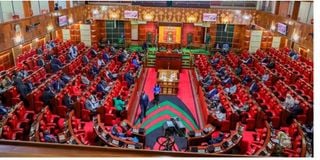
The National Assembly’s decision to reject amendments proposed by the Senate and Suba South MP Caroli Omondi on the live-streaming of election results has inadvertently pushed the country back to a clause that the court declared unconstitutional.
This comes as Parliament on Friday fought off allegations that it banned the live-streaming of election results following the passage of the Elections (Amendment) Bill, 2024, during a stormy session on Thursday.
During the session, lawmakers rejected a proposed amendment to the election law that sought to establish a mechanism for live-streaming presidential election results as tallied in constituencies.
Mr Omondi’s proposal stated that the IEBC “shall at the national results centre establish a mechanism for live-streaming and display of presidential election results announced and at the point of declaration in each of the constituency tallying centres plus the diaspora vote.”
In a subsequent section, Mr Omondi proposed: “The Commission shall at the national results centre, an open public space within the capital city of Kenya, in a live-stream announce results as verified, collated, tallied and declared by the returning officers in the constituencies and diaspora, aggregate the said results and thereafter verify the provision of Article 138(4) of the Constitution has been met by any candidate.”
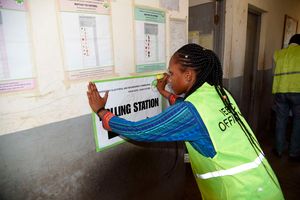
The National Assembly, however, maintained that it had not banned live-streaming, saying the process remained active under Section 39(1G) of the Elections Act.
IEBC denies plan to ban live election result streaming
“The National Assembly after public participation on the Bill and guided by the recent judgement resisted the attempt to interfere with Section 39 as it is currently provided for in the Elections Act and the attendant established procedure for the determination and declaration of election results,” the National Assembly said in a statement.
But Mr Omondi’s proposals, which were intended to improve on amendments already passed by the Senate on the tallying and transmission of presidential election results, were defeated after the National Assembly had earlier scrapped the Senate amendments.
By deleting this new section, however, members of the National Assembly rejected Mr Omondi’s proposed amendments, arguing that they were based on a non-existent clause because the House had deleted the entire Clause 22.
The implication of the National Assembly’s decision is that the only clause on live-streaming in the Elections Act is one that the High Court had declared unconstitutional.
“The Commission shall, to facilitate public information, establish a mechanism for the live streaming of results as announced at polling stations, and the results so streamed shall be for purposes of public information only and shall not be the basis for a declaration by the Commission,” states Section 39(1G).
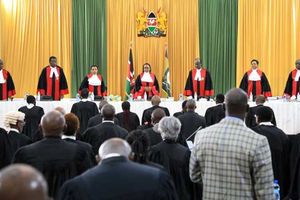
The court had declared this clause unconstitutional because it sought to downplay the validity of results from polling stations, which petitioners successfully argued were final, but which the clause described as being for “purposes of public information” only.
The court questioned why a country would spend massive resources on election technology if the results were to be used merely “for information purposes”.
Following the High Court’s declaration that the section was unconstitutional, the IEBC recommended that Parliament enact new legislation through the Draft Laws (Amendment) Bill, 2026, to facilitate live-streaming without offending the court’s ruling.
The National Assembly’s decision returns the country to the clause that the High Court nullified and which the IEBC wanted addressed, with the Senate and Mr Omondi having sought to resolve the issue.
Suba South MP Caroli Omondi.
Photo credit: Dennis Onsongo | Nation Media Group
The National Assembly, however, argued that Section 39(1G), which concerns live-streaming, had never been declared unconstitutional and remained in force, adding that the House had not amended it.
“That is the law and it has not changed. So let me tell those clueless people spreading rumours online misleading Kenyans through propaganda, no tinkering of election laws on streaming of results has been done neither in the Senate or in the National Assembly,” said Majority Leader Kimani Ichung’wah.
“If we start tinkering with the electoral laws, particularly the election transmission of results, we stand accused. Let us stick to what Kriegler advised us,” he added.
National Assembly Majority Leader Kimani Ichung’wah
Photo credit: File | Nation Media Group
The Elections (Amendment) Bill, 2024, was passed during a stormy session on Thursday evening, the last day of the fifth session before the Houses proceeded on a short recess.
In December 2024, the Senate had passed a new Section 22 in the Elections (Amendment) Bill, 2024, to replace Section 39 of the Elections Act.
The Kriegler report, released after the 2007–2008 post-election violence, advised against changing electoral laws at least one year before an election.
Lawmakers argued that it would be risky to legislate on the matter with barely 10 months remaining before the next election. However, the provision that makes polling-station results final remains in place.
Minority Leader Junet Mohamed warned that ignoring the recommendations of the Kriegler report could plunge the country into chaos similar to that witnessed in 2007–2008.
“The Kriegler report was adopted by this House, so when you say you want results transmitted to your own house, what are you saying?” he asked.
Suba South MP Caroli Omondi opposed the move, arguing that a recommendation in the Kriegler report should not prevent the House from exercising its legislative mandate.
“How will the results be tallied, verified, who is responsible for what, how they are communicated to the public, how people get to know the results, how parties can interrogate the results and how technology will be used,” he added.
Funyula MP Wilberforce Oundo, while opposing the deletion, said it risked reviving concerns about opacity in the electoral process that had been raised by courts in previous presidential petitions.
Funyula MP Wilberforce Oundo.
Photo credit: Dennis Onsongo | Nation Media Group
“I’m afraid that the deletion seems to be masking a very serious concern that was raised in the last elections. The issue of opaqueness and timeliness of submission of election results. Why would Kenyans wait for eight days to declare presidential results?” he asked.
The House also rejected Mr Omondi’s proposal to establish a separate register of voters who had transferred their polling stations.
The amendment followed claims that foreigners were being registered as voters, but the House rejected the proposal.
The proposed amendment was defeated, with the Speaker directing that evidence be submitted to support claims that foreigners, particularly Ugandans, were being registered in border regions.
Kirinyaga Woman Representative Njeri Maina supported an amendment to establish a separate register for voters who had transferred polling stations, but the proposal was rejected by MPs from the broad-based government side.
Ms Maina claimed that foreigners were being registered as voters, saying the proposed separate register for voters who had transferred was intended to address illegal registration.
“It is information that is in public domain and I indicated that aliens are possibly being registered as voters. We have seen in media stations that IDs are being issued to persons who are not Kenyans,” Ms Maina said.
Dadaab MP Farah Maalim, who was presiding over the Committee of the Whole House, insisted that Ms Maina substantiate her claims and provide evidence.
“That is a very serious allegation. The rules are very clear in this House, if you make a sweeping statement like that, then you substantiate or withdraw,” Mr Maalim said.
Daadab MP and Wiper Deputy Party Leader Farah Maalim.
Photo credit: File | Nation Media Group
Ms Boss said the IEBC was currently registering Kenyans in the diaspora as voters, adding that they were not aliens.
“Even if you go to Uganda, you will find Kenyans living there, they are not aliens,” Ms Boss said.
Lawmakers also introduced a new requirement compelling the electoral commission to submit audited registers to both Houses of Parliament.
“The Commission shall, within fourteen days of receipt of the report publish the report on its website and submit the report to the National Assembly and Senate,” reads the new clause passed by the House.
The House also introduced a new Section 82A outlining procedural guidelines for election courts when ordering the examination of electronic evidence, such as servers, memory cards and logs.
The provision requires the electoral commission to submit digital evidence under confidential cover for scrutiny by the court and for the evidence to be returned to the IEBC within seven days of the delivery of judgment.
While the committee agreed with the proposal, it recommended deleting the phrase “under confidential cover”, noting that election petitions are generally open and accessible to the public to safeguard transparency.
On the nomination of MCAs, lawmakers opposed Clause 19 of the Bill, which seeks to amend the principal Act to require anyone nominated to a county assembly to be a registered voter in the county in which they are seeking nomination.
“A person shall not be nominated by a political party unless the person is, on the date of submission of the party list by the political party, a registered voter in any of the wards in the county in which the person is nominated,” reads the Bill.
The proposal is a new clause introduced in the Bill that seeks to amend Section 34 of the Elections Act.
Currently, anyone can be nominated to any of the 47 county assemblies. There are 770 nomination slots for MCAs, in addition to the 1,450 seats filled through direct election.
On party primaries, MPs passed an amendment that would effectively bar the electoral commission from handling disputes arising from party nominations, restricting its role to registering candidates nominated by political parties.
Lawmakers want disputes arising from party primaries to be handled by the Elections Disputes Tribunal rather than the IEBC.
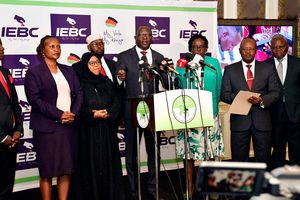
The Independent Electoral and Boundaries Commission (IEBC) Chairperson Erastus Edung Ethekon (center, podium) briefs the media on April 30, 2026, on the completion of the Enhanced Continuous Voter Registration (ECVR). With him are fellow IEBC Commissioners.
Photo credit: Francis Nderitu| Nation Media Group
The lawmakers also rejected the commission’s proposal to increase the number of voters per polling station from the current 700 to 1,000.
They cited the electoral agency’s failure to increase the number of polling stations to accommodate the additional voters, the risk of malpractice and the possibility of locking out many Kenyans from voting in the 2027 General Election.
Having been passed by the National Assembly with amendments, the Bill will be returned to the Senate in accordance with Article 110(4) of the Constitution.