For more than two decades, President William Ruto and his predecessor, Uhuru Kenyatta, were bound by one of Kenya’s most consequential political partnerships.
First as allies seeking power following President Daniel arap Moi’s retirement in 2002, then as president and deputy president running the country between 2013 and 2022, and finally as bitter political adversaries in the run-up to the 2022 General Election.
Now, nearly four years after their bruising 2022 contest, the two men are again at the centre of a political confrontation, only this time the roles have been dramatically reversed.
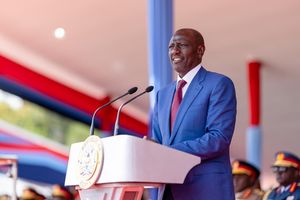
President Ruto, who once complained that his ambitions were being frustrated by his then boss, is now in State House and has openly accused Mr Kenyatta of sponsoring politicians opposed to his re-election.
Mr Kenyatta — who once controlled the levers of government and backed opposition candidate, Raila Odinga, against his then deputy in 2022 Dr Ruto — is now being scrutinised by the administration that succeeded his.
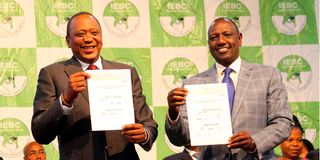
Jubilee coalition principals President Uhuru Kenyatta (right) and Deputy President William Ruto at a past Jubilee convention.
Photo credit: File | Nation Media Group
The latest exchange began with President Ruto accusing Mr Kenyatta of failing to deliver during his decade in office, and of sponsoring political “puppets” against him ahead of the 2027 General Election.
“You know their sponsor and how I assisted him while in office, but he could not deliver on affordable housing, universal healthcare and education funding for our children. Now he is sponsoring his political puppets against me, but I will trounce them by a landslide margin,” Dr Ruto said in Eldoret and later in Bungoma last week.
President William Ruto receives the instruments of power from his predecessor Uhuru Kenyatta after he took the oath of office at Moi International Sports Center, Kasarani on September 13, 2022.
Photo credit: File | Nation Media Group
As the bitter exchanges unfold, immediate former Deputy President Rigathi Gachagua has told Dr Ruto to stop attacking Mr Kenyatta and instead face his real competitors.
“Kasongo (Ruto) is stuck; he has gone to Eldoret crying to his people, telling them to say ‘tutam.’ He is telling them that his problem is Uhuru Kenyatta. Kasongo, leave Uhuru Kenyatta alone. Uhuru left you a country that still had hope, but after four years you have brought goons, suspended the rule of law and allowed thugs to run Kenya,” Mr Gachagua charged.
Similarly, Wiper Patriotic Front leader Kalonzo Musyoka asked Mr Kenyatta not to engage Dr Ruto, but instead allow him to confront Dr Ruto directly.
“I have personally advised former President Kenyatta to step aside. He was Kenya’s fourth president, and I do not want his name soiled. I am asking him to stay away and let Kalonzo fight Ruto man to man,” he said.
Then-President Uhuru Kenyatta (right) and his then-Deputy William Ruto during a Jubilee Party rally at Kasarani Stadium.
Photo credit: File I Nation Media Group
The exchanges have revived memories of a political divorce whose consequences have shaped Kenyan politics since 2018.
The origins of the Uhuru-Ruto partnership lie in the aftermath of the 2007-08 post-election violence and the International Criminal Court cases that subsequently brought the two men together politically.
By 2013, they had fashioned themselves into the unlikely UhuRuto ticket. Mr Kenyatta, the son of Kenya’s founding president, and Dr Ruto, the political outsider from Sugoi, who had risen through the ranks, built the Jubilee coalition and won the 2013 presidential election. The repeated the feat five years later.
The partnership was not merely electoral. During their first term, the two presented themselves as a united administration, with Dr Ruto repeatedly defending the government’s record and Mr Kenyatta publicly affirming the importance of his deputy and even promising him 10 years of presidency after him.
But beneath the surface, the succession question was already casting a shadow. Dr Ruto expected to succeed Mr Kenyatta in 2022. That understanding became increasingly difficult to sustain after Mr Kenyatta’s dramatic reconciliation with Raila on March 9, 2018. This became famously known as the handshake.
The handshake transformed Kenya’s political landscape significantly, resulting in the UhuRuto political arrangement.
“For Ruto, the problem was not simply that his boss had reached out to their former political adversary. It was that the new alliance appeared to redefine the priorities of the Jubilee administration while pushing him further from the president’s political centre,” claims advocate Chris Omore.
Then-President Uhuru Kenyatta and then-Deputy William Ruto during a past event.
Photo credit: File | Nation
Today, Dr Ruto occupies the position Mr Kenyatta once held. He controls the government machinery, commands the ruling Kenya Kwanza coalition and is seeking another term.
Mr Kenyatta, meanwhile, cannot appear on the presidential ballot again, but he remains the Jubilee leader and has been restructuring of the Azimio la Umoja One Kenya Coalition following Raila’s death last year. Jubilee has settled on former Interior Cabinet Secretary Fred Matiang’i as its presidential candidate.
Mr Kenyatta’s influence therefore depends on his ability to shape alliances, influence political actors and help determine who emerges as an alternative to the incumbent.
“There is, however, an important distinction between political influence and direct sponsorship. The allegations that Mr Kenyatta is financing or directing opposition groups remain claims by Ruto and his allies. Mr Kenyatta has not publicly acknowledged that he is orchestrating an anti-Ruto campaign,” political analyst Prof Gitile Naituli said.
Another analyst Geoffrey Mboya said:“The strange possibility now is that the 2027 election could become another Uhuru-Ruto contest even though only one of the two men can actually be a candidate. That is why Ruto’s repeated references to his predecessor have attracted so much attention.”