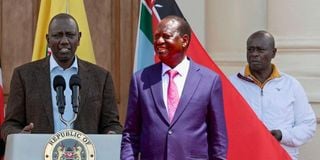
President William Ruto, ODM leader Raila Odinga and former Deputy President Rigathi Gachagua’s camps have kicked off a high-stakes political contest for control of Nairobi County — with the coveted gubernatorial seat at the heart of the battle.
According to data from the Independent Electoral and Boundaries Commission (IEBC), Nairobi had the highest number of registered voters among Kenya’s 47 counties — a total of 2,415,310 as of the August 9, 2022, General Election.
Political analysts argue that this voter base makes Nairobi a strategic battleground for any coalition with ambitions of clinching the presidency in 2027.
Combined with its status as the country’s economic nerve centre, the capital remains a prized asset in the national power equation.
“Nairobi is not just a county, it is a symbol of national power. Whichever side controls Nairobi sends a strong signal to the rest of the country about its political strength and organisational capacity,” explains Prof Gitile Naituli, a leadership and management professor at Multimedia University of Kenya.
As the political temperature rises, all eyes are now on whom these camps will back for the capital’s top job and how that choice could tilt the scales in the wider race for State House.
In the 2022 General Election, incumbent Johnson Sakaja clinched the Nairobi gubernatorial seat on a United Democratic Alliance (UDA) ticket under the Kenya Kwanza alliance led by President Ruto.
Nairobi County Governor Johnson Sakaja speaks during the launch of Nairobi County bursaries and scholarships at Nairobi Primary School on January 13, 2024.
Photo credit: Wilfred Nyangaresi | Nation Media Group
He defeated Jubilee Party’s Polycarp Igathe, who was backed by then-President Uhuru Kenyatta and Azimio la Umoja–One Kenya presidential candidate Raila Odinga.
Mr Sakaja garnered 699,392 votes, representing 54.95 percent of the total, while Mr Igathe secured 573,516 votes (45.06 percent) — a decisive victory that underscored Kenya Kwanza’s growing influence in the capital.
In the run-up to the 2022 polls, Mr Odinga was forced to compromise within the Azimio coalition, backing Jubilee’s Igathe for the Nairobi gubernatorial race in exchange for broader presidential support.
This deal led to the withdrawal of ODM’s initial candidate Westlands MP Tim Wanyonyi, sparking internal discontent within ODM’s Nairobi base.
Now, with two years to the 2027 polls, the race for Nairobi is already gaining momentum — and it’s shaping up to be one of the most fiercely contested in the country.
At the centre of the unfolding political chessboard are four national powerbrokers: President Ruto and Mr Odinga, now working together under a broad-based government framework, versus Mr Gachagua and Wiper leader Kalonzo Musyoka’s united opposition camp — all strategising to place a trusted ally at City Hall to cement influence in the capital.
Since assuming office, he says he has made significant strides across multiple sectors, transforming service delivery and infrastructure in the capital.
"Under the Dishi na County programme, launched on August 28, 2023, more than 310,000 learners in 230 public primary and ECDE schools receive a hot meal daily," he says.
In healthcare, Mr Sakaja’s administration boasts of strengthening leadership by appointing CEOs to all Level 5 hospitals and is in the process of recruiting CEOs for Level 4 hospitals.
“Nairobi has witnessed the opening of the first public ICU at Mama Lucy Hospital, alongside enhanced specialised services such as East Africa’s first public eye hospital in Umoja, dental and physiotherapy clinics, and a modern physio gym at Mbagathi," he adds.
Digitisation of health facilities is underway, with 28 already digitised and 34 more planned in Phase Two.
On market infrastructure, the governor told Nation that five new markets are under construction: Mutuini (85 percent), Karen (50 percent), Kahawa West (45 percent), Juja (50 percent), and a miraa market set to begin construction this quarter.
Mr Sakaja adds: "The national government is supporting the construction of five more markets — in Kware Road, Riruta, South B, Mathare, Maji Mazuri, and Jogoo Road."
In efforts to keep Nairobi clean, "a total of 2,452 Green Army youth are being confirmed as permanent and pensionable staff."
"Revenue collection has hit a historic high of Sh13.8 billion in FY 2024/25, up from Sh12.8 billion the previous year. This was boosted by digitisation, the introduction of the Unified Business Permit (UBP) in 2023, and new customer service centres at City Hall Annex, Ruai, and Dandora," added the governor.
In sports development, the county has completed Dandora Stadium, while Joe Kadenge, Woodley, Kihumbuini, and Mwiki stadiums are under construction and expected to be completed in FY 2025/26.
"In the mobility sector, over 120 kilometres of roads have been repaired, 80 kilometres of storm drainage installed, and over 400 streetlights erected to improve safety and connectivity."
Already, Mr Tim Wanyonyi — who was widely touted as Mr Sakaja’s main rival — has backed off and declared interest in the Bungoma gubernatorial seat, following what insiders say were backroom deals involving President Ruto, Mr Odinga, and Ford Kenya party leader Moses Wetang’ula.
Veteran journalist-turned-politician Tony Gachoka.
Photo credit: Pool
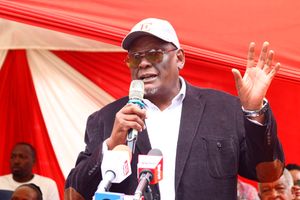
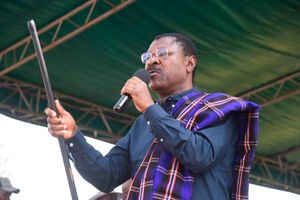
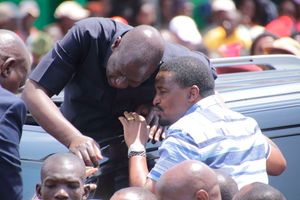
Still, Mr Sakaja must contend with strong opposition from Embakasi East MP Babu Owino, his Embakasi North counterpart James Gakuya, veteran journalist-turned-politician Tony Gachoka, and former Transport Principal Secretary Irungu Nyakera.
Embakasi East MP Babu Owino.
Photo credit: Dennis Onsongo | Nation Media Group
Others touted for the seat include former Dagoretti South MP Dennis Waweru, businesswoman Agnes Kagure, Makadara MP George Aladwa, and former Kiambu Governor Ferdinand Waititu — who was recently ordered to secure a Sh53 million bank guarantee to avoid jail in a corruption-related case.
Mr Aladwa, who had previously set his sights on the Vihiga gubernatorial seat, is also reportedly contemplating a Nairobi bid.
Embakasi East MP Babu Owino has already declared his intention to run for the post — with or without his ODM party’s backing — something that could jolt his prospects.
Although Mr Owino has clashed with the ODM leadership over the Ruto-Raila broad-based government pact, he insists his loyalty to Mr Odinga remains intact.
In a recent interview with Nation, the second-term legislator said he’s ready to run as an independent if denied the ODM ticket.
“I know ODM may not give me the ticket... but it doesn’t matter, because it’s the citizens who vote,” said Mr Owino.
He has received public backing from Lang’ata MP Phelix Odiwuor, alias Jalang’o, who declared that Mr Owino is the best-suited candidate.
Mr Gachoka told Nation he will be seeking to dislodge Mr Sakaja on Gideon Moi’s Kenya African National Union (KANU) ticket.
“I belong to the United Opposition, and as things stand, I see nothing that can hinder me from clinching the Nairobi governor seat,” he said.
“If you look at my opponents, Babu Owino still doesn’t know the party on whose ticket he’ll contest — same as Sakaja, who is torn between UDA and ODM,” Mr Gachoka added.
He argued that leaders should be elected based on merit, not ethnicity.
“I’m a proud son of the Mt Kenya region, but I should be judged by what I can do, not by my tribe. Nairobi needs a transparent servant and an effective leader.”
Mr Nyakera, a former PS during President Kenyatta’s regime, has since abandoned his Farmers Party for Mr Gachagua’s Democracy for the Citizen’s Party (DCP), on whose ticket he is banking for the Nairobi gubernatorial race.
He is expected to battle it out with Mr Gakuya, who views him as a latecomer in the opposition camp.
Mr Gachagua has declared that the Mt Kenya region will front one of their own for the Nairobi seat, arguing that the community has the numbers to win. His remarks, however, have drawn sharp criticism for playing the ethnic card.
The former DP has vowed to mobilise Kikuyu and Kamba voters, with support from Mr Musyoka, to clinch not only the governor’s seat but also up to 15 parliamentary positions in Nairobi.
Governor Sakaja, though allied to UDA, has maintained cordial ties with both President Ruto and Mr Odinga, fuelling speculation about potential support from the two leaders.
Meanwhile, Mr Aladwa recently secured support from a section of Nairobi grassroots ODM officials following Mr Wanyonyi’s shift to Bungoma County.
Unlike Mr Owino, Mr Aladwa has openly supported the Ruto-Raila pact.
Former Transport Principal Secretary Irungu Nyakera
Photo credit: File | Nation media Group
As 2027 draws closer, Nairobi is shaping up to be the most dynamic battleground in the country — a city where political ambitions, ethnic coalitions, party loyalties, and personal rivalries will collide in a contest with national consequences.
Insiders in the broad-based government say President Ruto is keen on ensuring that whoever flies the ruling coalition’s flag in Nairobi is not only loyal, but also capable of mobilising the city’s diverse vote blocs.
As battle lines harden, what is emerging is not just a race for Nairobi’s top seat — but a power struggle over who gets to shape the political narrative in Kenya’s capital.
With alliances shifting and Gen Z voters showing signs of political independence, analysts say Nairobi could become the country’s biggest political wildcard.