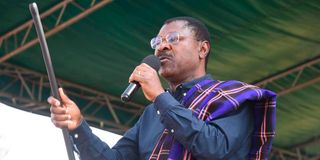
National Assembly Speaker Moses Wetang’ula during the Soy Constituency Women Empowerment Program held at Ziwa in Uasin Gishu County on June 27, 2025.
National Assembly Speaker Moses Wetang’ula has absolved Parliament from blame over the delay in enacting a law on the recall of MPs.
He said that the responsibility lies with the Independent Electoral and Boundaries Commission (IEBC) and the Attorney-General.
In an exclusive interview with the Nation, Mr Wetang’ula said that after sections of the Elections Act 2011 dealing with the recall of MPs were nullified by the courts, it is now up to the IEBC and the Attorney-General to draft and present a new Bill to Parliament for consideration.
"When such a Bill is brought before the House, I will ensure it is fast-tracked, following all legislative procedures, including public participation," Mr Wetang’ula said.
“No law on recall has been presented to Parliament and rejected. The correct authority to draft and submit such a Bill is the electoral commission.
“I hear there is a petition to recall one of my members, and claims that there is no law. It’s up to the IEBC, in consultation with the Attorney-General—as the government’s legal adviser—to draft the law and bring it to Parliament. Only then can you judge whether Parliament is reluctant or not.
Independent Electoral and Boundaries Commission chairperson Erastus Ethekon (centre), flanked by fellow commissioners, addresses the media at Pride Inn Paradise in Shanzu, Mombasa County on July 19, 2025.
“So Parliament is not guilty in any way over the delay. I don’t know of any MP who would bring a law that could lead to their own recall—it’s only human.”
Article 104 of the Constitution mandates Parliament to enact legislation outlining grounds and procedures for recalling MPs.
Last week, the IEBC stated that Parliament is yet to align the Elections Act with a court judgment that rendered the recall clauses unconstitutional.
In 2017, a three-judge bench—Justices Kanyi Kimondo, George Odunga, and Chacha Mwita—declared the existing law on MP recall “meaningless, discriminatory, and unconstitutional.”
High Court Judge Chacha Mwita at the Milimani Law Court on January 26, 2024.
The ruling affected sections 45 (2) (3) and (6), 46 (1) (b), (ii) and (c) and 48 of the Elections Act (Cap 7) and sections 27 (2) (3) and (6) and 28 (1) (b) (ii) and 9c) of the County Governments Act (Cap265) unconstitutional in its judgment in a case of Katiba Institute and Another vs Attorney General and Another (2017) Eklr1.
Mr Wetang’ula said it was not Parliament that challenged the law in court. “Was it not the people themselves who went to court?” He asked.
On the six pending by-elections in the National Assembly, Mr Wetang’ula said he had issued all the writs to the IEBC.
“For every MP who either died or joined the Executive, I issued writs to the IEBC as required. Unfortunately, the writs expired because the IEBC did not conduct the by-elections within the 90 days for reasons we all understand,” he said.
He added that the current laws are silent on what happens when writs expire without elections being held.
“There is no provision for reissuing writs. What we are doing now is simply notifying the IEBC that writs were issued, expired, and that they should now begin preparations for the by-elections,” the Speaker said.
He said that he had been sued by some constituencies for lack of representation, but said such suits are misdirected.
“As Speaker, once I issue writs, I become functus officio. Suing me does not make legal sense,” Mr Wetang’ula said.
On whether Parliament would consider amending the law to enable the IEBC to delimit boundaries before the 2027 General Election, Mr Wetang’ula expressed doubt due to time constraints.
“This new IEBC has several by-elections on their hands—almost like a mini-General Election. There are six from the National Assembly, one from the Senate, and 17 from county wards. That’s a heavy task,” Mr Wetang’ula said.
“They are auditing, cleaning, and registering new voters. The Kriegler Report recommended that this be done at least a year before elections,” he added.
With all that, the delimitation exercise may be better suited for the post-2027 period.”
Regarding reports that the Azimio coalition planned to impeach him over his controversial ruling on the House majority-minority status in February, Mr Wetang’ula said: “I’m not aware of such an attempt. So there’s nothing to discuss.”
He also defended his political engagements on weekends, denying any conflict of interest.
“For instance, when I was in Kisumu last weekend, I was with MPs from both Azimio and Kenya Kwanza doing public service. Parliament is not in Kisumu. Where is the conflict?” he asked.
“I’m a conscientious person, legally trained to distinguish right from wrong. I make my decisions in the chamber based on law and enjoy strong support from both sides.”
He also noted that in Uganda and Tanzania, speakers of parliament are members of the executive councils of their political parties yet still serve impartially.
Mr Wetang’ula maintained that Parliament will continue to fulfil its constitutional mandate despite public criticism.
“People will talk—you can’t stop them. I constantly remind MPs to focus on serving the public and doing their job diligently,” he concluded.