Had history tilted just slightly differently in August 2022, Raila Amolo Odinga might today have marked his 81st birthday not in solemn remembrance, but on the manicured lawns of State House — as Kenya’s fifth president, surrounded by aides, family and the burdens of power he pursued for decades.
Instead, January 7, 2026 has arrived heavy with absence.
Barely three months after his death in October last year, and at a time various reasons factions within ODM are trading barbs about why he lost the 2022 election, those close to him paused to remember a man whose political life was defined by near-misses, moral victories and a presidency that always seemed within reach, yet forever elusive.
The irony was not lost on his allies: Raila, the most consequential political figure of his generation, never lived to see the office he wanted most.
For some within and outside his circle, the tragedy carries an even sharper edge.
“There is a high likelihood that Raila would be alive and at State House today (January 7), having secured proper medical attention,” Jubilee Party Secretary-General Jeremiah Kioni said on Tuesday.
“Raila might have won and received the medical care he needed. Angekuwa mzima sasa hivi (he could have been alive today),” he added.
It was a statement as painful as it was provocative — reopening wounds from the contested 2022 election and raising uncomfortable questions about the human cost of political defeat.
On what would have been his 81st birthday, the Odinga family issued a statement marked by gratitude. They thanked President William Ruto and his deputy, Prof Kithure Kindiki, the Prime Cabinet Secretary Musalia Mudavadi, Chief Justice Martha Koome and the entire government for what they described as “outstanding support, understanding and kindness” during Raila’s final days and burial.
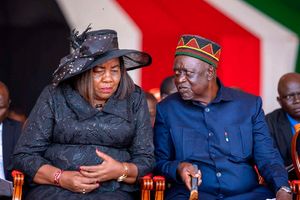
Mama Ida Odinga, widow of the late former Prime Minister Raila Odinga, speaks during celebrations marking what would have been Raila Odinga’s 81st birthday at his home in Karen, Nairobi, on January 7, 2025.
Photo credit: Bonface Bogita | Nation Media Group
They also acknowledged foreign leaders — India’s Prime Minister Narendra Modi, former Presidents Uhuru Kenyatta, Olusegun Obasanjo, Nana Akufo-Addo, Jakaya Kikwete and African Development Bank president Akinwumi Adesina — for standing with Kenya during the farewell of a man whose influence stretched far beyond its borders.
The family also paid tribute to the medical teams in India and Kenya who cared for Raila, and to Kenyans who, in life and death, treated him as “Baba” — a father figure of the republic.
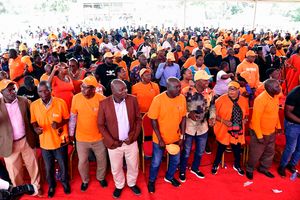
Mining Cabinet Secretary Hassan Joho leads ODM leaders in marking what would have been Raila Odinga’s 81st birthday in Kilifi County on January 7, 2025.
Photo credit: Kevin Odit | Nation Media Group
Former Cabinet Secretary Aisha Jumwa comforts Raila Odinga's ex-aide Maurice Ogeta during the former PM's 81st birthday celebrations in Kilifi.
Photo credit: Kevin Odit | Nation Media Group
Yet, beneath the gratitude, lies a quiet national reckoning.
The president Kenya never had
To his supporters, Raila was the president Kenya never had, while to his critics, he was the perennial challenger who never quite closed the deal.
For his brother and ODM Party leader Dr Oburu Oginga, the loss is deeply personal.
“We grew up as twins,” he said.
Raila Odinga (left) and his elder brother Oburu Odinga.
Photo credit: File | Nation Media Group
His words cut through the political noise, reminding the country that beyond rallies and courtrooms was a man bound by family, friendship and shared struggle.
“Happy 80 + 1 heavenly birthday,” he said.
That pain was echoed across ODM, where several party members gathered Wednesday to celebrate his birthday. In Nairobi, they streamed into the Odinga family home in Kerarapon.
Mama Ida Odinga, widow of the late former Prime Minister Raila Odinga, speaks during celebrations marking what would have been Raila Odinga’s 81st birthday at his home in Karen, Nairobi, on January 7, 2025.
Photo credit: Bonface Bogita | Nation Media Group
Here, Ida reminded ODM members why unity of the party was important.
"Raila ran ODM with dedicated, firm and fair hands. He ran ODM on the principle of constant consultation and always deferring to the people. It is my wish that we can preserve the party in his honour and as a matter of service to our country.," she said.
"I want to end by appealing to those Baba left in the leadership of the party to reflect deeply and sincerely on his dreams for the party and our country. Let us approach the problems facing the party by always asking, what would Baba do under these circumstances? He would tell us to sit down and talk. So at this moment, let us put our differences aside and do just that."
Few leaders have loomed over Kenya’s political imagination like Raila Odinga. From detention without trial in the 1980s, to the second liberation, to the birth of multiparty democracy and the 2010 Constitution, several leaders agree, Raila was not merely a participant in history — he interrupted it.
He ran for president five times, lost narrowly at least twice, and contested results in court when he believed democracy had been subverted.
He was the face of resistance, reform and reconciliation, often all at once.
President Ruto, in a rare moment of reflection, captured this complexity in his tribute.
“Baba taught us that the country must always come before self… Whether in struggle or reconciliation, he chose stability over chaos, unity over division, and hope over despair,” the President said.
“As we remember him on his birthday, we celebrate not just the man but the enduring lessons he left us: To close ranks for the common good, to rise above partisanship, and to keep faith in the Kenyan dream.”
The tension reflects a deeper question Raila himself grappled with until the end about when compromise preserves stability, and when does it erode principle?
Beyond the political sparring, Raila’s birthday reignited reflection on the man himself. Prof Anyang’ Nyong’o described him as “Kenya’s political colossus” — a leader who believed democracy without equity was hollow, and independence without dignity a betrayal.
“Raila Odinga belonged to that rare category of leaders who do not merely participate in history but interrupt it,” Prof Nyong’o said.
From Kilifi to Kisumu, from Nairobi to the diaspora, commemorations focused less on what Raila failed to achieve and more on what he forced the nation to confront: injustice, exclusion and the unfinished promise of independence.
Perhaps, leaders say, the cruelest irony is that Raila spent his life arguing that power should serve the people, yet it may have been power — or the lack of it — that shortened his time among them.