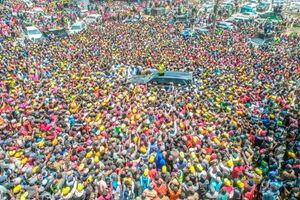
At least 11 people have lost their lives in violence and other incidents linked to political rallies across the country since February, turning gatherings meant to mobilise voters into increasingly dangerous encounters as Kenya heads towards the August 10, 2027 General Election.
The deaths have occurred in Nairobi, Homa Bay, Kisumu, Kisii, Vihiga, Kajiado and Embu, with the victims killed or fatally injured in shootings, stabbings, mob attacks, clashes involving police and incidents arising from disorder at political gatherings.
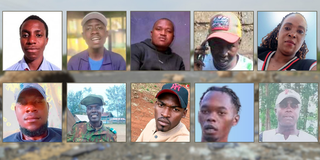
At least 11 people killed in clashes, shootings, mob attacks and other incidents linked to elaborate political gatherings between February and September. (From left) Brandon Ong'or, Joseph Shikuku, Dickson Oduogo, Josephat Mogaka, Norine Nalwanga, George Olwanda, Jim Richardson, Moses Munene, Mike Macharia, and Vincent Osiemo.
Photo credit: NMG
And with the official campaign period still months away, the growing toll is raising fresh questions about how political violence is being contained and whether the security and electoral institutions will be able to prevent the escalation of violence as the 2027 contest gathers pace.
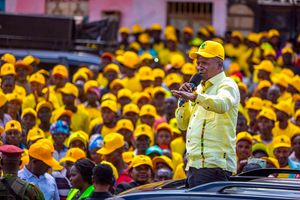
From the Linda Mwananchi rally in Kitengela, Kajiado County, to a political gathering addressed by Deputy President Kithure Kindiki in Embu last weekend, political meetings have increasingly been accompanied by clashes, destruction of property and allegations of organised goonism.
In Nairobi, records at the Nairobi Funeral Home indicate that three bodies, initially unidentified, were brought in by police following last Sunday’s Linda Mwananchi rally which began in the city centre and ended at Jacaranda Grounds.
But the families have come out in defence of their loved ones dismissing reports circulating on social media that they were beaten to death after being caught stealing phones on Jogoo Road.
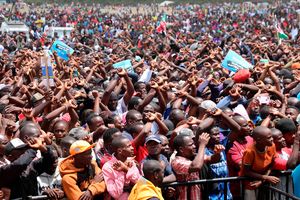
Thousands turn out as Linda Mwananchi storms Jacaranda Grounds in Nairobi
“My brother, Joseph Omondi Shikuku, has never stolen from anyone. He is a good person who was operating his small business of selling second-hand clothes and running a fast-food eatery here in Umoja 2. Whatever is being said on social media is totally wrong and we are hurt as a family,” Omondi’s sister Mercy Awino Shikuku told the Nation .
A postmortem showed that Omondi died from injuries to the skull. The family, however, suspects that he could have been pushed from a footbridge by people who have not been identified.
A photograph of the late Joseph Omondi Shikuku, 23, who died following mob justice during the recent Nairobi tour by the Linda Mwananchi brigade, at his family home in Umoja 2, Nairobi, on September 15, 2026.
Photo credit: Wilfred Nyangaresi | Nation
Brandon Ong’or, 19, also died on Sunday.
His mother Hellen Ong’or said her son had never stolen from anyone and was instead branded a thief and a supporter of a rival political group. The family of Josephat Mogaka, 19, who also died on Sunday, is awaiting the postmortem results, which are expected on Wednesday.
Buruburu OCPD Boniface Lomuk confirmed that three bodies were recovered after the victims were allegedly subjected to mob justice by local residents.
Embakasi East MP Babu Owino distanced Linda Mwananchi supporters from the reported deaths and condemned the violence, saying politics should not be a reason for people to lose their lives.
“This is so unfortunate and may their souls rest in peace. It is sad to lose people just because of politics. We need to treat each other with love. We experience the same challenges as Nairobians and Kenyans, and the enemy is poverty and bad governance,” the MP said.
“The Jacaranda rally demonstrates that political expression can take place without violence or disruption of public order. We therefore encourage all political leaders ,supporters and stakeholders to make this their standard for future political engagements.the National Police Service remains apolitical, impartial and committed to serving and protecting all Kenyans, residents and visitors, Mr Muchiri said.
The three deaths came days after two men were shot during clashes at a political gathering addressed by Prof Kithure Kindiki at Nembure Stadium in Embu County.
The victims, 23-year-old Mike Macharia and 30-year-old Moses Munene, were reportedly caught up in running battles between youths and anti-riot police on Saturday as Prof Kindiki addressed United Democratic Alliance officials inside the stadium.
Linda Mwananchi Nairobi Tour
Youths outside the venue shouted and hurled stones as he spoke, prompting anti-riot police to disperse them. The clashes lasted several hours and six vehicles were set ablaze.
The Embu deaths added to a string of fatalities recorded around political gatherings in recent months.
On August 16, two people died during chaos surrounding a Linda Mwananchi rally in Homa Bay.
Police constable Jim Richardson Onkundi, 36, was hit on the head by a stone while driving a police vehicle. He lost consciousness, causing the vehicle to veer off the road and crash into a building.
He was later pronounced dead on arrival at Jaramogi Oginga Odinga Teaching and Referral Hospital, where he had been referred for treatment.
The late Police Constable Jim Richardson Onkudi.
Photo credit: Pool
Norine Nalangwa was also killed after she was hit by a speeding vehicle while crossing the road during the chaos. She later died at Homa Bay County Teaching and Referral Hospital.
The death toll associated with the Homa Bay rally has been disputed, with different accounts putting it at between two and four, making it difficult to establish the full number of casualties arising from the violence.
On July 12, Dickson Oduor died following a violent confrontation between two rival groups outside ACK St Stephen Cathedral in Kisumu during a church service attended by leaders of Linda Mwananchi.
Mr Oduor, a boxer, sustained two stab wounds to the chest during the confrontation between Linda Mwananchi supporters and supporters of the broad-based government.
Several people were injured during the clash, while nine motorcycles and a police vehicle were damaged.
Kisumu Woman Representative Ruth Odinga blamed some politicians for supporting and entrenching goons and criminal gangs.
“Political competition must never be a license to sponsor violence or recruit young people to criminal networks,” said Kisumu Governor Anyang’ Nyong’o.
Just over a week earlier, Kisii had recorded another death during a Linda Mwananchi rally at Keumbu.
Vincent Osiemo, popularly known as Mapinduzi, died after sustaining severe head injuries during clashes involving suspected political goons on July 3.
The 36-year-old, who worked as a cameraman for a local politician, fell from a speeding vehicle that was trying to escape a hail of stones.
A postmortem found that he died from blunt-force trauma to the head, causing a skull fracture and internal bleeding in the brain.
A police report recorded his death as a case of mob violence after he was allegedly beaten by unknown assailants.
Vincent Osiemo.
Photo credit: Pool
On February 21, boda boda rider George Otobe was lynched by a mob after he reportedly stabbed someone during a Linda Mwananchi rally in Mbale Town, Vihiga County.
That same month, Vincent Ayomo lost his life after being shot during a Linda Mwananchi rally in Kitengela, Kajiado County, while going about his errands in the town.
The 28-year-old died after a bullet hit him below the left eye during running battles between police and protesters.
Last month, President William Ruto criticised the Judiciary over what he termed as lenient handling of cases involving goons accused of disrupting political rallies.
The President said courts were releasing suspects on low bond terms, allowing them to return to the streets and continue terrorising Kenyans.
“Young people arrested for criminality are taken to court, then they are given a bond of Sh200 and released because they are our children. They then go back to political rallies and that is how we end up with goons,” President Ruto said.
The President said Kenya must have an honest conversation about the growing problem of goons as political temperatures rise ahead of the 2027 General Election.
“Criminality, the rule of law and the security of our nation cannot be compromised. There cannot be any defence for criminality and for breaking the law,” he said.
Kenya has a long history of political and election-related violence. More than 1,100 people were killed and about 660,000 displaced during the 2007-08 post-election violence, while the 2017 election period was also marked by deaths, injuries and allegations of excessive use of force by security agencies.
The violence of past election cycles led to extensive reforms of Kenya’s electoral and security institutions but the latest incidents show that political violence remains a recurring feature of the country’s electoral politics.
During the Ol Kalou by-election campaigns in July, the Kenya National Commission on Human Rights raised concern over political violence, intimidation, destruction of property and other electoral malpractice. The commission said one person had died during the campaigns and warned of the possibility of the violence spreading beyond the constituency.
Zacharia Gakinya. He was beaten to death by goons during the Ol Kalou by election.
Photo credit: Pool
In August, the Commission also condemned political intolerance and the use of organised criminal gangs or goons.
Analysts have separately raised concerns about the role of politically connected groups in the violence.
The Armed Conflict Location & Event Data Project (ACLED) said in August that groups commonly described as political “goons” can draw recruits from gang networks, informal labour groups and local vigilantes, and that retaliatory mobs are also contributing to an escalation of lynchings.
The lobby said the violence witnessed in Homa Bay could be an indicator of the risks surrounding the 2027 election cycle, particularly where rival political groups mobilise large crowds and competing factions confront one another.
“The violence in Homa Bay signals a dangerous trajectory for the upcoming election cycle because the level of cohesion among political opposition parties will largely influence how political violence is organised, as well as whom it targets in the upcoming election cycle,” the lobby warned.
This adds another dimension to the growing concern that the violence is not necessarily confined to confrontations between police and political crowds but can involve rival political groups, organised youths, mobs and individuals caught up in the disorder.
For every death, there are questions over who organised the gathering, who provided security, whether there were warnings of possible violence, who was arrested, whether suspects were charged and whether those responsible for inciting or organising violence were identified.
Shells of torched vehicles in Homa Bay a day after a Linda Mwananchi rally turned violent.
Photo credit: NMG
The growing number of incidents has also exposed the gap between Kenya’s extensive legal framework and its enforcement on the ground.
The Electoral Code of Conduct and the Election Offences Act are already in force for the 2027 election period following an IEBC notice published on August 20, 2026.
The Electoral Code of Conduct regulates the behaviour of political parties, candidates, agents and supporters, while the Election Offences Act criminalises conduct that undermines the integrity and credibility of elections, including violence, intimidation, bribery and interference with electoral processes.
Section 13 of the Election Offences Act prohibits the direct or indirect use of force, violence, harassment or threats to prevent or disrupt a political meeting, march, demonstration or other political event.
It also prohibits conduct intended to materially disrupt a political party from holding a public political meeting.
A person convicted of such offences faces a fine of up to Sh500,000, imprisonment for up to five years, or both, while the Director of Public Prosecutions has powers to direct investigations and prosecute offences.
Article 81 of the Constitution requires elections to be free from violence and other forms of malpractice, while Article 84 requires candidates and political parties to comply with the electoral code of conduct.
Yet the deaths and repeated clashes raise questions about the effectiveness of those safeguards when political gatherings turn violent.
The IEBC has maintained that it will enforce electoral laws against those found to have violated them.
Commission chairman Erastus Ethekon has warned that offenders could face sanctions, including disqualification.
Mr Ethekon has said the Commission does not have the instruments to enforce security and therefore relies on security agencies to ensure peaceful political activities.
At a high-level security roundtable on September 2, he said the Commission was ready to take extraordinary measures to ensure that the August 10, 2027 General Election is peaceful, free, fair and credible.
Inspector-General of Police Douglas Kanja has pledged to strengthen election-security coordination and align security operations with electoral laws.
Last week, IEBC Vice-Chairperson Fahima Abdallah said the Commission was working with police and other relevant institutions to enhance security during electoral activities.
She described the campaign period as the most volatile phase of the election cycle and said the Commission would enforce the Electoral Code of Conduct while warning against the rising tide of goonism.
The official campaign period will begin on May 29, 2027 and end on August 7, two days before the election.
That means the country has months before the formal campaign begins but political mobilisation is already producing deaths.