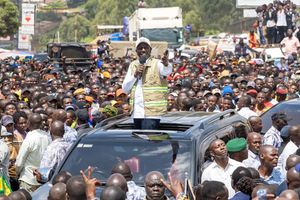
President William Ruto’s four-day tour of Kisii and Nyamira counties that ends today (Wednesday) has unfolded as far more than a routine development visit.
Insiders say it is a calculated political offensive anchored on multi-billion-shilling projects aimed at reclaiming influence in a region rapidly coalescing around his emerging rival, Fred Matiang’i.
From the ground-breaking of markets and hostels to the commissioning of water projects and roads, the President’s itinerary has been deliberately heavy on infrastructure - signaling a strategy that seeks to convert development into political capital in a region long regarded as a swing vote bloc.
“I will not engage on a campaign of insults and sloganeering. If my opponents decide to go that direction, I will answer them through development,” President Ruto told the Rigathi Gachagua- Fred Matiang’i-led United Opposition.
Analysts say that on the ground, the scale of the investments is difficult to ignore.
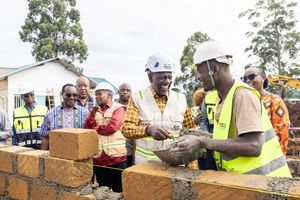
In Kisii County, the President laid the foundation stone for the Nyamache Kenya Medical Training College (KMTC) hostels and the Mogonga Modern Market, part of a broader plan that will see 22 modern markets constructed at a cost of Sh 2.5 billion.
Each of these facilities is expected to host hundreds of traders, providing structured trading spaces while reducing post-harvest losses.
At Nyakoe in Kitutu Chache South, he inspected an ongoing modern market that will accommodate more than 300 traders, before proceeding to launch another at Kegogi with similar capacity.
His message was candid that the economic empowerment at the grassroots remains the cornerstone of his Bottom-Up Economic Transformation Agenda.
“We are strengthening the Broad-Based Government through continuous consultation with grassroots and elected leaders,” President Ruto told more than 2,000 local leaders during a meeting at Kisii State Lodge. “Our goal is to unite the country around a shared agenda and drive inclusive growth where no region is left behind.”
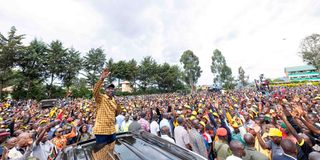
President William Ruto interacts with football fans after handing over a bus to Shabana FC at Gusii Stadium.
Beyond markets, the administration is pushing an aggressive infrastructure rollout aimed at unlocking the region’s economic potential.
In Kisii, the President launched the construction of the Bobaracho–Ting’a road and an access road to Gianchore Tea Factory—projects designed to ease the transport of agricultural produce.
In neighbouring Nyamira County, road projects are equally ambitious. The 61-kilometre Eronge–Kebuse–Omonyenya road is already 58 percent complete, while Manga–Motemomwamu stands at 38 percent. Additional roads, including Keumbo–Kiendeke and Chabera–Nyamusi–Nyamaiya, are lined up for rollout.
The President commissioned the Nyamira Water Supply Project, a 40-kilometre pipeline connecting over 15,000 households in Kebirigo, Nyaramba, Miruka and surrounding areas to clean water—an intervention expected to significantly improve public health and livelihoods.
A significant portion of the multi-billion spending is directed towards education and healthcare—sectors with immediate and long-term political resonance.
In Nyamira, the government has committed Sh 500 million to the construction of Nyamira University College and an additional Sh 300 million for student hostels. The broader plan includes lecture halls, laboratories, libraries and a medical centre.
At KMTC Nyamira, the President laid the foundation stone for a 580-capacity hostel, part of a larger Sh 1.3 billion investment to build accommodation for 3,000 students under the Affordable Housing Programme.
“We are strengthening our medical training institutions to ensure we have an adequate pool of professionals to support universal health coverage,” the President said.
At the same time, Nyamira County Referral Hospital is set for a Sh1 billion upgrade, while the county will also benefit from Sh 900 million earmarked for a new stadium.
President William Ruto interacts with members of the public after the inspection of the KSh75 million Mogonga Market in Bomachoge Borabu Constituency, Kisii County, on Tuesday, April 14.
Photo credit: PCS
Perhaps the most symbolic of the President’s projects is the planned transformation of Gusii Stadium.
On Sunday, President Ruto broke ground for the construction of a Sh 1 billion, 14,000-seater stadium complete with a FIFA-standard pitch and an eight-lane athletics track, expected to be completed by April 2027.
The event, attended by thousands of football fans, also saw the President hand over a bus to Shabana FC before joining spectators for a friendly match.
Beyond sports, the project is part of a broader national plan to build 25 modern stadiums—an initiative that blends youth engagement with political visibility.
If Kisii is receiving a significant share of projects, Nyamira is at the centre of an even larger investment push.
The government has committed Sh 15 billion for affordable housing, modern markets, and student hostels in the county—an unprecedented level of spending in a region that has historically complained of marginalisation.
Among the projects is the Sh 70 million Ikonge Modern Market, alongside last-mile water connectivity and expanded educational facilities.
Even as the President rolled out projects, a lingering controversy over the Standard Gauge Railway (SGR) extension cast a shadow over the visit.
Residents and leaders have raised concerns that initial designs appeared to bypass the Gusii region, denying it potential economic benefits.
To address the uproar, President Ruto directed Transport Cabinet Secretary Davis Chirchir to include an intermediate station at Ikonge, with Sh 300 million allocated for the facility.
The move came after sustained pressure, including a petition by local advocate Dennis Anyoka Moturi demanding transparency on the project’s design and routing.
For years, Kisii and Nyamira have been politically fluid—capable of swinging between alliances depending on national dynamics.
Historically aligned with opposition politics under Raila Odinga, the region is now undergoing a rapid transformation following his death.
Into that vacuum has stepped Dr Fred Matiang’i, whose rising profile has redefined the political landscape.
Backed by former President Uhuru Kenyatta, Dr Matiang’i has consolidated support among local leaders and grassroots networks, positioning himself as the de facto kingpin in Gusii.
Insiders within the Kenya Kwanza coalition acknowledge that the President is entering a politically hostile environment.
While South Mugirango MP Sylvanus Osoro and Kisii Governor Simba Arati remain among his key allies, much of the region’s leadership has gravitated towards Dr Matiang’i.
Former President and Jubilee Party leader Uhuru Kenyatta (left) with former Interior Cabinet Secretary Dr Fred Matiang’i during Jubilee Party Special National Delegates Conference at Ngong Racecourse in Nairobi on September 26, 2025.
Photo credit: Bonface Bogita | Nation Media Group
Figures such as former CS Ezekiel Machogu, Kisii Senator Richard Onyonka, Nyamira Governor Amos Nyaribo, and MP Anthony Kibagendi are increasingly aligned with the former Interior CS.
Recent Ward by-election victories by candidates linked to Dr Matiang’i’s camp in Nyamira have further cemented his influence, signaling a broader political shift.
The central question emerging from the tour is whether development alone can shift political loyalties.
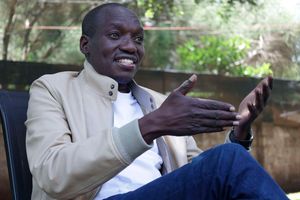
“For the President, the answer lies in visible, tangible projects that directly impact livelihoods—markets, roads, water, education and health facilities,” argues political analyst Dismas Mokua.
For his rivals, however, he says, politics in Gusii is increasingly shaped by identity, representation, and perceived respect for local leaders—particularly Dr Matiang’i, who is seen as the region’s political standard-bearer.
Recent remarks by President Ruto in other parts of the country, perceived as critical of Dr Matiang’i, have reportedly angered sections of the Gusii electorate, complicating his outreach efforts.
An Infotrak survey conducted in December 2025 placed President Ruto at 28 percent nationally, with Matiang’i emerging second at 13 percent—an impressive showing for a relatively new entrant.
With 27 percent of voters undecided, analysts say regions like Gusii could prove decisive in a tightly contested race.
More critically, projections suggest that a united opposition could command over 40 percent support—enough to force a presidential runoff.
For President Ruto, the multi-billion-shilling investment in Gusiiland represents both a development agenda and a political gamble.
As the 2027 General Election draws closer, the battle for Gusii is shaping up as a critical front in Kenya’s evolving political landscape.
For President Ruto, the path to retaining power may well run through regions like Kisii and Nyamira—where development promises must translate into political loyalty.
For Dr Matiang’i, the region represents both a base and a launchpad for national ambitions.
“In betting billions on infrastructure, President Ruto is effectively wagering that development can outmatch political realignment,” says Mr Mokua.
He adds: “Whether that bet pays off will depend not just on the projects themselves, but on how they are received by a population increasingly attuned to both economic and political signals.”