President William Ruto heads to Kisii and Nyamira counties this Sunday for a four-day tour that is shaping up to be one of the most politically charged visits of his presidency—an on-the-ground test of his influence in a region increasingly tilting toward his emerging rival, Fred Matiang’i.
The visit, running from April 12 to April 15, is being framed by State House as a development-focused tour aimed at inspecting ongoing projects and launching new initiatives.
But beneath the official itinerary lies a far more consequential political subtext: a battle for control of the Gusii vote bloc, one that could significantly shape the contours of the 2027 presidential race.
The Head of State is set to launch and inspect various development projects while addressing residents at different centres as part of his continued strategy to woo support in the region.
Dr Ruto is expected to attend a Sunday Church service and later Sunday evening meet elected leaders at the Kisii State Lodge, State House confirmed on Saturday.
On Sunday, he is also expected to attend a football match involving Shabana FC at Gusii Stadium. He will then present the Gusii-based club with a bus to ease their transport needs.
The Head of State is also expected to break ground for the expansion of Gusii Stadium to national standards.
He will further inspect the construction of the Kisii Cancer Centre of Excellence, Suneka Airstrip, the ongoing construction of Nyamira University at Kiabonyoru, a tuition block at Nyamira Primary School, and launch economic stimulus markets in Ekerenyo and Ikonge, among other projects.
President William Ruto joins in a youth dance while presiding over the disbursement of the Nyota Business Start-Up Capital for young entrepreneurs from Kisii, Nyamira and Migori counties at Gusii Stadium.
Photo credit: PSC
On Friday, Education Cabinet Secretary (CS) Julius Ogamba, during an advance tour of the region ahead of President Ruto’s visit, said preparations are ongoing.
“We are here today to ensure a smooth visit for our President. Let us support him and prioritize development. The President will launch various projects and inspect others that are ongoing,” said Mr Ogamba after visiting several projects in Nyamira County.
For years, Kisii and Nyamira have been regarded as a swing region—politically fluid, fiercely independent, and capable of shifting allegiances depending on prevailing national currents.
Historically aligned with opposition politics, particularly under the late ODM leader Raila Odinga, the region is now undergoing a dramatic realignment following his death on October 15 last year.
Into that vacuum has stepped Dr Matiang’i, whose rising profile has quickly transformed him into the most formidable political figure in the region.
Backed by former President Uhuru Kenyatta, Dr Matiang’i has consolidated support among local leaders and grassroots networks, positioning himself as the de facto political kingpin in Gusii.
Recent political developments suggest that Dr Ruto’s influence in the region appears to be waning significantly, making his upcoming tour not just routine governance, but a strategic attempt to reclaim lost ground.
Additionally, locals say, remarks made by President Ruto casting Dr Matiang'i in bad light during his recent tour of Western Kenya and Nyanza angered residents, who felt the Head of State had disrespected their “son.”
Dr Matiang’i, who hails from the region and was recently installed as the Gusii community spokesman, enjoys significant support as he eyes the presidency seat in 2027, with his backers demanding respect for him.
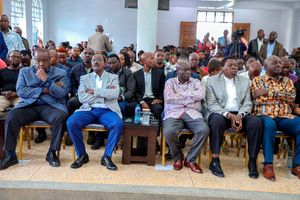
Insiders within the Kenya Kwanza coalition acknowledge that the President’s reception in Kisii and Nyamira could be less than warm.
Unlike previous visits where local political heavyweights rallied support, this time president Ruto is expected to rely on a thin bench of allies.
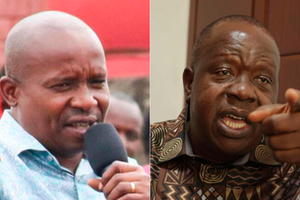
Among the few leaders openly aligned with him are South Mugirango MP Sylvanus Osoro and Kisii Governor Simba Arati. Beyond them, however, the political terrain appears largely dominated by figures who have shifted allegiance to Dr Matiang’i.
Key among these are former Education Cabinet Secretary Ezekiel Machogu, veteran politician Chris Obure, Kisii Senator Richard Onyonka, Nyamira Governor Amos Nyaribo, Kitutu Chache South MP Anthony Kibagendi, and former nominated Senator Gloria Orwoba.
At the heart of the changing dynamics is Dr Matiang’i’s growing popularity, which has been demonstrated both in electoral outcomes and opinion polls.
Jubilee presidential flag bearer Dr Fred Matiang'i and other local leaders at Magombo in Kitutu Masaba, Nyamira County on January 31, 2026.
Photo credit: Ruth Mbula | Nation Media Group
In the February by-elections, candidates associated with his camp secured key victories in Nyamira Ward races, reinforcing his grip on the region and signaling a broader political awakening among voters.
These wins, though localized, have had outsized symbolic impact, portraying Dr Matiang’i as a viable national contender capable of challenging Ruto’s dominance.
Analysts say his appeal cuts across traditional party lines, attracting former ODM loyalists disillusioned by internal divisions as well as voters seeking a technocratic alternative to the current administration.
A December 2025 survey by Infotrak revealed a fragmented presidential race, with Dr Ruto leading at 28 percent but facing stiff competition from a cluster of opposition figures.
Dr Matiang’i emerged second with 13 percent, followed closely by Wiper Patriotic Front leader Kalonzo Musyoka at 12 percent and Embakasi East MP Babu Owino at 7 percent.
Former Deputy President Rigathi Gachagua trailed at 5 percent, while People’s Liberation Party (PLP) leader Martha Karua and ex-Chief Justice David Maraga each registered 2 percent support.
Notably, 27 percent of respondents remained undecided, highlighting the fluidity of the race and the potential for significant shifts as political alignments crystallize.
Perhaps more concerning for president Ruto is the finding that a united opposition could command over 40 percent support—enough to force a runoff if elections were held today.
President Ruto’s planned tour of the Gusii region was postponed three weeks ago reportedly due to mounting public disquiet over the Standard Gauge Railway (SGR) extension and fears that the region could be side-lined.
To calm the rage, and although early project designs did not explicitly include a major station in Nyamira, President Ruto directed Transport Cabinet Secretary Davis Chirchir to ensure that an intermediate station is established in Ikonge.
“We are going to re-look at that, Your Excellency, towards Nyamira,” Mr. Chirchir said during the launch of Phase 2 of the project recently.
The SGR expansion, divided into two phases, is expected to link Naivasha to Malaba through Narok, Bomet, Kericho, Nyamira, and Kisumu—eventually completing a rail corridor from Mombasa to the Ugandan border.
However, project designs released so far do not clearly indicate any stopover within Gusii, fueling fears that the region could miss out on the economic benefits.
Already, Advocate Dennis Anyoka Moturi, acting on behalf of Gusii residents, has formally petitioned the Managing Director of Kenya Railways, demanding clarity.
“We demand copies of design specifications that prove the existence or absence of a major or subsidiary passenger and cargo station within Nyamira or the larger Gusii region,” Mr. Moturi states in his letter.
He also requested minutes of stakeholder consultations and an explanation as to why stations appear clustered in Mulot, Bomet, and Sotik, only for the line to skip Gusii before resuming at Sondu.
The petition—copied to the Office of the President, the Cabinet Secretary for Roads and Transport, and MPs from Kisii and Nyamira—warns that failure to respond within seven days could trigger legal action.
“It is discriminatory to bypass Gusii, yet we are a rich agricultural region,” the letter asserts.
The issue has lately dominated discussions on Ekegusii vernacular radio stations, with anxiety deepened by Kenya Railways’ publicity campaign.
Analysts say that a successful tour—marked by large crowds and enthusiastic reception—would signal that the Head of State still commands influence in the region, potentially slowing Dr Matiang’i’s momentum.
Conversely, a hostile or lukewarm reception would reinforce perceptions of a shifting political tide, emboldening the opposition and accelerating realignments ahead of the next polls.
Another poll by TIFA indicated that Kenyans are cautiously optimistic—but deeply divided— about the opposition’s ability to unite behind a single presidential candidate in 2027.
“Voters are watching behaviour, not declarations—alliances will only be believed once formalised,” said TIFA.