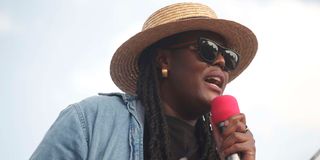
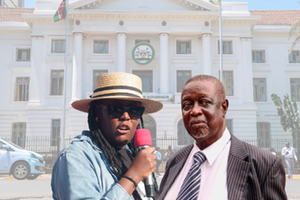
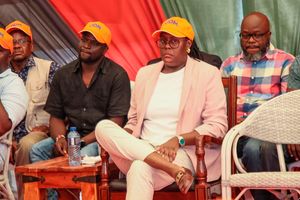
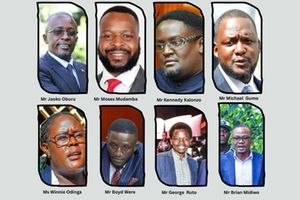
When she appeared at a press briefing convened by embattled ODM Secretary General Edwin Sifuna at Panafric Hotel in Nairobi last month, Winnie Odinga did more than just show up — she sent shockwaves through the party’s fragile power structure.
The briefing, called in the wake of Mr Sifuna’s controversial ouster, had already drawn sharp attention.
But it was Winnie’s presence, even though she uttered no word, which elevated it from a factional show of defiance into a moment of real political consequence.
Within ODM’s upper ranks and President William Ruto’s broad-based government, insiders say, alarm bells rang almost instantly.
“Her appearance there changed the entire perception,” said a senior party official familiar with the internal deliberations. “It was no longer just Sifuna’s camp speaking—there was an Odinga surname in it, we couldn’t afford to ignore it.”
Often described by insiders as the political heir to the late Raila Odinga, insiders say that Winnie carries a figurative weight that far exceeds her current role as an East African Legislative Assembly (EALA) legislator.
Her political choices are closely watched, not just for what they mean in the present, but for what they signal about the future of ODM.
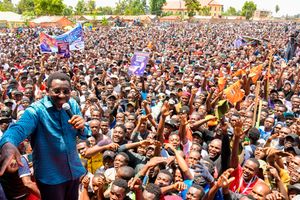
President William Ruto (left) confers with ODM party leader Oburu Oginga during the Piny Luo Festival in Senye Beach in Nyatike, Migori County on December 17, 2025.
Photo credit: Alex Odhiambo | Nation Media Group
Her brief but calculated appearance at Panafric, sources say, rattled a rival axis aligned to her uncle Dr Oburu Oginga, triggering a quiet but deliberate effort to bring her closer—or at the very least, keep her from drifting further away.
What has followed, according to multiple insiders, is a carefully choreographed political charm offensive, one that blends family outreach and cultural allegory.
“The thinking is simple,” said a source within the Oburu camp. “You don’t confront Winnie. You accommodate her. You make her feel part of the centre.”
Having been the closest to Raila, even accompanying him on his last trip out of the country in October, her association with the Linda Mwananchi camp carried a lot of weight and symbolism, which upset the powers that be.
It was this credibility dividend that gave both the ODM leadership and Kenya Kwanza honchos sleepless nights.
For President William Ruto’s handlers, the fear was that a category of Raila’s supporters who felt she had been mistreated into ‘defecting’ might vote against the broad-based lineup, especially in next year's presidential election.
On the contrary, her departure from the Linda Mwananchi faction would undoubtedly weaken the opposition, forcing them to reconsider their strategy.
This comes as the larger Kawuor clan is set to meet at Kang’o ka Jaramogi, on Sunday March 22 for a key meeting that will bring together the Odinga family as well as other kin.
Eala MP Winnie Odinga (center) during the ODM Nairobi County delegates and officials meeting at Jaramogi Oginga Odinga Foundation in Upper Hill, Nairobi, on March 17, 2026.
Photo credit: Wilfred Nyangaresi | Nation Media Group
While publicly framed as a cultural ceremony to bless and crown a new community leader, Dr Oginga, insiders say the event is also being viewed as a critical moment to realign internal alignments—including Winnie’s place within them.
“This is not just about tradition,” said clan member, who spoke in confidence. “It’s about who stands where, who is seen with who, and what that means going forward.”
The Oburu-aligned faction is said to be keen on ensuring that Winnie is not only present, but visibly integrated into the unfolding transition—subtly projecting unity within the family and, by extension, within the party.
Dr Oginga’s younger sister Ruth Odinga on Saturday confirmed Sunday’s meeting, noting that it will bring together family and the clan members to crown the new ODM chief as both community leader and the new political torchbearer.
“It’s a meeting of the Kawuor clan to crown him as the community leader and welcome him home officially as the new ODM leader after Raila’s passing,” Ms Odinga said, underscoring the cultural weight of the moment.
Unlike a typical political rally, the event will largely retain its traditional roots, and is seen as a wider plan to bring the family together, coming hot on the heels of a meeting in Nairobi by branch ODM delegates which proposed Winnie’s elevation.
“The event will take place at Kang’o ka Jaramogi. It’s more of a clan affair because it has been organized by them, but other guests are expected,” Ms Odinga, the Kisumu Woman Representative, said.
Former Prime Minister Raila Odinga’s children, Raila Odinga Junior and Winnie Odinga, attend a political rally at Kamukunji Grounds in Kibera, Nairobi, on January 18, 2026.
Photo credit: Evans Habil | Nation Media Group
The choice of venue carries deep symbolism. Kang’o ka Jaramogi, the ancestral home of Jaramogi Oginga Odinga, has long stood as the spiritual and political nerve centre of the Odinga family. Hosting the ceremony there elevates it beyond a mere gathering—transforming it into a rite of passage.
“It’s also important for us because it’s the first ceremony at Kang’o Ka Jaramogi since Raila departed. So, it’s very significant for us,” Ruth added, her words reflecting both grief and resolve.
Beyond the cultural rituals, the event is expected to carry significant political undertones, as ODM begins to realign in the absence of its long-time leader.
“He will get the blessings of the community in his endeavours,” she said, signalling the clan’s endorsement as a critical step in consolidating legitimacy both at home and within the broader political arena.
As elders gather, traditions observed, and blessings bestowed, the ceremony is set to mark not just the end of an era—but the careful, symbolic birth of another.
Yet beneath the solemnity and symbolism of the today’s ceremony lies a far more complex political chessboard— unity of the Odinga family.
Amid intensifying factional battles within the party, insiders say a quiet but calculated effort is underway by allies of Dr Oginga to draw the East African Legislative Assembly (EALA) legislator into their orbit—either as a partner in shaping the party’s future or, at the very least, as a neutral force in a widening internal contest.
Her positioning, sources say, has become one of the most delicate and consequential variables in ODM’s post-Raila transition.
“Winnie represents continuity, but also the future,” said a senior party official who is privy to the ongoing manoeuvres but requested anonymity. “Whoever she leans towards—or chooses to stay away from—will significantly influence how the party base interprets the ongoing changes.”
The intrigue surrounding Winnie’s role has only deepened in recent weeks, particularly after the Nairobi branch of ODM proposed her appointment to the party’s top decision-making organ—a move widely interpreted as an attempt to formalise her influence.
Winnie Odinga addresses a political rally at Kamukunji Grounds in Kibera, Nairobi, on January 18,2026.
Photo credit: Evans Habil | Nation Media Group
“ODM is home—it is the house my father built. Do you really expect me to walk away? And go where?” posed Winnie during a meeting steered by Nairobi County ODM chairman George Aladwa.
Mr Aladwa yesterday told the Nation that the delegates proposed Winnie’s elevation to a top party organ due to her commitment.
“During our engagement with Winnie Odinga, we raised concerns over her perceived association with Edwin Sifuna’s camp, urging her to remain steadfast within the party mainstream that her father built. We are encouraged that she assured us she will walk with us, and it was on that basis that delegates proposed her elevation to deputy party leader,” Mr Aladwa said.
However, that proposal has hit an institutional wall, at least for now.
Ms Wanga and the party’s director of elections Junet Mohamed however, both confirmed that the matter to elevate her to a party position will not feature in the agenda of the upcoming Special National Delegates Convention (SNDC).
“It will not be there; it is no part of the agenda. It has to wait for an ordinary NDC. In ODM’s constitution, there is a special NDC and the ordinary NDC,” Mr Mohammed said, effectively postponing what could have been a defining moment for Winnie’s formal entry into the party’s top hierarchy.
But even as the official route stalls, the political courtship continues—largely behind the scenes.
Sources within the Oburu camp indicate that their strategy is less about immediate elevation and more about gradual alignment—anchoring Winnie within a broader coalition that blends family legitimacy, clan endorsement, and grassroots mobilisation.
Kisumu Woman Rep Ruth Odinga.
Photo credit: File I Nation Media Group
“The idea is not to rush her,” said another insider. “It’s to make her comfortable, to ensure that when the time comes, she is already within a framework that supports stability in the party.”
Allies of Mr Sifuna have openly warned against what they describe as attempts to “use” Winnie to legitimise decisions that may not enjoy broad consensus within the party.
“I want to tell her to tread very carefully because I think those from Linda Ground would want to use her to justify what we are going to do on March 27, to confirm people without a fair competition,” said ODM co-deputy party leader Godfrey Osotsi.
“And I don’t think that Winnie needs that because she can easily win any seat,” he added, framing her as a political actor capable of charting her own path without relying on internal arrangements.
Embakasi East MP Babu Owino echoed similar sentiments, urging her to remain grounded in the party’s founding ideals.
“Let her not forget the ideologies of ODM. She should remain steadfast,” he said, in remarks that underscore the ideological undertones of the ongoing contest.
The competing messages — one of quiet courtship, the other of cautious distance — highlight the tightrope Winnie must walk as she navigates the evolving political landscape.
In January, the Kawuor clan publicly criticised Winnie and her brother Raila Junior for actions perceived as disrespectful to their uncle, Oburu Oginga—a rare and telling moment that exposed underlying generational and strategic differences within the Odinga family fold.
The fallout prompted calls for restraint and unity, with elders urging the younger generation to align more closely with established structures and traditions.
That episode, political observers say, may have reinforced the Oburu camp’s resolve to engage Winnie more directly—both to mend internal rifts and to ensure that the family presents a united front during a critical transition period.
For the Oburu camp, securing even a tacit endorsement from Winnie—or avoiding her alignment with rival factions, is a win.
For the Sifuna-led faction and its allies, ensuring that she remains independent—or at least not co-opted into Oburu wing—may be equally critical.
Caught at the centre of these competing interests, Winnie has so far maintained a measured silence in the recent days, carefully avoiding public declarations that could tilt the balance in either direction.