A surge in last-minute turnout on Tuesday places the electoral agency within touching distance of its 2.5 million voter targets, as the Enhanced Continuous Voter Registration (ECVR) exercise wraps up after a month of nationwide mobilisation.
The Independent Electoral and Boundaries Commission (IEBC) had, as of its latest update, registered 1.87 million new voters —equivalent to 75 percent of its 2.5 million targets.
The commission expressed confidence that the remaining 25 percent gap would be bridged by the close of the exercise on Tuesday.
Beyond the numbers, however, the latest voter registration drive is quietly reshaping the political arithmetic ahead of the 2027 General Election, with far-reaching implications for candidates, parties and the country’s democratic trajectory.
The near-attainment of the 2.5 million targets, according to the commission, reflects a broadening of Kenya’s electoral base.
“The credibility and legitimacy of any election is dependent on a comprehensive and accurate Register of Voters,” IEBC Chairperson Erastus Ethekon said.
The numbers come against the backdrop of the 2022 presidential contest—one of the closest in Kenya’s history—where President William Ruto secured 7,176,141 votes (50.49 percent) against Raila Odinga’s 6,942,930 votes (48.85 percent), a margin of just over 233,000 votes.
In that context, even marginal shifts within the newly registered voters could decisively tilt the balance in 2027.
The enhanced mobilisation exercise demonstrates not just the scale of registration but the pace at which youthful Kenyans turned out to register.
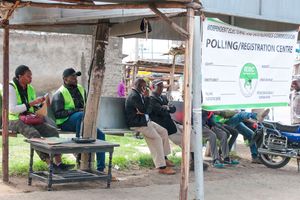
Independent Electoral and Boundaries Commission (IEBC) officials register new voters at CDN offices in Nakuru on April 28, 2026.
Photo credit: Boniface Mwangi| Nation Media Group
Half a million in six days
In just one week, between April 17 and April 23, the IEBC added 505,344 new voters, pushing total registrations to 1,876,274, a figure expected to surge to the 2.5 million target after the exercise closes.
Alongside this, 159,410 voters transferred their registration, while 2,817 updated their particulars—pointing to a highly active and engaged electorate.
A look at the county-by-county breakdown reveals a deepening trend, with Kenya’s urban and peri-urban centres driving voter growth.
Nairobi leads by a wide margin, registering 209,965 new voters—more than double any other county.
It is followed by Kiambu (97,557), Nakuru (81,166) and Kakamega (80,711), forming a cluster of high-density political battlegrounds, figures that are expected to increase when IEBC delivers its last update.
Other fast-growing counties include Machakos (65,616), Bungoma (62,203), Meru (56,486) and Kilifi (54,171), each reflecting a mix of population growth, urbanisation and political competitiveness.
At the lower end, Lamu (8,345) and Isiolo (9,291) recorded the least new registrations.
These figures reinforce projections that by 2027, Nairobi could surpass 3.1 million voters, while Kiambu (1.63 million), Nakuru (1.35 million) and Kakamega (1.08 million) will each cross the one-million mark.
Together, these four counties alone could account for more than seven million voters—effectively forming a decisive electoral core.
For political strategists, this “mega-county” phenomenon is rapidly redefining the path to State House.
Victory will increasingly depend on performance in these populous, competitive regions rather than dominance in traditional ethnic strongholds.
Beyond the top four, a second tier of counties is emerging as critical swing zones.
Machakos (65,616 new voters), Kajiado (44,615), Uasin Gishu (43,745), Nandi (42,334), Kericho (42,315) and Mombasa (41,444) are all registering significant growth, positioning themselves as battlegrounds where small shifts in voter preference could have outsized national impact.
In Western Kenya, Bungoma (62,203), Kakamega (80,711), Busia (30,350) and Vihiga (20,787) underline the region’s rising numerical weight.
Meanwhile, in Nyanza, counties such as Kisii (50,551), Homa Bay (39,770), Kisumu (37,090), Migori (37,004) and Siaya (33,295) reflect steady growth, even as the region enters a period of political transition.
Kenyans queue to register as voters at the Independent Electoral and Boundaries Commission (IEBC) CDN offices in Nakuru City on April 28, 2026.
Photo credit: Boniface Mwangi| Nation Media Group
At the Coast, Kilifi (54,171), Mombasa (41,444) and Kwale (24,394) point to moderate but strategic growth, while northern counties such as Garissa (20,954), Wajir (17,930) and Mandera (14,946) continue to play a crucial role in meeting constitutional thresholds.
This demographic is widely viewed as less anchored in ethnic voting patterns and more responsive to issues such as the cost of living, unemployment, taxation and governance.
Analysts argue that this could mark a gradual shift from identity-based politics to issue-driven campaigns—forcing candidates to rethink strategy, messaging and coalition-building.
Prof Gitile Naituli of the Multimedia University of Kenya argues that, “the influx of new voters, particularly young Kenyans registering for the first time adds an unpredictable dimension to the 2027 presidential race.”
“These voters are less bound by historical loyalties and more responsive to contemporary issues, making them a key target for all candidates,” he says.
The turnout reflects a broad national response, according to IEBC.
Independent Electoral and Boundaries Commission clerks register voters at Eldoret National Polytechnic in Eldoret City, Uasin Gishu County, on March 30, 2026.
Photo credit: Jared Nyataya | Nation Media Group
Notably, the Commission has also highlighted the participation of elderly citizens—some over 80 years old—alongside a wave of young, first-time voters.
“This convergence of generations underscores a wider democratic impulse and a recognition across age groups that the 2027 election will be consequential,” says Mr Dismas Mokua.
So far, at least 159,410 voter transfers have been recorded during the exercise that ended yesterday, providing another critical insight.
From Nairobi (29,223 transfers) to Kiambu (11,474) and Kisii (8,860), large numbers of voters are relocating their registration to align with where they live and work.
This trend is particularly pronounced in urban corridors, where economic migration is reshaping population patterns.
The trend suggests that urban centres will not only expand in population but also gain greater political clout.
For President Ruto, analysts say, the expanding voter base presents a double-edged sword.
President William Ruto.
Photo credit: PCS
To them, it offers the president an opportunity to consolidate support through development-focused politics, particularly in rapidly growing counties.
But they also warn that it introduces unpredictability, especially among younger voters who are less tied to historical loyalties.
Pro and cons for the Opposition
For the opposition, they argue, the numbers present a clear opportunity—but also a challenge.
While a large pool of new and potentially unaligned voters exists, fragmentation could dilute their advantage, particularly in competitive counties.
The absence of Raila as a dominant candidate further complicates the equation, especially in traditional strongholds such as Nyanza, where political loyalties may change, especially at a time when the ODM party faces two major factions – Linda Ground led by Dr Oburu Oginga and Edwin Sifuna’s Linda Mwananchi group.
ODM party leader Dr Oburu Oginga (left) and party secretary-general Edwin Sifuna.
Photo credit: Dennis Onsongo and Billy Ogada | Nation Media Group
Even as the numbers grow, attention is now shifting to the integrity of the Register of Voters.
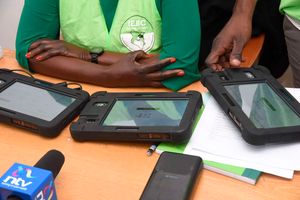
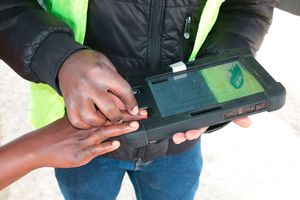
The IEBC had outlined a rigorous, multi-stage process involving biometric data capture, deduplication, validation and public verification.
The register was to undergo a 30-day public scrutiny period, followed by an independent audit before final certification and publication in the Kenya Gazette.
These processes are designed to ensure accuracy, transparency and public confidence—critical factors in a country where electoral disputes have often hinged on the credibility of the voter roll.
Ultimately, while the ECVR exercise provided a snapshot of Kenya’s evolving voter landscape, it is only the first step in the electoral process.
Political strategists, however, maintain that registration does not automatically translate into turnout. Nor do numbers alone determine outcomes.
Campaign strategies, coalition dynamics, candidate appeal, and voter mobilisation will all play decisive roles in shaping the final result.
However, as data from IEBC indicates, the 2027 election will be fought on a significantly expanded and reconfigured electoral map.
The IEBC projects that it will need at least 6.3 million new voters to reach its target of 28.5 million registered voters by 2027.
The rise of mega counties, the surge in youth voters, and the growing influence of urban centres are collectively redefining Kenya’s political battlegrounds.
For the commission, the task ahead is to convert these gains into a credible and trusted register.
“For political actors, it is to interpret the data and craft strategies that resonate with a changing electorate, while for the voters, the significance goes beyond statistics, but participation, representation and the power to shape the country’s future,” says advocate Chris Omore.