Months after embracing each other at Kabarak and promising to work together in President William Ruto’s broad-based government, the country’s two most prominent Rift Valley political figures are once again locked in open political warfare.
The dramatic collapse of the Ruto-Gideon Moi rapprochement has reopened a rivalry that stretches back more than two decades, exposing a deeper contest over political legitimacy, succession and the unfinished battle for Daniel arap Moi’s legacy.
Political analysts say the renewed fallout is a story of mentorship and inheritance, loyalty and ambition, and the unresolved question of who truly inherited Moi’s political kingdom.
For much of his political life, Dr Ruto’s journey was inseparable from that of the Moi family. The late President Moi spotted his talent, nurtured his rise and opened doors that transformed an obscure university activist into one of Kanu’s brightest young leaders.
Gideon, on the other hand, grew up at the centre of power as the son of Kenya’s second President and was widely viewed as the natural custodian of the family’s political legacy and Kanu’s dominance in the Rift Valley.
For years, the two men occupied different spaces within the same political orbit. One derived legitimacy from personal struggle and political organisation; the other carried the weight of a surname, history and family legacy.
Their latest fallout has revived a question that has lingered since Moi left office in 2002: Who truly inherited the former president’s political kingdom?
Long before Dr Ruto occupied State House, he was an ambitious student leader at the University of Nairobi during the final years of one-party rule.
His defining political breakthrough came in 1992 when he joined Youth for Kanu ‘92 (YK’92), the influential mobilisation outfit established to campaign for President Moi’s re-election during Kenya’s first multiparty elections.
Led by the late Nicholas Biwott and Cyrus Jirongo, YK’92 assembled an energetic generation of young politicians who would later dominate Kenya’s political landscape. Among them was a little-known activist from Uasin Gishu.
Dr Ruto distinguished himself through discipline, organisational ability and exceptional grassroots mobilisation skills.
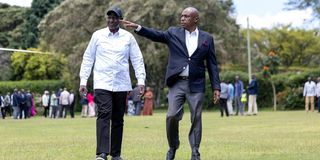
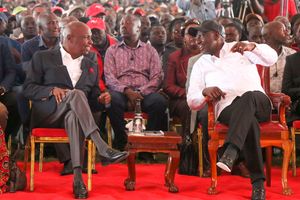
President William Ruto at Kanu Chairman Gideon Moi's Kabarak home on October 10, 2025.
Photo credit: PCS
Unlike many youthful politicians who relied on flamboyance, Dr Ruto built his reputation through relentless political organisation and loyalty to the ruling party.
In 1997, when Dr Ruto sought the Kanu nomination for the Eldoret North parliamentary seat, influential figures within the party wanted him to step aside for Reuben Chesire.
Many expected the young politician to be punished for defying senior party figures. Instead, Moi allowed him to contest, and he won.
At only 30 years old, Dr Ruto entered Parliament and immediately established himself as one of Kanu’s fastest-rising politicians.
It marked the beginning of a political ascent that would eventually take him to the Deputy Presidency and later to the Presidency.
As Dr Ruto’s star rose, another succession story was quietly unfolding inside State House and later at Kabarak.
Unlike Dr Ruto, Gideon did not fight his way into politics.
Daniel Moi kept his youngest son away from frontline politics until what many observers considered the right moment.
Gideon successfully contested the Baringo Central parliamentary seat, effectively succeeding his father in the constituency that had anchored the Moi political dynasty for decades.
His election immediately fuelled speculation that Daniel Moi was preparing him to safeguard the family’s political legacy after retirement.
The expectations were immense after 24 years of Moi’s rule and nearly four decades of Kanu dominance. Protecting that legacy meant retaining influence over the Rift Valley political base.
Yet by the time Gideon formally entered politics, another Kalenjin politician had already emerged as the region’s fastest-rising star: William Ruto.
Ironically, Dr Ruto’s loyalty to Daniel Moi during Kanu’s most difficult period strengthened his own claim to the political machinery the former President had painstakingly built.
As President Moi prepared to retire in 2002 after serving the constitutional term limit, he stunned many within Kanu by endorsing the relatively inexperienced Uhuru Kenyatta as his preferred successor.
Senior figures, including Raila Odinga, George Saitoti, Kalonzo Musyoka and Joseph Kamotho, abandoned Kanu to form the National Rainbow Coalition.
Although he harboured significant political ambitions of his own, he campaigned vigorously for Uhuru Kenyatta.
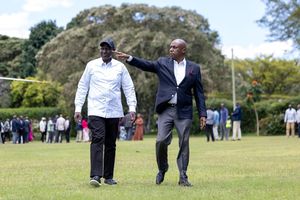
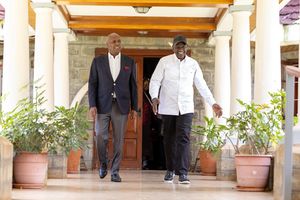
President William Ruto and KANU Party Leader Gideon Moi after a meeting at State House, Nairobi.
Photo credit: PCS
While nationally the Moi establishment suffered a devastating defeat, regionally, Dr Ruto’s loyalty enhanced his standing.
Many within the Rift Valley increasingly viewed him as the politician who had remained faithful when others deserted the party.
For nearly five years after Kanu’s defeat, Dr Ruto and Gideon coexisted without open confrontation.
Yet beneath the surface lingered a defining question: Who was Daniel Moi’s true political successor?
In the 2007 election, Dr Ruto aligned himself with Raila Odinga and ODM, while Gideon supported President Mwai Kibaki.
Although they occupied opposing political camps, their rivalry had not yet become personal.
Dr Ruto’s alliance with Uhuru Kenyatta transformed him into the Deputy President and firmly established him as the Rift Valley’s dominant political figure.
Gideon, meanwhile, embarked on rebuilding Kanu as an independent force capable of reclaiming the influence it once enjoyed.
The rivalry evolved into a contest between two ideas of political legitimacy: Dr Ruto’s belief in electoral mobilisation and Gideon’s claim to family legacy and Kanu symbolism.
By 2017, most elected leaders across the region had aligned themselves with Jubilee. Kanu steadily lost ground.
Instead, he intensified efforts to revive the former ruling party while presenting himself as an alternative centre of Kalenjin politics.
Relations deteriorated further in 2018 after Dr Ruto’s planned visit to the ailing Daniel Moi at Kabarak ended without the Deputy President seeing his former mentor.
Whether the decision reflected Moi’s wishes or those of his family mattered less than its symbolism.
Like in 2007, the two most prominent political figures from the Rift Valley openly backed opposing presidential candidates.
Dr Ruto led the Kenya Kwanza coalition. Gideon chose to support Raila Odinga and Azimio la Umoja. His decision surprised many within the region.
Rather than rally behind a fellow Kalenjin candidate seeking the Presidency, Gideon aligned himself with the opposition.
To his supporters, it reflected principle and political conviction. To Ruto’s allies, it amounted to abandoning regional solidarity.
The election produced a decisive political verdict. Dr Ruto won the presidency, and Gideon lost his Baringo Senate seat to UDA’s William Cheptumo.
Kanu suffered another painful electoral setback. For the first time since Daniel Moi retired, the Moi family no longer exercised decisive political influence over the Rift Valley.
Power had unmistakably shifted from Kabarak to State House. Yet politics rarely produces permanent enemies.
By 2025, President Ruto had embarked on building what he termed a broad-based government.
Following his cooperation agreement with Raila Odinga, attention shifted to another symbolic political prize — Kanu.
In September 2025, Gideon unexpectedly withdrew from the Baringo Senate by-election after meeting President Ruto.
Dr Ruto welcomed Gideon and senior Kanu officials to State House, and the reconciliation reached its symbolic peak on October 10 when the President travelled to Kabarak.
Standing beside Gideon, Dr Ruto spoke of unity rather than rivalry.
“This is not about individuals or regions. It is about Kenya. I need more hands, and that is why I formed the broad-based government. Now I need Gideon to help me move the country forward.”
Behind the public gestures, however, negotiations were considerably more complex.
Kanu insiders, who spoke in confidence, say the understanding extended beyond Gideon’s withdrawal from the Baringo race in October 2025. Some in Kanu say they expected appointments and the settlement of outstanding payments involving companies linked to the Moi family.
Analysts say that for Dr Ruto, the arrangement promised to eliminate the last significant centre of political resistance within the Rift Valley, while for Gideon it offered Kanu a pathway back to national relevance after years in political isolation.
Months passed without the anticipated appointments, and frustration steadily grew inside Kanu.
Officials who had defended Gideon’s withdrawal from the Baringo contest began questioning whether the party had sacrificed too much.
President Ruto accused Gideon of political blackmail and of using media outlets associated with his family to wage propaganda against the government.
Kanu hit back. Secretary-General George Wainaina accused the President of failing to honour commitments made during the negotiations.
“Whatever we agreed on, nothing happened. There was no goodwill from their side. They never fulfilled their part of the bargain,” Mr Wainaina told Sunday Nation.
For many within Kanu, the collapse confirmed a painful lesson.
Political goodwill, without formal agreements, rarely survives changing political interests.
Political analysts argue that the renewed confrontation extends beyond personal differences. It reflects competing claims to political legitimacy.
Dr Ruto draws legitimacy from electoral victories, grassroots mobilisation and personal political achievement.
Ironically, both careers were shaped by Daniel arap Moi.
“Without Moi’s mentorship, Ruto’s political rise might have taken a different path, and without Moi’s legacy, Gideon would never have become Kanu’s undisputed leader. The same man created both political careers,” says advocate Chris Omore.
Multimedia University professor Gitile Naituli believes the latest exchanges should be viewed as the opening phase of the 2027 contest rather than an isolated quarrel.
“What we are witnessing is the early shaping of the 2027 political battlefield. Every public statement, every confrontation and every alliance should be viewed through that lens. The campaign has effectively begun.”
As Kenya edges closer to another General Election, few observers expect the Ruto-Gideon relationship to recover.
Gideon, meanwhile, appears increasingly inclined to reconnect with opposition politics following the apparent collapse of the broad-based arrangement.
Whether Kanu can once again become politically consequential remains uncertain. Its electoral strength has diminished, but the Moi name continues to command historical significance, particularly among older generations who associate it with the region’s political identity.
The rivalry has entered a decisive new chapter, becoming a struggle over memory, inheritance and the future of Rift Valley politics ahead of the 2027 General Election.
More than twenty years after Daniel arap Moi left State House, the battle over his political inheritance remains unresolved. The protégé and the son are once again on opposite sides. And as the country slowly moves towards another election cycle, the question that has haunted Kenyan politics since 2002 remains alive: who, in the end, truly inherited Moi’s kingdom?