Nairobi Senator Edwin Sifuna’s Linda Mwananchi Movement has finally secured the green light to reserve its preferred political name, but the legal breakthrough has opened a fresh set of political and organisational questions that appear to have complicated plans for the unveiling of the party.
The Office of the Registrar of Political Parties on Thursday approved the reservation of the name Linda Mwananchi Movement (LMM) for 90 days, following an order by the Political Parties Disputes Tribunal directing it to reconsider the application.
The development came just two days before the movement had been expected to launch its political vehicle, with Saturday, October 3, having previously been touted by its leaders as the date for unveiling the party. Reports that consultations were still ongoing suggested that the launch would not proceed as initially planned.
Vihiga Senator Godfrey Osotsi, one of the movement’s senior officials, told the Daily Nation: “You will be informed at an appropriate time,” when asked about the Saturday launch.
The delay points to a bigger problem facing Mr Sifuna and his allies on how to accommodate the interests of other principals who have since acquired other political outfits but insist they are still under the movement.
Mr Sifuna and Linda Mwananchi spokesperson Caroli Omondi did not respond to the Daily Nation’s enquiries on when the party will be launched.
Mr Omondi had promised to respond to the queries but had not done so by the time of going to press, despite repeated attempts by Nation to reach him.
“I’m attending a committee meeting currently, but I will call you for a comment,” Mr Omondi told Nation.
The first lingering question, however, is whether Mr Sifuna should proceed with Linda Mwananchi as a completely new political party or adopt one of the existing parties that have been offered to the movement.
For months, the senator’s allies explored existing political parties as possible vehicles after the Registrar initially blocked the Linda Mwananchi name.
One of the options was the United Democratic Party (UDP), the party formerly associated with the late Cyrus Jirongo and in which Trans Nzoia Governor George Natembeya has interests.
But the attempt has encountered objections from officials who have questioned changes to its leadership and reported plans to transform it into a vehicle for Mr Sifuna.
Two objections were lodged with the Registrar on September 28, with officials disputing the reported appointment of an interim leader and questioning the succession arrangements following Mr Jirongo’s death.
That option has therefore become politically and legally complicated, especially after the Political Parties Disputes Tribunal temporarily barred the party from unveiling a new party leader or presidential flag bearer.
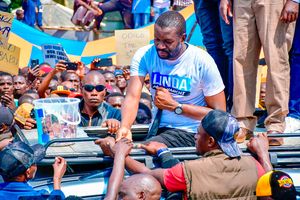
Nairobi Senator Edwin Sifuna addresses a Linda Mwananchi Movement political rally at Jacaranda Grounds in Nairobi on Sunday, September 13, 2026.
Photo credit: Dennis Onsongo | Nation Media Group
“Now that LMM has received a 90-day reservation, Sifuna must decide whether to abandon the existing-party route and invest fully in creating a new organisation,” says advocate Chris Omore.
However, another elephant in the room, Mr Omore argues, is what happens to the other parties associated with members of the movement if LMM becomes the main political vehicle.
Embakasi East MP Babu Owino has The Mwananchi Party, while Saboti MP Caleb Amisi has launched the People’s Renaissance Movement. Kakamega Senator Boni Khalwale has secured the United Patriotic Movement (UPM), which has also received full registration.
Siaya Governor James Orengo has now taken control of the Liberal Democratic Party, the political vehicle historically associated with the late Raila Odinga.
“If LMM becomes Mr Sifuna’s presidential vehicle, the principals must determine whether their individual parties will become coalition partners, remain independent platforms or eventually be folded into a common arrangement,” says political analyst Geoffrey Mboya.
Under the Political Parties Act, registration has two stages: provisional and full registration. The Office of the Registrar of Political Parties says a provisional application must include, among other things, founding minutes, a constitution, the party’s name, symbol and slogan, its ideology and evidence of membership recruitment.
A party must recruit at least 1,000 registered voters from each of more than half of Kenya’s counties, with the membership reflecting regional and ethnic diversity, gender balance and representation of special-interest groups. Its governing body must meet similar diversity requirements, while the party must establish offices in more than half of the counties.
That makes the decision to go full hog with LMM considerably more demanding than simply launching a party at a political rally.
“The approval itself creates another dilemma — time. The Registrar has reserved the Linda Mwananchi name for 90 days and the movement must therefore use the window to move from a reserved name to an actual political organisation,” adds Mr Mboya.
“At the same time, the political calendar is already tightening. IEBC says that parties have until October 15 to submit the names and specimen signatures of authorised officials, making the party question particularly urgent for Sifuna and his allies,” he argues.
Mr Charles Wanyonyi has claimed that his February 24 application for the Linda Mwananchi Party of Kenya predates the June application associated with Mr Sifuna.
He has asked the Registrar to give priority to his application, even though the fresh dispute was not directly determined by the tribunal case that cleared the way for the Sifuna-linked application.
This means that while the Registrar has now approved the reservation for LMM, the broader contest around the political identity remains an issue that the movement must navigate.
The Linda Mwananchi Movement recently endorsed Mr Sifuna as its presidential candidate after a retreat attended by several senior figures.
Siaya Governor James Orengo during a Sunday service at St Stephens ACK Cathedral in Kisumu on July 12, 2026.
Photo credit: Alex Odhiambo | Nation Media Group
But Mr Orengo, who had also expressed interest in the presidential ticket, was absent from the meeting. His subsequent move to take control of LDP has complicated the picture further.
LDP carries considerable historical significance because it was previously associated with Raila Odinga and played a prominent role in the opposition coalition that helped defeat Kanu in 2002.
“Orengo’s decision to revive the party as his own political vehicle means the movement now has to reconcile his individual platform with its collective political project,” says Mr Dismas Mokua.
The emergence of multiple political vehicles has raised questions about the future structure of Linda Mwananchi.
The movement has spent months presenting itself as a broad political formation bringing together leaders from different regions.
But the emergence of individual parties gives its principals independent bargaining platforms ahead of 2027.
Kisii Senator Richard Onyonka has attributed the development to what he described as “deep mistrust” among the principals.
“Because Kenyan politics is built on deep mistrust, all the principals have gone ahead and registered their own political parties. Our politics has no ideology,” Mr Onyonka said.
He also alleged that some politicians were motivated by the prospect of personal wealth and political power, although that remains his interpretation of their motives.
“I want to give my vow before you that Linda Mwananchi is going to transition into a political party. We know the election timelines and I want to tell you we are not going to let you down,” he said.
His decision to take control of LDP does not necessarily mean he has abandoned the movement, but it raises the question of whether LLM will become the movement’s single party or operate alongside other parties.
The movement has also contemplated a broader coalition in which individual parties retain their identities while working under the Linda Mwananchi banner.
That model would allow politicians such as Mr Orengo, Mr Owino, Mr Amisi and Dr Khalwale to retain their parties while supporting a common presidential project.
But it also creates another layer of negotiations over nominations, leadership, parliamentary seats and the eventual presidential ticket.
Perhaps the biggest dilemma is that Mr Sifuna’s allies have been announcing political plans faster than the senator himself has disclosed his final vehicle.
Nairobi Senator Edwin Sifuna addresses a Linda Mwananchi rally at Shianda in Mumias on August 9, 2026.
Photo credit: Alex Odhiambo | Nation Media Group
Mr Natembeya and Mr Osotsi have previously said the movement’s decision was for Mr Sifuna to pursue the presidency, while Mr Osotsi has announced plans for a major political gathering in Kakamega later this year.
Other insiders have also maintained that the senator himself will announce the political vehicle he intends to use.
That leaves the movement with a delicate balancing act as it now has the legal opening to build LMM, but it must decide whether the party will be the umbrella for the entire movement, Mr Sifuna’s personal presidential vehicle or one component of a wider coalition of parties.
The Tribunal ruling removed one obstacle by setting aside the Registrar’s earlier refusal, after finding that the previous Linda reservation had lapsed. The Registrar’s subsequent approval has now secured the name for 90 days.
But analysts have warned that the political decisions that follow may prove more complicated than the legal battle that preceded them.
For Mr Sifuna, they say, the immediate question is no longer simply whether Linda Mwananchi can become a party but which party structure can hold together a movement whose principals are increasingly building political vehicles of their own.