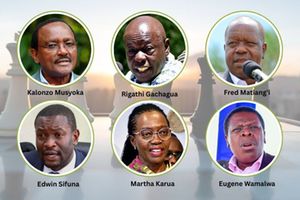
When four key ODM officials relinquished their positions to take up Cabinet slots in the broad-based government in 2024, then ODM Secretary-General Edwin Sifuna believed he had found a way out of an increasingly uncomfortable job.
The party was preparing to fill positions left vacant by the departure of two deputy party leaders - Hassan Joho and Wycliffe Oparanya - as well as National Chairperson John Mbadi and Opiyo Wandayi, who had joined the Cabinet. The Nairobi senator saw an opportunity to relinquish his position as secretary-general and take up one of the deputy party leader slots.
But Raila Odinga, who was presiding over the meeting, had other ideas.
“Not you, Edwin. Sit down,” Mr Sifuna recalls Raila telling him when he rose to leave the room, as the late ODM leader had requested all aspirants to do before the discussion began. The remark drew laughter from the other leaders in the room.
Nairobi Senator and The Equitable Party (TEP) leader Edwin Sifuna during a joint media engagement at Four Points By Sheraton Nairobi Hurlingham on October 9, 2026.
Photo credit: Evans Habil | Nation
The intervention, Mr Sifuna says, ended his attempt to use the recruitment process to escape a job that had become increasingly difficult as ODM navigated its relationship with President William Ruto’s administration.
In a revealing account of his relationship with his former boss, Mr Sifuna says he had reached a point where he wanted to stop being the person required to defend the party’s decisions in public, particularly when he believed those decisions risked compromising its political identity.
The encounter, which he places at a meeting in Upper Hill in August 2024, offers a glimpse into the relationship between the two men before Raila’s death and the subsequent rupture between Mr Sifuna and sections of the ODM leadership.
It also provides his response to claims that his relationship with Raila had deteriorated in the final months of the former Prime Minister’s life.
Mr Sifuna says that, contrary to accounts suggesting Raila wanted him removed, the former Prime Minister had expressly rejected his request to leave the secretary-general’s office and assured him that he remained free to criticise the government.
The senator recounted during a media roundtable on Friday that the meeting had been convened to discuss filling positions left vacant by officials who had joined the government.
As the discussion turned to potential candidates, Raila asked those interested in the positions to leave the room.
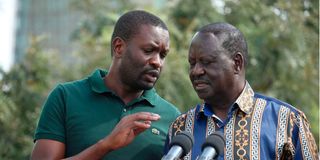
From left: Then-ODM Secretary-General Edwin Sifuna, ODM leader the late Raila Odinga and Siaya Senator James Orengo.
Photo credit: File
“And everybody in the room just burst out laughing,” he recalled.
Mr Sifuna said he attempted to persuade Raila to let him go, joking that the former Prime Minister had received his papers first. But Raila refused.
Instead, according to Mr Sifuna, the veteran politician explained that the secretary-general’s position was more important than the vacancies being discussed.
“He gave a story there about how the SG is the heart of the party. You know, these positions here, really, they cannot compare to this,” Mr Sifuna recalled.
The exchange was light-hearted, but it exposed a serious dilemma for the senator. As secretary-general, he was responsible for communicating the party’s position, even when he was uncomfortable with the direction it was taking.
“The heart is very emotional,” he recalled telling his boss.
He warned that he would continue to cause friction because he intended to speak truth to power and call out the government whenever he believed it was acting wrongly.
“I want to continue to speak truth to power. I want to be able to call out this government when they do wrong. And I can see I’m causing unnecessary friction within the party,” he said he told Raila.
Nairobi Senator and The Equitable Party (TEP) leader Edwin Sifuna during a joint media engagement at Four Points By Sheraton Nairobi Hurlingham on October 9, 2026.
Photo credit: Evans Habil | Nation Media Group
His proposed solution was to leave the secretary-general’s position and take up one of the deputy party leader roles, allowing someone else to manage the increasingly difficult task of explaining ODM’s political choices.
“He refused. And he said expressly, ‘Sifuna, nobody has told you not to say anything. You proceed,’” Mr Sifuna recalled.
The account is significant because it places the disagreement over ODM’s cooperation with the Kenya Kwanza administration within the context of an earlier decision by Raila to retain a secretary-general whose public statements sometimes generated controversy within the party.
The late Raila Odinga (left) with Mr Edwin Sifuna during the ODM National Governing Council meeting in Nairobi on March 1, 2019.
Photo credit: File | Nation Media Group
It also offers a window into the relationship that Mr Sifuna says allowed him to survive repeated attempts by colleagues to have him removed.
The senator has repeatedly rejected suggestions that he and Raila were estranged before the former Prime Minister died in October 2025.
He argues that if Raila had wanted him out, the decision would not have taken months to implement.
“If I had a disagreement with Raila, he would not have waited to oust me,” Mr Sifuna said in the interview.
He also disputed claims that a television interview in which he questioned the direction of the party’s cooperation with the government had been the final straw in their relationship.
Mr Sifuna said that if Raila had lost confidence in him, he would not have survived subsequent meetings in which his conduct and statements were challenged.
Nairobi Senator and The Equitable Party (TEP) leader Edwin Sifuna during a joint media engagement at Four Points By Sheraton Nairobi Hurlingham on October 9, 2026.
Photo credit: Evans Habil | Nation Media Group
One such meeting, he recalled, became particularly tense as leaders questioned him over his public comments about the memorandum of understanding between ODM and the ruling United Democratic Alliance (UDA).
At one point, Mr Sifuna said, Raila asked him whether he wanted to attend to his responsibilities at the meeting.
The former Prime Minister also directed the party secretariat to print copies of the memorandum so that the leaders could read the document for themselves.
The discussion eventually led to proposals for a committee to oversee implementation of the agreement, Mr Sifuna said.
For him, the episode demonstrated that Raila was willing to allow disagreement within the party and insist that leaders examine the substance of the issues rather than treat criticism as an offence.
His account comes against the backdrop of a broader dispute over what Raila intended ODM’s relationship with President Ruto to achieve.
Mr Sifuna maintains that Raila’s decision to cooperate with the government was rooted in concerns about the preservation of democratic institutions and the loss of young lives during protests, rather than an unconditional commitment to support the President in the 2027 General Election.
He cited a statement issued after Raila contacted him and other party officials while in Dubai, expressing concern that ODM members were being approached to join the government without the party’s approval.
According to Mr Sifuna, the statement made clear that anyone who joined the government without ODM’s blessing did so in an individual capacity.
He argues that the arrangement was intended to give Kenyans an opportunity to remove President Ruto through the ballot in 2027, not to commit ODM to supporting his re-election.
Nairobi Senator Edwin Sifuna.
Photo credit: File | Nation Media Group
This position has, however, been contradicted by other ODM leaders, including Raila’s son, Raila Junior, who has insisted that his father intended to support the broad-based government to the end.
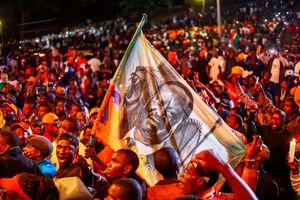
During Raila’s candle-lighting ceremony in Mombasa on Friday last week, Raila Junior appeared to draw a line between the family and political formations seeking to appropriate his father’s legacy.
“Today is the day to remember Baba Raila Amolo Odinga and as Raila Junior, I wish to reaffirm one point, the Party where Baba left us is ODM and broad based government where we belong and support president Ruto.”
“I know there are some people running around — here and there — but I wish to tell our youth that not all that glitters is gold.”
But Mr Sifuna insists that those seeking to explain Raila’s intentions should rely on statements he made publicly rather than attribute to him positions that cannot be independently established.
“It’s very wrong, and I say this during his life, to put words into a dead man’s mouth,” he said.
The Upper Hill meeting, in Mr Sifuna’s account, also helps explain why he continued to occupy the secretary-general’s office despite the growing strain associated with the job.
He says Raila understood the role as central to the party’s identity and was unwilling to let him abandon it simply because the political environment had become uncomfortable.
That confidence, however, did not mean Raila agreed with everything he said.
Mr Sifuna recalled another episode in 2021, when the party was preparing for the 2022 presidential election and Raila had not formally submitted his application to seek the ODM nomination.
The deadline was approaching, and only two aspirants had submitted their papers.
Mr Sifuna said governors and other party figures were pressing for clarity because their own political plans depended on knowing whether Raila would run.
During a meeting at Raila’s home, where the former Prime Minister was recovering after treatment for Covid-19, Mr Sifuna raised the matter.
He recalled Raila responding in a manner he understood as permission to proceed with the necessary announcement.
Mr Sifuna then contacted the party official responsible for political affairs, and the information was communicated to the media.
The following morning, however, Raila saw the reports and called him, demanding to know where he had heard that the former Prime Minister was submitting his papers to contest the 2022 presidential race.
Mr Sifuna said he was stunned because other leaders had been present when the discussion took place.
He recalled that Raila called several times as the disagreement continued, eventually instructing him to tell journalists that the announcement had been an April Fool’s prank.
“I then switched off my phone,” Mr Sifuna said, recalling the criticism that followed.
He said the episode left him convinced that Raila could be stern when he believed a mistake had been made, even as he continued to protect his secretary-general from pressure by other leaders.
The senator believes the incident illustrates the complexity of their relationship: a boss who could reprimand him sharply but was also prepared to stand by him when his position within the party was challenged.