In the history of Kenya’s political “moles”, Bruce McKenzie occupies an intriguing place. He sat in Jomo Kenyatta’s Cabinet while maintaining connections with British officials and, according to subsequent accounts, foreign intelligence services.
He supplied information to the British High Commission, represented settlers and British opinion, and was later alleged to have worked with MI6 and Israeli intelligence. Here was an independence minister whose relationships raised questions about where service to Kenya ended, and service to another power began.
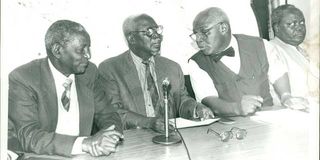
Former Cabinet minister Bruce McKenzie.
Yet historian Charles Hornsby offers an important qualification: McKenzie’s divided loyalties were known at Cabinet level, though High Commission correspondence has never established actions detrimental to Kenya.
As Kenya approaches the 2027 election, some politicians are being branded “moles” to discredit their independence, question their motives and deny them a legitimate place in the political conversation. The accusations often arrive before the evidence, and sometimes the supposed offence is simply refusing to follow a leader.
Kiharu MP Ndindi Nyoro when he announced that he had defected from UDA to the People's Party of Kenya at Safari Park Hotel, Nairobi on August 17, 2026.
Photo credit: Lucy Wanjiru | Nation Media Group
Rigathi Gachagua’s DCP allies have, for example, portrayed Ndindi Nyoro’s People’s Party of Kenya as a government project intended to divide the Mt Kenya vote. Nyoro has rejected the accusation of being Ruto’s ‘mole’. The description of emerging parties as “small wheelbarrows” turns political competition into supposed camouflage for UDA.
Nonetheless, Kenya has a history of actual infiltration, covert operations and divided loyalties. It is that history that has supplied contemporary politicians with something more convenient: a vocabulary through which disagreement can be recast as betrayal.
During the Mau Mau Emergency, infiltration became an organised weapon. Special Branch officer Ian Henderson helped direct pseudo-gangs that impersonated insurgents and penetrated resistance networks.
Former fighters and other recruits supplied the knowledge needed to establish contacts, identify supporters and locate those still in the forests. These operations gave betrayal a concrete and dangerous meaning. After independence, because of that history, Jaramogi Oginga Odinga deported Henderson , who left for Ian Smith’s Rhodesia (Zimbabwe) and Bahrain.
Independence inherited both the intelligence apparatus and the suspicion it had generated. The Cold War added further anxieties about foreign influence, ideological allegiance and concealed patrons. Kenya deported several Chinese and Russian spies, either disguised as diplomats, businessmen or teachers. Dr Njoroge Mungai, indeed, deported several of those who were associated with the Lumumba Institute, before it was closed.
Under Daniel arap Moi, Hezekiah Oyugi built a parallel network of informers and intelligence gatherers who reported directly to him. As Permanent Secretary for Provincial Administration in the Office of the President, he accumulated power through an apparatus that shadowed the official security services, giving him his own channels for monitoring political loyalties and suspected dissent. Former intelligence Chief Wilson Boinett describes this system as undermining the Special Branch and creating a rival intelligence operation.
It has also been reported by Lee Njiru, a long-time State House press officer, that intelligence chief James Kanyotu alleged that Wamatu Njoroge, a presidential service boss, was Attorney General Charles Njonjo’s mole inside State House and was working with G.G. Kariuki and Jeremiah Kiereini.
These allegations belong to an account of a bitter power struggle, and their significance lies in how claims of infiltration could connect presidential security to factional rivalry.
The attempted coup of August 1, 1982, intensified suspicion within Moi’s government. Yesterday’s trusted insiders became a security concern. For instance, Charles Njonjo, the former Attorney-General and Minister for Constitutional Affairs, became the most conspicuous example. In May 1983, Moi announced that an unnamed “traitor”, backed by a foreign power, was seeking to take over the presidency. The ensuing campaign identified Njonjo as that enemy within. By July, he had resigned from the Cabinet.
Former Attorney General Charles Njonjo.
Photo credit: Evans Habil | Nation Media Group
A judicial commission appointed to investigate allegations found that Njonjo had “conducted himself in a manner prejudicial to the Head of State, the image of the President and the constitutionally established Government.” The traitor saga ended the political careers of many politicians who were labelled traitors.
Outside State House, Special Branch recruited “moles” who infiltrated university classrooms and student organisations. During the repression associated with Mwakenya, lecturers and students had reason to wonder who might report their conversations. Political discussion could carry consequences far beyond the seminar room. Fear encouraged people to censor themselves before an officer needed to intervene. Student leader Wafula Buke was jailed for allegedly spying for Libya. Then chairman of the University of Nairobi students’ union, he was sentenced to five years’ imprisonment on November 30, 1987, after he was coerced into “pleading guilty” to providing information to the Libyan government. Buke’s arrest was due to infiltration of Special Branch moles at the University of Nairobi.
The return of multiparty politics in 1991 carried these suspicions into opposition organisations. Parties had legitimate reasons to fear government interference. But the accusation also offered an explanation for internal conflict that spared leaders from examining their own conduct: disagreement must have been planted by the enemy.
Martin Shikuku’s visit to State House in May 1992 supplied a memorable example. As FORD secretary-general, his meeting with Moi provoked accusations that he was a Kanu mole. His defence—that he had eaten ugali—gave the controversy a phrase that outlived the visit. A meal became shorthand for suspected political purchase.
When FORD subsequently split into Oginga Odinga’s FORD-Kenya and Kenneth Matiba’s FORD-Asili, suspicion helped supporters interpret the opposition’s collapse. But the split itself could not prove every accusation of infiltration. However, it has been established that Matiba’s return from London was choreographed, without his knowledge, by the Special Branch, to spark leadership rivalry and organisational disputes. It is not clear which “moles” were used to scatter the original FORD, leading to Moi’s victory.
The opposition soon faced fears of infiltration, while defections to the ruling party KANU became the most visible sign of Moi’s efforts to weaken rival political parties. Each departure raised questions about those who remained. Who was negotiating secretly with Kanu? Who was passing information to State House? Who would abandon the struggle when the right offer came?
It was in this atmosphere that “moles” became a powerful explanation for the opposition’s setbacks. A disputed decision, an unexplained meeting or a disagreement over strategy could invite accusations of serving Moi. Defections gave those suspicions credibility, even though crossing over did not, by itself, prove that a politician had been an infiltrator all along. The accusation also offered party leaders a convenient weapon against internal critics: an uncomfortable question could be dismissed as evidence of a hidden allegiance. Moi benefited from the resulting divisions. Even the fear of infiltration could accomplish some of the work of an actual infiltrator.
Wiper supplied another example in 2015. Kilome MP Regina Ndambuki and nominated MP Robert Mutemi were ejected from a retreat at Maanzoni Lodge amid accusations that they were Jubilee moles. Ndambuki said they had been accused of attending to record proceedings for Jubilee, and that Kalonzo Musyoka intervened to protect her.
Ababu Namwamba encountered the same language before resigning as ODM secretary-general in 2016. Edwin Sifuna was among those who branded him a Jubilee mole. That year, ODM elections board chair Judith Pareno also described vetting intended to separate loyal aspirants from “moles” and joyriders. Suspicion was becoming part of the machinery of belonging.
Jubilee reproduced the pattern. In 2018, MPs led by Rigathi Gachagua accused Nyeri Town MP Ngunjiri Wambugu of being an ODM mole. Wambugu denied it. The accusation placed him on the defensive over an allegiance his political rivals claimed to understand better than he did.
Former UDA Secretary-General Cleophas Malala.
Photo credit: File | Nation Media Group
In 2023, Kimilili MP Didmus Barasa demanded the removal of UDA acting secretary-general Cleophas Malala, accusing him of serving the interests of those opposed to the party and undermining Moses Wetang’ula and Musalia Mudavadi. A dispute about coalition leadership was presented as evidence of an opposition operation within the governing party.
It is the same logic that now shapes the contest within the opposition. Once someone is labelled a mole, colleagues are encouraged to treat every meeting, statement and disagreement as evidence of concealed allegiance. Denial offers little escape: it can itself be dismissed as part of the deception.