Tears flowed and tempers flared during a tense meeting of staff of the late ODM leader Raila Odinga, as a sweeping shake-up of his employees unfolded behind closed doors at the Capitol Hill office in Nairobi on Wednesday — five months after his death.
The emotionally charged meeting on Wednesday March 11 brought together long-serving aides and administrators who for years formed the backbone of Odinga’s political secretariat.
Many had served the veteran opposition chief through successive election cycles, political crises and shifting alliances that defined Kenya’s political history.
But what began as a routine staff briefing quickly turned into a painful reckoning as some employees were informed their services were no longer required.
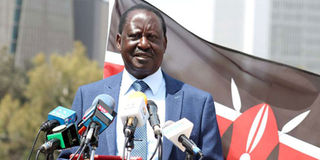
ODM leader Raila Odinga speaks after meeting the party’s Central Committee at Capitol Hill Square in Nairobi on April 3, 2024.
Photo credit: File| Nation Media Group
Among those asked to step aside was Odinga’s longtime driver Philip Juma, a familiar figure within the former Prime Minister’s political orbit who chauffeured him through some of Kenya’s most turbulent political seasons.
Staff who attended the Wednesday meeting described moments of visible anguish as the reality of the changes sank in.
The meeting had been convened through a memo dated March 5 by Raila’s chief of staff Andrew Mondo, a retired senior civil servant who previously served as a Permanent Secretary (PS).
Mr Mondoh served as the PS in the Ministry of State for Special Programmes in the 2008-2013 Grand Coalition Government, where he oversaw the resettlement of Internally Displaced Persons (IDPs).
He previously served as a District Commissioner (DC) in Kisumu and later worked as a Chief of Staff for Odinga during his tenure as premier.
The notice for the Wednesday meeting, copied to ODM Party Executive Director Oduor Ong’wen, summoned staff to Capitol Hill, indicating that the agenda would be “circulated at the meeting” and urging punctuality for the 10am session.
However, in a twist that stunned many inside the office, Mr Mondo himself was also caught up in the sweeping changes, effectively bringing an abrupt end to his role in the secretariat he had helped manage.
Reached by the Nation, Mr Mondo said he was unaware of the details surrounding the sackings.
“I have been unwell,” he said briefly in a phone interview.
The developments come at a time when the Orange Democratic Movement (ODM) is grappling with what insiders describe as its most serious internal crisis since the party was founded two decades ago.
The turmoil has been characterised by internal ideological warfare and rival mobilisation drives within the party, notably the “Linda Ground” and “Linda Mwananchi” campaigns, which have exposed deep divisions over the party’s political direction ahead of the 2027 General Election.
Party insiders warn that unless the differences are addressed quickly, they could snowball into a major political challenge for the party.
Even before resolving the simmering Linda Ground–Linda Mwananchi rivalry, the party has now opened another front — the restructuring of the late Odinga’s support staff network that operated from his office.
According to letters seen by the Nation, some employees were informed that their positions had become redundant following Mr Odinga’s death.
For years, Mr Odinga maintained an elaborate support system comprising several categories of staff.
Some were paid directly by ODM through the party payroll, others operated under the presidential retirement benefits package available to former prime ministers, while a third group was supported personally by Mr Odinga from his own resources.
This was confirmed by Mr Ong’wen, the ODM Party Executive Director.
However, the Executive Director dismissed claims of mass sackings, insisting that the number of affected staff was small and that the situation had been exaggerated.
“There are a lot of errors going around,” he told the Nation .
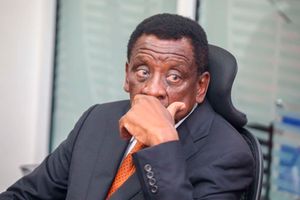
ODM Party Executive Director Oduor Ong’wen.
Photo credit: File
“Even at the ODM national secretariat we do not have 90 people. The number cannot even reach 20. People have not been sacked.”
Mr Ong’wen explained that Mr Odinga’s staff fell into three distinct categories — those seconded from the public service, those paid through the party payroll and those supported personally by Odinga.
Those seconded from government, he said, remain public servants and are awaiting redeployment.
Staff who were on the ODM payroll, he added, continue to receive their salaries.
According to Mr Ong’wen, only seven individuals are currently under review following Mr Odinga’s death.
“These seven, when the party leader passed on, we as a party have been supporting them but without any formal arrangement,” he said.
“We felt audit queries could arise because the party is usually audited. So we gave them some money and explained that the new party leader would open an office and some could be absorbed while others might be redeployed.”
“The seven affected staff range from chief of staff (Mr Mondoh) to office cleaners,” he said.
Beyond the formal structures, the veteran politician was also known to quietly support hundreds of individuals across the country on modest monthly stipends.
Many were elderly supporters, long-time political allies, friends of his late father Jaramogi Oginga Odinga, childhood associates or individuals in need of medical assistance.
Odinga’s generosity had touched countless lives, often quietly and far from the public eye, ODM politician Ben Ombima said, adding that many who once depended on the former premier’s personal support are now struggling.
Mr Ombima told the Nation that several of Mr Odinga’s friends from Vihiga County, whose medical bills he used to personally settle, are now languishing in pain following his death.
“Raila touched many families in ways people may never fully know,” Mr Ombima said. “Some of his friends, especially elderly ones whose medical expenses he quietly took care of, are now suffering in silence. Across villages in Kenya, some are slowly fading away because the person who stood by them is no longer there.”
The new restructuring at his former office, Capitol Hill Square in Nairobi, has since triggered uncertainty among those who depended on the system built around Odinga’s personal networks and political legacy.
Some of them were reportedly responsible for handling his philanthropic gestures across villages, something that has since been cut off.
The shake-up is unfolding against the backdrop of leadership changes within the party following the appointment of Odinga’s elder brother, Oburu Oginga, as the new party leader.
Dr Oginga has since established a new office at Riverside in Nairobi and appointed political activist Mike Agwanda as his chief of staff.
However, Mr Agwanda’s appointment has stirred unease within sections of the party, with some insiders describing him as an outsider unfamiliar with the structures that have long defined ODM’s political machinery.
Critics note that Mr Agwanda previously ran as an independent candidate and had been a vocal critic of ODM politics in parts of Nyanza, raising questions about how he will integrate into the party’s inner circles.
Party officials privately worry about how the new leadership team will function at a time when the party is approaching a critical political period.
Some ODM officials have also expressed concern about what they perceive as a lack of clear direction under the new leadership.
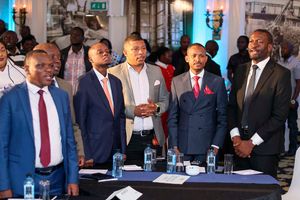
Linda Mwananchi movement members led by Nairobi Senator Edwin Sifuna(right), Embakasi East Constituency MP Babu Owino, political analyst Brian Weke and Kilimani Ward MCA Moses Nyangaresi during the Linda Mwananchi Forum in Nairobi on March 11, 2026.
Photo credit: Wilfred Nyangaresi | Nation Media Group
For instance, insiders say Dr Oginga on Tuesday opted not to read a prepared speech outlining the party’s position on a 10-point political agenda at the joint UDA-ODM Parliamentary Group meeting graced by President William Ruto, instead choosing to speak off the cuff.
“Your Excellency I said I’m no very good at reading speeches and therefore I will leave this speech here. I don’t know whether to give it to the president but I have spoken my heart and finished what I wanted to say. Thank you very much,” Dr Oginga said amid laughter.
The decision, according to some party insiders, left many leaders uncertain about the official messaging they should carry to grassroots supporters.
Others point to what they describe as a lack of structured programmes within the party, saying meetings are being held frequently but without clear outcomes or policy direction.
Meanwhile, questions have also emerged over attempts to introduce new administrative staff at Capitol Hill.
Odinga’s son Raila Junior is said to have introduced a new secretary and accountant to the office, although the existing accountant reportedly declined to hand over, arguing that he was a civil servant seconded by the government and was only waiting redeployment.
The dispute has further illustrated the complex administrative arrangements that governed Odinga’s office during his lifetime.
For many long-serving aides who gathered at Capitol Hill on Wednesday, the meeting was more than an administrative exercise.
It was a moment of painful transition — the dismantling of a system built over decades around one of Kenya’s most influential political figures.
And as some staff quietly packed their private belongings and left the compound, many could not escape the feeling that an era inside Raila Odinga’s political office was slowly drawing to a close.
Whereas some of Odinga’s security guards have been absorbed by Dr Oginga, head of the team, Maurice Ogeta had in January secured a new job as Mombasa county’s Adviser on Security Affairs.
Mombasa Governor Abdulswamad Nassir, also an ODM Party co-deputy leader gave him the job, noting that he was appointed “due to his extensive experience and years of dedicated service to the party’s founding leader.”
For nearly 18 years, Mr Ogeta, alongside Mr Juma – the driver, served as a bodyguard and driver, respectively, to the former ODM leader, accompanying him through some of the country’s most volatile political moments, including mass rallies, high-risk convoys, and periods of heightened political tension.
Mr Ogeta was with Odinga at his final moments at Kerala State in India last year where he died on October 15.