Major political parties are racing against time to meet the Independent Electoral and Boundaries Commission (IEBC) nomination requirements, or risk being locked out of the 2027 General Election.
The development follows the electoral agency's revelation that only 11 political parties complied with the applicable nomination requirements, leaving 94 others to amend their nomination rules.
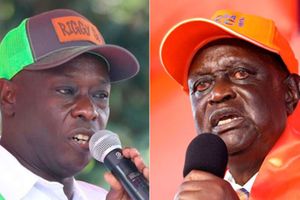
President William Ruto's United Democratic Alliance (UDA), the Orange Democratic Movement (ODM), former Deputy President Rigathi Gachagua's Democracy for the Citizens Party (DCP) and Senator Edwin Sifuna-led Linda Mwananchi Movement, formerly known as The Equitable Party, are among the major political outfits that need to make amendments to comply with the rules.
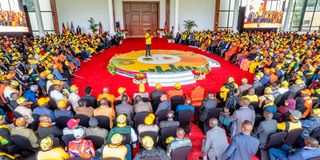
President William Ruto joins Nairobi UDA and ODM leaders and delegates in a dance when he hosted them at State House, Nairobi on November 13, 2026.
Photo credit: PCS
On the other hand, Kalonzo Musyoka's Wiper Patriotic Front, Jubilee Party and Embakasi East MP Babu Owino's The Mwananchi Party are among the 11 parties that met the requirements.
Other compliant parties include Kenya Moja Movement Party, Safina Party, Liberal Democratic Party, Grand Dream Development Party, Democratic National Alliance Party, Chama ya Mapatano of Kenya, Vision for Development Alliance and Forward Kenya Party.
On August 25, the IEBC announced key constitutional timelines for the 2027 elections, setting October 15, 2026 as the deadline for political parties to submit the names of their authorised persons and specimen signatures.
The parties were also required to have their nomination rules certified by the Registrar of Political Parties by October 30, 2026, before submitting them to the Commission by November 6, 2026.
However, following the first review of the nomination rules submitted by political parties for the 2027 General Election, 94 were flagged for non-compliance.
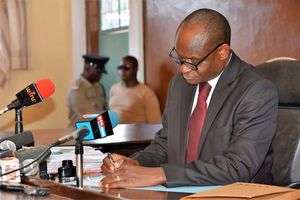
IEBC Chairperson Erastus Ethekon said the affected parties now have until December 7, 2026 to make the necessary amendments as the clock ticks towards the August 10 elections.
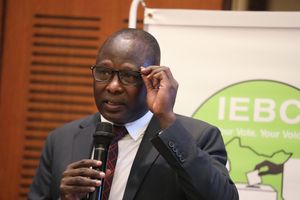
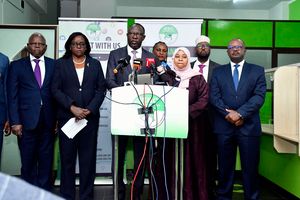
Independent Electoral and Boundaries Commission (IEBC) Chairperson Erastus Edung Ethekon address political reporters at Iconic Plaza on Tuesday, November 24, 2026, during an engagement to brief journalists on the commission's preparedness for the upcoming elections.
Photo credit: Dennis Onsongo | Nation
He said the review was intended to ensure that the nomination rules comply with the Constitution, the Elections Act and relevant regulations, providing for transparent, fair, inclusive and lawful nomination processes.
The assessment examined several areas, including the structure and mandate of party election boards, procedures for identifying and nominating candidates, eligibility requirements, the conduct of party nominations and the nomination of party lists.
The Commission also assessed mechanisms for ensuring compliance with the law, particularly provisions relating to the Electoral Code of Conduct and electoral malpractices, as well as internal party dispute resolution mechanisms.
"Following the first review of the nomination rules submitted by political parties for the 2027 General Election, the Commission found 11 political parties compliant with the applicable legal requirements, while 94 political parties were found to require amendments to their nomination rules," said Mr Ethekon.
The IEBC chairperson said the Commission had communicated the outcome of the review to the respective parties and outlined the specific areas requiring amendments.
He said the affected parties were expected to address the identified deficiencies and resubmit their amended nomination rules within the stipulated timelines.
"Non-compliant political parties will be required to rectify and resubmit their nomination rules to the Commission by December 7, 2026," he said.
However, Mr Ethekon clarified that being found non-compliant during the first review did not automatically mean a political party would be excluded from participating in the 2027 General Election.
He explained that the law provides for the review of nomination rules and requires the Commission to notify parties of any deficiencies identified, allowing them to make the necessary amendments.
"The Commission's approach is therefore intended to ensure that political parties are allowed to align their nomination rules with the applicable legal requirements while maintaining the integrity of the nomination process and adherence to the statutory timelines," he said.
Mr Ethekon urged the affected parties to promptly address the identified shortcomings and ensure their nomination rules are fully aligned with the law ahead of the commencement of party nomination activities.
Political parties have until March 16, 2027 to submit their membership lists to the Commission, alongside the names of candidates seeking to contest in their primaries, as well as the dates and venues of the exercises.
According to the IEBC, all party primaries must be concluded and any internal disputes resolved by May 8, 2027.
Party primaries have often proved contentious for major political outfits as they struggle to balance competing interests while maintaining their political bases.
For instance, ODM leader Oburu Oginga and his DCP counterpart, Mr Gachagua, are facing mounting nomination challenges as they come under pressure to guarantee credible exercises amid growing internal competition.
In Nyanza, ODM faces the delicate task of maintaining its dominance in the post-Raila Odinga era, with seasoned politicians jostling for key elective positions.
The party is also facing questions over proposals to zone the region for ODM amid growing competition from rival outfits, including the Movement for Democracy and Growth and former Cabinet Minister Eliud Owalo's People's Prosperity Party.
Similarly, Mr Gachagua is working to manage a growing political coalition in the Mt Kenya region under DCP, where politicians previously aligned with UDA have been trooping to his Wamunyoro political base to rebuild ties with the former Deputy President as the party positions itself as a major political force in the region.