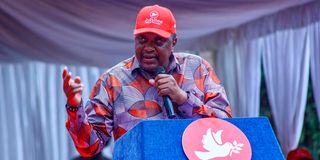
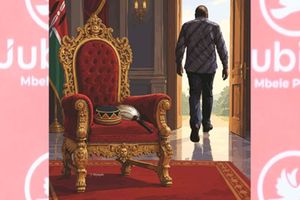
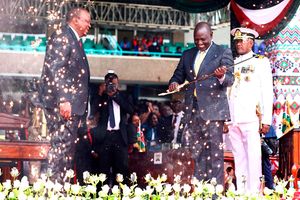
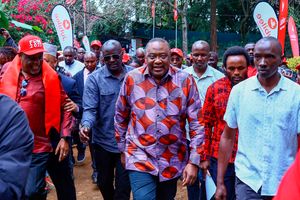
Retired President Uhuru Kenyatta has formally resigned as the Azimio La Umoja Coalition Council Chairman, paving the way for major leadership restructuring amid rebranding in readiness for the 2027 contest.
Mr Kenyatta resigned in a letter dated October 5, 2026. Azimio Coalition has since rebranded as The Ukombozi Alliance (TUA).
The Nation has since established an effort to entice Democracy for Citizens Party (DCP) leader Rigathi Gachagua to take up the position as part of the opposition’s coalition-building.
Mr Gachagua’s name and that of Siaya Governor James Orengo were reportedly floated during the coalition’s meeting on Wednesday, which was chaired by Wiper Patriotic Front leader Kalonzo Musyoka.
Siaya Governor James Orengo during a Sunday service at St Stephens ACK Cathedral in Kisumu on July 12, 2026.
Photo credit: Alex Odhiambo | Nation Media Group
“Consultations are ongoing about who takes up the role. We have largely agreed that it should be taken by either Mr Gachagua or Governor Orengo,” a top official, who attended the meeting, told the Nation . Mr Orengo is said to have agreed to take up the role. Mr Gachagua’s name came up after some of the officials mentioned his crucial role in the opposition politics.
The latest overtures to have Mr Gachagua sit at the top leadership of the coalition comes days after some of his allies said DCP would rather build its own political base before negotiating with other opposition parties. Nairobi Senator Edwin Sifuna’s Linda Mwananchi has also in the past rejected an invite to join the coalition.
At the heart of the resistance by both DCP and Linda Mwananchi to join the coalition is a clause in its deed of agreement that names the party leader as the automatic presidential candidate.
DCP Party leader Rigathi Gachagua addressing journalists in Nairobi on July 10, 2026.
Photo credit: Bonface Bogita | Nation Media Group
Mr Kenyatta named Mr Musyoka as the new leader of the coalition in February, replacing the late opposition leader Raila Odinga. Mr Odinga was the coalition’s party leader and presidential candidate in the 2022 race.
In his letter addressed to the coalition’s party leader and the National Steering Committee, Mr Kenyatta said he remains a committed member of the opposition coalition.
“Following the official handover of the Jubilee Party Leadership, I am writing to formally resign from my leadership position within the Azimio La Umoja Coalition, effective immediately,” said Mr Kenyatta.
Mr Kenyatta recently rolled out a major restructuring and rebranding of the coalition to take President William Ruto head-on in the 2027 presidential race. He has repeatedly rallied opposition leaders to present a united front going into the next year’s polls.
Former President Uhuru Kenyatta (right) interacts with former Interior Cabinet Secretary Fred Matiang’i during the handover of leadership of the Jubilee Party at the party headquarters in Nairobi on September 22, 2026, pending approval by the party’s National Delegates Convention.
Photo credit: Wilfred Nyangaresi | Nation Media Group
He is said to be pulling all the stops to have one presidential candidate to avoid a repeat of the mistake made by the opposition in the 1992 elections when they fielded multiple candidates that consequently handed then President Daniel Moi another win.
Beyond his role in rejuvenating the coalition, Mr Kenyatta has been a unifying factor for the opposition coalition. His deep pockets have also been crucial in the running of the two outfits.
Dr Ruto’s allies have repeatedly accused him of bankrolling the opposition to undermine his Kenya Kwanza administration, accusations that he has denied.
Mr Kenyatta recently led the coalition in making major leadership changes, including the admission of Jubilee Party leader Fred Matiang’i, Party of National Unity (PNU) leader Peter Munya and Devolution Empowerment Party (DEP) party leader Lenny Kivuti as new council members.
Mr Kenyatta had earlier named Mr Musyoka as the coalition’s party leader, replacing the late Prime Minister Raila Odinga, who ran for the presidency on the ticket.
Former President Uhuru Kenyatta and Wiper leader Kalonzo Musyoka during the burial ceremony of the late Mzee Mwalimu Jackson Karua, father of Martha Wangari Karua, at Mugumo Primary School grounds on Saturday, October 3.
Photo credit: Pool
Mr Kenyatta said his resignation is not a departure from the opposition’s shared political journey, but a ‘necessary step in the continuous renewal of the country’s democratic institutions.’
He said the coalition was formed in the run-up to the 2022 polls on the realization that the country’s diverse political voices must converge to protect democracy and drive national development.
“I remain, as always, a committed member of the Azimio family, ready to support the institution from the ranks, and always available to offer counsel when called upon,” he said.
In a statement, Mr Musyoka said the former Head of State had stood with the coalition when “defence of our democracy demanded courage.”
“He remains a committed member of the Azimio family, ready to support from the ranks and to offer counsel when called upon. We shall call on President Kenyatta for an official visit, during which the handover ceremony will take place,” said Mr Kalonzo.
In the grand scheme of things, Mr Musyoka and his strategies seek to rebrand Azimio to make the coalition more appealing to the youthful population, popularly known as Gen Z as well as new partners.
In their thinking, the team also believes that Raila’s supporters can easily identify with the coalition that sponsored him in the 2022 presidential race.
Mr Musyoka also sought to explain the leadership structure of the coalition, stating that the Party Leader and the Chair of Council are two distinct offices.
“The Chair of Council was the coalition's council-level position, one of counsel, convening and guidance, and it is the office President Kenyatta has now relinquished. The Party Leader is the political and executive head of the party.”
He also announced that the Office of the Registrar of Political Parties (ORPP) had reserved the name The Ukombozi Alliance (TUA) for purposes of rebranding.
The former Vice President said the coalition was in the process of completing the compliance requirements before a formal launch.
The coalition is pushing for a coalition model inspired by the National Rainbow Coalition (Narc) that swept Mwai Kibaki to power in 2002.
Under the new arrangement, parties would retain their identities while rallying behind a common presidential candidate and a shared coalition platform.
In 2002, Odinga’s Liberal Democratic Party joined Mr Kibaki’s National Alliance Kenya to form Narc, which fielded candidates in 205 of 210 constituencies and won 125 of them, with 62 per cent of the presidential vote.
Mr Kenyatta, in his resignation letter, assured partner parties that they would not lose their identity.
“In a coalition, political parties are like tributaries joining a great river. The tributaries do not lose their unique identity when they merge; rather, they combine their waters to form a current strong enough to shape the landscape.”
“My role in this leadership has been to help guide that confluence, to ensure our waters ran clear, and protect the riverbed from the erosion of internal division,” he said.
Retired President Uhuru Kenyatta.
Photo credit: File | Nation Media Group
Prof David Monda, a US-based political analyst, says that the maneuvers by Mr Kenyatta all depend on whether other opposition members agree to join the coalition and if they would accept Mr Musyoka as the presidential candidate.
“At a bare minimum, it is Uhuru's effort to bring some type of unified structure around Kenya's fractured opposition. It is becoming clear Kenyan's know who they will vote against. What is not clear is whom they will vote for.”
Prof Monda says rebranding Azimio makes sense because it elevates Kalonzo and forces peripheral opposition power brokers either to play ball or leave.