As Uhuru Kenyatta prepares to relinquish the leadership of the Jubilee Party, one question will inevitably arise: does his departure mark the end of the Kenyatta political dynasty, or merely its retreat from the formal structures of political power?
Unlike ODM, which survived the death of Raila Odinga with another member of the family, Oburu Oginga, assuming the party leadership, Jubilee has no obvious Kenyatta waiting in the wings. Uhuru’s exit therefore carries a significance that goes well beyond an ordinary leadership transition: for the first time in decades, the Kenyatta name is being separated from direct control of a political organisation.
For nearly a century, although not continuously, the Kenyatta name has been associated not simply with wealth, presidential power or national symbolism, but with the control of political organisations through which power was negotiated, distributed or retained.
Uhuru’s father, Jomo Kenyatta, rose through the Kikuyu Central Association, later took over the Kenya African Union and eventually became president of Kanu before independence.
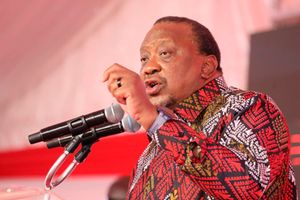
Jubilee Party leader and retired President Uhuru Kenyatta during a past Jubilee National Delegates Conference.
Photo credit: Lucy Wanjiru | Nation Media Group
Uhuru was brought into Kanu politics by President Daniel Moi, later took control of the independence party, built The National Alliance party and finally presided over Jubilee, the political vehicle that carried him through two presidential elections.
Now, the High Court has ruled that a retired president cannot continue holding office in a political party and that brings to an end a long tradition in which a member of the Kenyatta family stood at the head of a political organisation capable of nominating candidates, building alliances and bargaining for national power.
While the family will still possess its wealth, history, networks and famous name, it may no longer possess the political machinery through which those assets could be converted directly into electoral power. It is possible that that might be the real significance of Uhuru’s exit.
Uhuru may also have wanted to remain the political kingpin of Mt Kenya and to retain some command over the region’s succession politics. Without heading a political party, however, that ambition becomes much harder to sustain.
There is a reason for that: regional supremacy in Kenyan politics has rarely rested on name recognition alone but depends on the ability to control nominations, determine alliances, reward loyalists and provide aspiring MPs, governors and senators with a political vehicle. Whether Uhuru, once he relinquishes Jubilee, can still convene leaders, endorse candidates and influence opinion, remains to be seen.
Without that leverage, Uhuru risks becoming an elder whose blessing is sought rather than a regional commander whose decisions must be obeyed.
Yet there is an intriguing reversal taking place in Mt Kenya politics. Two politicians who stood firmly against him in the 2022 election, Rigathi Gachagua , now leader of the Democracy for Citizens Party, and Ndindi Nyoro, now leading the People’s Party of Kenya, have increasingly found themselves defending the former president against attacks from William Ruto .
Gachagua has rejected claims that Uhuru is financing the opposition, while Nyoro has publicly argued that the former president should be accorded dignity and allowed to participate in national affairs regardless of his political views.
Ruto: Uhuru is lowering dignity of the office of the former president
The irony is difficult to miss. The men who once helped dismantle Uhuru’s political authority in Mt Kenya are now, for their own reasons and without necessarily accepting his leadership, pushing back against a President who has portrayed Uhuru as an opposition “sponsor” and, more recently, a “rebel leader.”
This does not restore Uhuru’s old command over the mountain, nor does it mean that Gachagua and Nyoro have accepted him as regional kingpin. Indeed, the two are themselves competing for influence in Mt Kenya. But it illustrates how dramatically the political ground has shifted.
Uhuru’s departure from Jubilee will therefore open the Mt Kenya field in a way that his continued party leadership did not. Rival politicians can now build their own vehicles without necessarily passing through the Kenyatta political gate.
In that sense, Uhuru’s retreat from party leadership will mark not simply the weakening of Jubilee, but the erosion of the last institutional basis upon which he could claim to command Mt Kenya politics.
Former President Uhuru Kenyatta (centre) with former Interior Cabinet Secretary Fred Matiang'i (right) and Jeremiah Kioni during a Jubilee Party meeting in Murang’a County on November 7, 2025.
Photo credit: Martin Mwaura | Nation Media Group
However, that is not to say that the Jomo Kenyatta family will become irrelevant. It remains influential, perhaps even indispensable at moments of political crisis; though influence in Kenya politics is different from supremacy. Without a party under his control, Uhuru can shape the contest for Mt Kenya leadership but he may find it much harder to own it.
For Jubilee, the transition is equally consequential. The former ruling party has already been weakened by defections, internal disputes and the loss of the advantages that come with controlling the State. Yet Uhuru’s continued presence gave it a recognisable centre of gravity. His name reassured some supporters, attracted others and helped sustain the idea that Jubilee remained more than a shell left behind by the collapse of the 2013 political partnership.
While Uhuru’s departure could, in theory, liberate Jubilee from the perception that it is a Kenyatta possession and allow a new generation to rebuild it as an institution, it also threatens to unleash a fresh struggle for control from within. Already, Jeremiah Kioni’s declaration that he wants to succeed Uhuru as party leader has complicated the calculations around Fred Matiang’i, Jubilee’s presidential candidate and fellow deputy party leader.
The emerging contest is therefore about more than who occupies Uhuru’s old office; it is about who inherits his political machinery, controls the party’s structures and ultimately becomes the principal custodian of the Kenyatta political mantle inside Jubilee as 2027 approaches.
Uhuru may continue to possess considerable personal influence after leaving Jubilee, but he will no longer exercise it from the same institutional position. Again, he may favour a presidential aspirant, but he will not personally own the political ticket that aspirant requires.
As 2027 approaches, that distinction will become increasingly important. While politicians may value Uhuru’s blessing, elections are not fought with blessings alone and Uhuru will not be on anyone’s campaign trail.
This is why the question of whether the Kenyatta dynasty is ending depends entirely on what one means by dynasty.
If dynasty means the direct control of a political vehicle by a member of the family, then Uhuru’s exit represents a genuine rupture. At the moment, there is no obvious Kenyatta waiting to inherit Jubilee, no family member currently leading a national political party and no visible heir preparing a presidential campaign. The institutional chain linking the Kenyatta name to organised party power may therefore be approaching its end.
But historically, dynasties have never survived on party titles alone. They endure through property, wealth, social standing, business networks, accumulated loyalties and proximity to other centres of influence. On those measures, the Kenyatta family will hardly disappear from Kenyan public life merely because Uhuru vacates Jubilee’s leadership.
Jubilee Party leader Uhuru Kenyatta during a meeting of his party's delegates at Kiambu Golf Club in Kiambu County on May 25, 2026.
Photo credit: Evans Habil | Nation Media Group
More importantly, the family possesses something that cannot be created quickly by money or political engineering: a name deeply embedded in Kenya’s national story. To its supporters, that name evokes independence, continuity and state-building. To its critics, it represents privilege, accumulated wealth and the persistence of dynastic politics. Either way, the name still carries political meaning.
Once he exits Jubilee politics, Uhuru himself may become more difficult to define politically. Freed from nominations, branch disputes and the daily quarrels of party management, he could occupy the less structured position of retired president and political elder, appearing selectively and speaking only when he chooses. Distance from active party management could diminish his influence, but it could also make him harder to attack on the ordinary failures of political organisation.
That poses an interesting problem for President Ruto. For years, his political narrative has relied partly on presenting Uhuru as the embodiment of the establishment he defeated — the “dynasty” against which the “hustler” revolt was organised. Four years after taking office, however, Ruto still repeatedly returns to his predecessor, portraying him as a sponsor of opposition politics and, more recently, as a “rebel leader.”
To Ruto’s critics, this has become a convenient way of keeping the previous administration in the dock whenever questions arise about the performance of the present one. Yet the irony is that the more Ruto portrays Uhuru as the hidden organiser of the opposition, the more he risks restoring the very political relevance that retirement from Jubilee might otherwise diminish.
There is, however, another side to the argument. By retaining the leadership of Jubilee while chairing the Azimio Coalition Council, Uhuru may have hoped to preserve considerable influence over the opposition’s preparations for the 2027 election — not necessarily as a candidate, but as a broker capable of shaping alliances, reconciling competing ambitions and influencing the eventual presidential ticket.
His departure from Jubilee makes such a role considerably harder. Once control of the party passes to somebody else, Uhuru can no longer assume that Jubilee’s structures, delegates and political interests will automatically move with him inside Azimio.
That leaves him in an increasingly unusual position. Ruto may continue presenting Uhuru as the power behind the opposition, yet the former president could simultaneously be losing some of the institutional leverage required to play precisely that role. A retired president who chairs a coalition while controlling one of its constituent parties has considerable bargaining power; one who controls neither must increasingly depend on personal relationships, persuasion and the willingness of other political leaders to follow his lead.
The consequences of that transition will be felt most immediately in Mt Kenya, where Uhuru may also have hoped to retain his place as the region’s political kingpin. Though Uhuru lost the region decisively to Ruto in 2022, he has remained one of its unavoidable political reference points. Some voters blame him for the political choices of his final years in office; others have gradually reassessed his presidency in light of subsequent developments.
His departure from Jubilee could therefore widen the competition for leadership of the region. Without a Kenyatta commanding a political organisation, no aspirant can assume that the family will automatically provide the centre around which the mountain reorganises itself. Different leaders and parties will have to construct their own constituencies and bargaining structures.
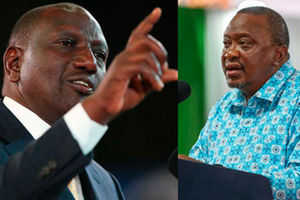
President William Ruto (right) and his predecessor Uhuru Kenyatta at State House, Nairobi, on August 1, 2025.
Photo credit: PSC
For the Kenyattas, the more important question is what survives when the machinery disappears. For generations, the family’s political weight was reinforced by control of organisations that could nominate candidates, build coalitions and bargain for national power.
If Uhuru relinquishes Jubilee and loses his formal place within Azimio, that tradition is broken. The family may retain wealth, history, networks and the immense symbolic capital of its name, but it will no longer possess an obvious vehicle through which those advantages can be converted into organised electoral power.
The future of the Kenyatta dynasty may therefore depend less on whether another Kenyatta enters politics than on whether the family can remain politically consequential without owning a party. But without an heir willing and able to rebuild a political machine, its influence may gradually recede into memory.
That is what makes Uhuru’s departure potentially historic. As history has shown, political dynasties rarely end at a single election or with the resignation of one leader. They fade when the name can no longer be translated into organisation, loyalty and succession. While the Kenyatta name will remain embedded in Kenya’s political history for generations, whether it remains embedded in Kenya’s political future is a different question.
For now, the dynasty may not be dead. But the machinery that sustained it is being dismantled — and, for the first time in decades, there is no Kenyatta waiting to inherit it.