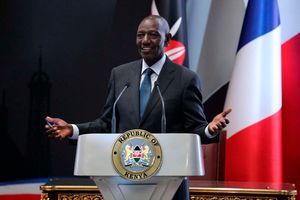
In the run-up to the 2022 General Election, President William Ruto, a self-styled "Hustler", successfully campaigned for the presidency on a populist narrative.
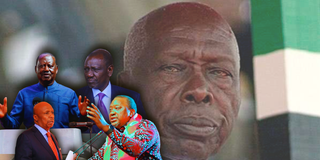
He framed the election as a David-versus-Goliath contest, pitting marginalised working-class Kenyans against entrenched political dynasties represented by the Kenyattas, Odingas and Mois.
Ruto capitalised on his humble origins as a chicken seller in rural Kenya to endear himself to ordinary Kenyans by selling the "hustler versus dynasty" narrative to boda boda riders, unemployed youth and market women (mama mboga).
He aggressively campaigned against former President Uhuru Kenyatta and the late opposition leader Raila Odinga, labelling them privileged scions determined to retain generational power.
In August 2022, Ruto, the self-styled "Hustler-in-Chief", won the presidency, defeating Raila Odinga, who was backed by then-President Uhuru Kenyatta, another scion of the Kenyatta dynasty.
But in what many political observers described as a change of tactics, following the deadly June 25, 2024, Gen Z-led protests, President Ruto sought protection from the very dynasties he had aggressively campaigned against in a bid to salvage his "Hustler" presidency and "bottom-up" administration.
Amid the political and economic turmoil that followed the Gen Z protests, he shook hands with former Prime Minister Raila Odinga and formed the broad-based government.
Raila Odinga (right) makes his remarks after the signing of a Memorandum of Understanding (MoU) between ODM and UDA at KICC in Nairobi on March 07, 2025.
Photo credit: File | Nation Media Group
Driven by the need to stabilise his administration after the youth-led protests, Ruto made a U-turn, co-opting members of the opposition into the broad-based government as he sought rapprochement with the same families he had once denounced.
He actively courted the country's most powerful political families — the Odingas, Kenyattas and Mois.
After courting Mr Odinga, Ruto later visited former President Uhuru Kenyatta at his Ichaweri home, seeking his support to stabilise his government.
In October 2025, weeks before Raila Odinga's demise, President Ruto entered into a political pact with Kanu chairman Gideon Moi, a son of Kenya's longest-serving President, Daniel arap Moi.
The deal, negotiated at State House, saw the Moi scion withdraw his interest in the Baringo Senate seat.
But the political truce between President Ruto and the Moi and Kenyatta dynasties appears to have been short-lived.
Fast forward to 2026, and as the country gears up for the 2027 General Election, Ruto is once again at war with the dynasties.
A decision by former President Uhuru Kenyatta to support the opposition ahead of the 2027 polls appears to have reignited his rivalry with Ruto.
Former President Kenyatta has publicly backed former Interior Cabinet Secretary Dr Fred Matiang'i for the presidency, while Gideon Moi is also believed to be backing the opposition.
In a fresh political battle, President Ruto now appears keen to neutralise and dismantle the political influence of the dynasties as he seeks a second term in office.
President Ruto has often styled himself as a master political strategist, but his critics now argue that he is engaging in diversionary politics instead of remaining accountable to Kenyans.
Former Nandi Hills MP Alfred Keter.
Photo credit: File | Nation
According to former Nandi Hills MP and one of Ruto's fiercest critics, Alfred Keter, the President is at a crossroads ahead of 2027 and has resorted to diversionary politics.
"Facing a re-election battle in 2027, President Ruto is cornered and has once again turned against the elite families he once denounced. These are diversionary politics. In 2024, when his administration was facing turbulence, he embraced the same dynasties to help him stabilise his government. With both the Kenyatta and Moi dynasties no longer in his fold, he is exposed ahead of the 2027 polls," Mr Keter told the Nation .
According to Mr Keter, despite championing the interests of the poor and taking on the dynasties in 2022, Ruto's actions in office have betrayed ordinary Kenyans.
"He used the hustler narrative in 2022 as a stepping stone to power, but he is now aligning with elite interests to establish his own dynasty. It was, and remains, diversionary politics," he added.
Democracy for Citizens Party (DCP) Secretary for Economic Planning, Dr Peter Mbae, also says Ruto's strategy of dismantling the dynasties ahead of the 2027 General Election may not work.
"President Ruto's strategy to dismantle the dynasties will be an uphill task. It is already too late for him. The dynasties are with the majority of Kenyans against his style of leadership," said Dr Mbae.
On Wednesday, June 24, President Ruto, for instance, declared open political war against the Moi dynasty.
He described Gideon Moi as a privileged inheritor of his father's political and commercial network whose stewardship, in the President's account, embraced political witch-hunts.
Ruto's inner circle also turned its guns on the Moi dynasty, reinforcing the President's rebuke.
"We want Gideon Moi and his allies to respect the current presidency. President Ruto showed the late President Daniel arap Moi loyalty and respect until he left office. We won't allow political sabotage from the Mois," said the Senate Majority Leader on Thursday.
The public warfare now marks the abrupt end of an uneasy political and economic settlement reached between the two leaders in October 2025.
Last year's truce had appeared to signal a thaw in relations between two men whose political rivalry ran deep.
The Moi-backed Azimio leader, Raila Odinga, in the run-up to the 2022 General Election, placing them squarely in the opposition camp when Ruto won the presidency.
The truce was also expected to consolidate Ruto's dominance in the Rift Valley ahead of the 2027 polls in exchange for State protection of the Moi dynasty's extensive business empire.
But the strained relationship has once again placed the Moi dynasty's vast business empire under pressure ahead of 2027.
"The intersection of Kenyan politics and business has never been more acute for the family than now. In previous administrations, particularly under Uhuru Kenyatta, the Moi dynasty enjoyed sufficient political proximity to protect its commercial interests. Under Ruto, the relationship has been difficult to sustain, and that leaves the family businesses exposed," says lawyer and political analyst Steve Kabita.
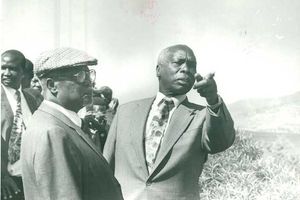
Former Prime Minister Raila Odinga and former President Daniel Moi in Nairobi on July 8, 2012.
According to official and unofficial records, the Moi dynasty has interests spanning media, hospitality, agriculture, real estate, security, education, banking, aviation, manufacturing, construction and tourism, among other sectors.
The family's vast empire also includes assets in multiple jurisdictions, including the United Kingdom, Australia and Malawi.
The Mois are arguably one of Kenya's wealthiest families, having built a business empire estimated to be worth more than Sh310.2 billion.
The wealth was accumulated before, during and after the late President's 24-year rule (1978–2002), with his children, among them former Baringo Senator Gideon Moi and former Rongai MP Raymond Moi, expanding the family empire further.
Kenya's second President, who ruled the country with an iron fist, remained influential long after leaving State House, with his businesses continuing to play a significant role in the economy.
According to Africa Confidential , a fortnightly newsletter covering politics and economics in Africa, Moi’s capital is also “held in trust by relatives and friends, and in front companies in Kenya, offshore tax havens and several major international banks.”
This includes Union Bank of Switzerland, where the Moi dossier “is treated as a matter tantamount to national security.”
The list of property and investments owned or co-owned by the family and its partners is extensive, with the family of the late Nicholas Biwott, former President Moi’s close ally, being a major investment partner. His former private secretary, Joshua Kulei, is another figure who has managed Moi’s multibillion-shilling business empire for decades.
The family has more than 100 companies across different sectors, with interests in numerous public and private businesses locally, across Africa and overseas.
President William Ruto at Kanu Chairman Gideon Moi's Kabarak home on October 10, 2025.
Photo credit: PCS
The Mois either fully own or hold shares in several banks and financial institutions, including Trans-National Bank, Equatorial Bank, First American Bank, Giro Bank, Giant Forex Bureau, Equity Stock Brokers and Sovereign Group.
The Moi dynasty also owns Standard Group, the parent company of Kenya Television Network (KTN), The Standard newspaper and several radio stations, including Radio Maisha.
Former President Daniel arap Moi settled at his Kabarak home in Nakuru County after retiring in 2002 and was buried there following his death in February 2020.
The expansive farm, estimated at more than 2,300 acres, hosts multibillion-shilling properties, including Kabarak Primary School, Kabarak High School, Kabarak University, Kabarak Guest House, a church, a garage and extensive farmland.
During the 2022 General Election, President Ruto's United Democratic Alliance (UDA) wave swept through the Rift Valley, and two of Mzee Moi's sons, who were carrying their father's political mantle, were casualties. Gideon Moi lost his Baringo Senate seat, while his elder brother, Raymond Moi, lost the Rongai parliamentary seat.
President Ruto crafted a strategy and fronted formidable candidates in Baringo and Nakuru counties to challenge the duo, successfully elbowing out the Moi dynasty, which, like the Kenyatta and Odinga families, had dominated Kenya's politics since Independence.
Before 2022, President Ruto, with the help of his loyalists, had managed to wrest the Mount Kenya region from former President Uhuru Kenyatta's grip and defeated Raila Odinga, Mr Kenyatta's preferred presidential candidate.
However, Mr Kenyatta's re-entry into politics after completing his two constitutional terms has caused jitters in the corridors of power.
His support for former Interior Cabinet Secretary Dr Fred Matiang'i, combined with his perceived political influence, financial muscle and expansive networks, has sparked growing anxiety within Ruto's camp ahead of the 2027 General Election.
Even Ruto's allies in the broad-based government have criticised the former President, accusing him of engaging in "partisan" politics and attempting to frustrate the government's development agenda.
They have increasingly pushed back against what they see as Mr Kenyatta's growing political influence, particularly in the Mt Kenya region, where the former Head of State continues to command considerable support.
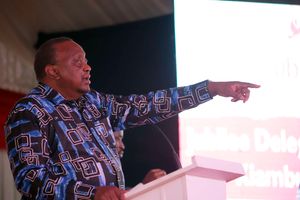
Jubilee Party leader Uhuru Kenyatta addresses delegates at Kiambu Golf Club in Kiambu County on May 25, 2026.
Photo credit: Evans Habil | Nation Media Group
Senate Majority Leader Aaron Cheruiyot, who has led the attacks against Mr Kenyatta, warned him against engaging in what he termed partisan politics.
"If you behave like a retired president, everyone will respect you. But if you misbehave, people will deal with you accordingly," said Mr Cheruiyot.
Political observers say the former President's continued influence may have prompted Ruto to craft a strategy aimed at dismantling the Kenyatta dynasty.
"Even after leaving office, Uhuru Kenyatta remains firmly at the centre of opposition politics. The backlash reflects deeper fears within government over Kenyatta's enduring ability to shape the country's political direction," Prof Tom Nyamache, a Turkana University don, told the Nation .
"Mr Kenyatta retains strong grassroots networks and loyalty in key regions and is capable of mobilising support for a preferred candidate, a factor that complicates Ruto's re-election strategy in 2027."
Recently, Nandi Senator Samson Cherargei threatened to sponsor a motion and mobilise fellow legislators to strip Mr Kenyatta of his retirement benefits.
Meanwhile, Mr Kenyatta and his brother, Muhoho Kenyatta, have been actively backing Dr Fred Matiang'i's presidential bid ahead of next year's polls.
As the political heat intensifies, analysts say President Ruto appears to have devised aggressive manoeuvres behind the scenes "to tame the Kenyattas."
"In an environment where government contracts, regulatory approvals and political access are significant factors in business, the Kenyattas are bound to feel the heat because of their political stand," said political analyst Jesse Karanja.
"Since 2023, President Ruto has been dismantling Uhuru Kenyatta's legacy policies, some of which were believed to have benefited the Kenyattas' business empire," added Mr Karanja.
President Ruto's administration has also increased scrutiny of taxation and regulation in key sectors in which the Kenyattas have interests, including agriculture and manufacturing.
"The government has, for instance, actively been countering the dominance of Brookside, owned by the Kenyattas, in the Kenyan milk market by revitalising the New Kenya Cooperative Creameries (New KCC)," Mr Karanja added.
After the death of former Prime Minister Raila Odinga in October last year, President Ruto also stepped up efforts to woo the Odinga family.
Ruto has been negotiating with Oburu Oginga, Raila Odinga's elder brother and Orange Democratic Movement (ODM) party leader, along with other members of the family.
He recently appointed Ida Odinga, the widow of the late former Prime Minister, as Kenya's Ambassador and Permanent Representative to the United Nations Environment Programme (UNEP) in Nairobi.
Political observers say Ida's appointment is part of a broader strategy to bring the Odinga family into Ruto's fold.
He has shifted his political strategy towards implementing visible development projects in regions that supported Mr Odinga, as he seeks to persuade those voting blocs to back his second presidential bid.
Political observers argue that it is a calculated effort to consolidate goodwill through development at a time of political uncertainty following Mr Odinga's death.
He has sustained a charm offensive towards the Odinga family, hoping to inherit the late Raila Odinga's political support base.