As Kenya’s United Opposition coalition inches towards the crucial task of choosing a single presidential candidate to face President William Ruto in the 2027 General Election, one of its leading principals has drawn a firm line in the sand: there will be no boardroom coronations and no political zoning.
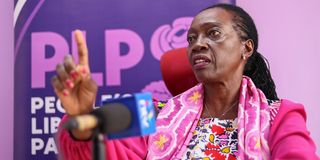
People’s Liberation Party (PLP) leader Martha Karua says the Opposition must resist the temptation to retreat into closed-door negotiations and instead embrace a transparent, scientific and democratic process that reflects the will of Kenyans.
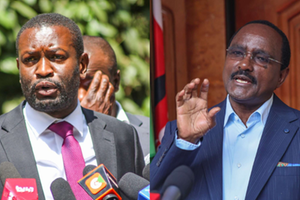
Ms Karua, who is part of the broad opposition alliance bringing together former Deputy President Rigathi Gachagua , Kalonzo Musyoka (Wiper Patriotic Front), Fred Matiang'i (Jubilee), Justin Muturi (Democratic Party), Eugene Wamalwa (Democratic Action Party-Kenya) and Peter Munya (Party of National Unity), argues that the coalition’s credibility will depend on how it settles the inevitable battle for the ticket.
Democracy for the Citizens Party (DCP) Party Leader Rigathi Gachagua (second right) addressing a press briefing at the SKM Centre on April 15, 2026. With him are (from left) Wiper Party Leader Kalonzo Musyoka, Jubilee Deputy Party Leader Fred Matiangi and Democratic Action Party-Kenya (DAP-K) Party Leader Eugene Wamalwa.
Photo credit: Francis Nderitu | Nation Media Group
Power-sharing arrangements
Ms Karua’s declaration, in an exclusive interview with Sunday Nation , comes at a time when speculation is rife over possible regional power-sharing arrangements, zoning proposals and behind-the-scenes negotiations aimed at avoiding bruising internal contests within the United Opposition, now christened United Alternative Government.
But Ms Karua insists that Kenya’s next opposition flag bearer to face President Ruto cannot emerge from elite bargaining.
Instead, she argues, the coalition must submit itself to a process that is measurable, transparent and rooted in public opinion.
"Anybody who tells you that we'll lock ourselves in a house and come with a candidate is missing the point. We cannot select a candidate in a boardroom. We must take into account the views of the majority, and there is no other way for a presidential candidate other than a scientific process that tells us what the people want,” Ms Karua said.
On zoning, she quipped: “PLP does not favour zoning and is unlikely to accept zoning. Parties must compete. Democracy dictates that we compete and let the people decide."
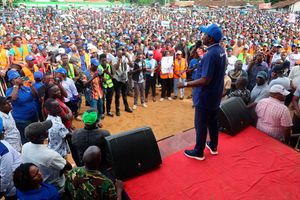
The former Justice Minister also dismisses claims that separate political tours by opposition leaders signal cracks within the coalition, maintaining that parties are naturally engaged in friendly competition as they recruit members and build structures ahead of the election.
Ms Karua, and sometimes Dr Matiang’i and Mr Munya, have occasionally missed out during the joint opposition tours, signaling a possible falling out.
Beyond coalition politics, Ms Karua also took aim at President Ruto and the Kenya Kwanza administration over public spending, taxation, the Finance Bill, alleged corruption, police brutality, the multi-billion Jomo Kenyatta International Airport (JKIA) expansion controversy and the government’s handling of strategic national resources.
In this wide-ranging interview, the PLP Party leader speaks candidly about the Opposition’s future, the qualities required of a presidential candidate and why she believes the coalition must trust the people rather than political dealmakers.
You have in the recent past, toured the Mt Kenya region to market the People’s Liberation Party. How is the reception?
The reception has been extremely encouraging. We have seen great enthusiasm from wananchi and a genuine appetite for political alternatives. What excites us most is that this is only the beginning.
Many people associate PLP with Mt Kenya because of recent activities there, but ours is a national party. We have elected leaders in regions such as Wajir and Mandera and other parts of the country. Our objective is not to build a regional outfit but a national liberation movement.
We will continue expanding both in Mt Kenya and across Kenya because our vision is national in character.
Every part of Kenya is important to us. We are not approaching politics through ethnic or regional lenses. We shall continue engaging Kenyans from the coast to Eastern, from northern Kenya to western Kenya.
The challenges facing citizens are largely similar—high taxes, unemployment, poor healthcare, rising cost of living and governance concerns. Those are national issues requiring national solutions.
Statements by some leaders and parallel rallies suggest friction within the opposition. Is the coalition still united?
I do not understand why people interpret individual party activities as signs of division. Every party within the coalition is conducting its own meetings and recruitment drives.
The DCP conducts its meetings. Wiper conducts its own. DAP-K does the same. PLP is doing the same. Even Dr Matiang'i has been holding his own engagements.
That is normal political activity. No political party can recruit members while carrying another party on its back. We are united in purpose but remain separate political entities.
What exists is friendly competition, not hostility.
Democracy requires competition. The people should be allowed to decide who represents them. Political parties should not be told where they can or cannot compete.
The best example I can give is the NARC experience in 2002. Where there was competition, parties conducted joint nominations and let voters decide.
You may think your party is stronger in a region, but another party may have a very popular candidate. Why deny voters the opportunity to choose?
The answer is free and fair nominations, not zoning.
The critical question is whether Kenyans want change. If they do, they must prioritise integrity and leadership over cash handouts.
Leadership should be judged on integrity, competence, honesty and commitment to public service. Kenyans must ask whether those dishing out money acquired it honestly and whether they are using public resources for political gain.
The government should stop imposing excessive taxes to finance wasteful expenditure. We should first seal corruption loopholes and eliminate unnecessary spending.
For example, we proposed significant reductions in government travel expenditure and stronger controls against theft of public funds.
Before asking Kenyans to pay more taxes, the government must demonstrate efficiency and accountability.
Unfortunately, many legislators have become rubber stamps.
Parliament's primary responsibility is to represent wananchi, not the Executive.
When citizens overwhelmingly reject certain policies yet Parliament proceeds regardless, serious questions arise about whom MPs truly represent.
If the Opposition settles on a ticket that places you outside the top two positions, would you support it?
Yes. If the process is fair, transparent and reflects the will of the people, I will support the outcome.
Elections are about the people's choice, not personal ambition.
My commitment is to ensuring the Opposition fields a single candidate capable of defeating President Ruto.
Mt Kenya is part of Kenya. Like other regions, it wants a strong and credible candidate who can deliver change.
We need leaders with integrity, accountability, respect for human rights and commitment to public service.
We need leaders who protect lives, respect public resources and uphold the rule of law.
Scientific opinion polling is essential because it tells us whether a candidate resonates with voters.
Between scientific polling and political negotiations, which is more credible?
Negotiations are important, but they cannot replace the voice of the people.
The process must be transparent, objective and acceptable to all participants.
Yes. If the people decide someone else is better placed to carry the flag, I will support that individual.
If the process is fair, transparent and reflects the genuine wishes of Kenyans.
The coalition was founded on the principle of unity of purpose, and we remain committed to that objective.
My strengths are integrity, consistency, courage and commitment to constitutionalism.
As for weaknesses, that is for Kenyans to judge.
Ultimately, voters will decide who among us is best suited to lead.
The government should publish all relevant documents and allow public scrutiny of the procurement process.
Modernisation is necessary, but it must be undertaken transparently and competitively.
Kenyans should know who is bidding, how contracts are awarded and whether the country is receiving value for money.
What are your thoughts on President Ruto's growing engagement with the West, particularly the United States?
Foreign policy should not be measured by the number of trips or meetings but by tangible benefits for citizens, including jobs, investment and economic growth.
Any agreement involving strategic minerals should be transparent, environmentally sustainable and beneficial to local communities.
The government should apologise to affected families and commit to ensuring such violations never happen again.
The responsibility for changing the country's direction does not rest with politicians alone. It rests with every Kenyan voter.
We must elect leaders who value human life, respect public resources, uphold the Constitution and place citizens at the center of governance.
Above all, we must remain united in the struggle to liberate our country and build a better future for generations to come.