When it began, some political observers dismissed Linda Mwananchi as just another pressure group that would eventually be absorbed into Kenya's ever-shifting coalition politics.
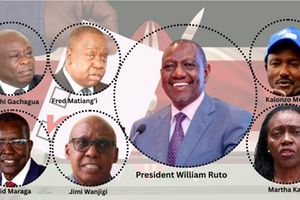
The survey puts Mr Musyoka, the Wiper party leader, at 13 per cent chance if a presidential election were held today, while Linda Mwananchi leader Edwin Sifuna is tied with Jubilee's Fred Matiang'i at 12 per cent.
For a politician who has only recently emerged as the face of a movement seeking to redefine opposition politics, Mr Sifuna's support levels have fundamentally altered the country's political landscape.
Analysts say his support is now too significant for President Ruto to ignore, yet also substantial enough for the opposition to assume it will automatically migrate behind its eventual presidential candidate.
This explains why the Linda Mwananchi party has unexpectedly found itself under attack from both political camps.
President Ruto has increasingly portrayed the opposition as a danger to Kenya's progress, arguing that its leaders are stuck in the past and unable to offer new solutions.
Speaking at State House on Monday while hosting a youth football team from Migori County, the President urged Kenyans to reject the opposition and hand him a second term.
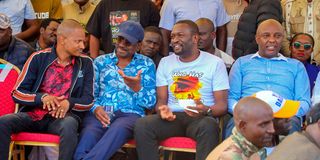
Murang'a County Governor Irungu Kang'ata (centre) joins Linda Mwananchi Movement leaders Nairobi Senator Edwin Sifuna (left) and Siaya Governor James Orengo during a public rally at Kivulini Grounds in Thika, Kiambu County, on June 14, 2026.
Photo credit: Dennis Onsongo | Nation Media Group
"They are a very big risk. They pose a risk to our country because they don't have an agenda to go forward. They have an agenda to go back to the past," he said.
Dr Ruto accused his rivals of lacking fresh ideas, insisting they were merely recycling policies that had previously failed.
While the President did not specifically mention Linda Mwananchi, his remarks came as the movement continues gaining national visibility and attracting increasing public attention.
The movement's leaders, however, interpret the government's growing criticism differently.
Speaking Sunday attacks targeting Linda Mwananchi activities in Kisumu and Nyahururu, Mr Sifuna claimed the government had become unsettled by the movement's growing influence.
"I think everybody in the country now can tell that Linda Mwananchi has rattled people in very high places, and they think that the only way to deal with us is through violence," he said.
Linda Mwananchi is no longer simply positioning itself as another opposition platform challenging President Ruto.
Increasingly, it is competing for ownership of the opposition space itself.
Political analyst Arnold Maliba argues that many politicians have misunderstood the movement's significance by viewing it as merely another coalition partner.
"Linda Mwananchi is not simply another political outfit competing for space. It is a pincer movement that is simultaneously exerting pressure on both the established opposition and the government of the day. That is precisely why it has suddenly found itself on everyone's radar," he says.
According to Mr Maliba, the movement's greatest strength lies not in traditional ethnic alliances but in its attempt to recast politics around governance, constitutionalism, accountability and citizen participation.
Unlike conventional political formations organised around personalities, he argues, Linda Mwananchi has sought to derive its momentum from ideas.
"It seeks to change not merely who governs Kenya, but how politics itself is practised," he says.
David Maraga arrives at Monarch Hotel in Mosocho, Kisii County, ahead of the Linda Mwananchi women empowerment forum on July 3, 2026.
Photo credit: Alex Odhiambo | Nation Media Group
Yet the movement has already achieved something few new political formations manage—it has forced virtually every major political player to respond to it.
Although largely driven by younger leaders such as Mr Sifuna and Embakasi East MP Babu Owino, Mr Maliba says Linda Mwananchi has evolved into a coalition cutting across generations, bringing together students, professionals, workers, retirees and veterans of Kenya's democratic struggles, including Siaya Governor James Orengo.
Unlike previous youth-driven formations that remained confined to urban activism, Linda Mwananchi, he notes, has begun building structures in regions traditionally associated with established political parties.
Its growing influence in Nyanza, Nairobi, parts of Western and the Coast has introduced a new variable into opposition arithmetic.
For the United Opposition, that presents both an opportunity and a dilemma.
Observers say that it’s on this basis, to ring-fence his Mt Kenya backyard, that Mr Gachagua last Friday criticised Murang’a Governor Irungu Kang’ata ahead of his rally in Ol Kalou with the Linda Mwananchi brigade on Sunday.
Mr Gachagua had cautioned Mr Kang'ata against inviting the Linda Mwananchi movement to campaign in Ol Kalou ahead of the Thursday by-election.
“I heard Irungu Kang’ata say that they want to come with Linda Mwananchi to Ol Kalou. He should not bring kiherehere (unnecessary interference) to Ol Kalou; it is not necessary,” Mr Gachagua warned.
Mr Gachagua’s United Opposition has spent months attempting to settle on a single presidential candidate capable of defeating President Ruto.
Until recently, some within the coalition had quietly floated the possibility of Mr Sifuna becoming a running mate.
The Infotrak numbers, however, complicate that thinking.
Embakasi North MP James Gakuya, one of Mr Gachagua's close allies, believes those numbers cannot simply be ignored.
"Sifuna is a factor by himself. In any particular election, it is a game of numbers," he says.
"Nobody can stand here and wish away Sifuna. Despite the split in ODM, the majority of the bases that were enjoyed by the late Raila Odinga have been inherited by Sifuna, including Nyanza itself."
According to Mr Gakuya, Mr Sifuna remains capable of attracting votes beyond Raila Odinga's traditional strongholds.
"He will command numbers in Western, Nyanza, the Coast and even Nairobi. In terms of negotiations, he has a base to negotiate."
Richard Onyonka (centre) arrives at Monarch Hotel in Mosocho, Kisii County, ahead of the Linda Mwananchi women empowerment forum on July 3, 2026.
Photo credit: Alex Odhiambo | Nation Media Group
If Mr Sifuna insists on pursuing the presidency independently, analysts warn, he risks fragmenting the anti-Ruto vote.
“If he accepts a subordinate role within a coalition, his supporters will expect meaningful political concessions.”
"For victory, there have to be sacrifices. Even if Fred Matiang'i or my boss Gachagua has to sacrifice for Kalonzo to take the mantle, it would be wise.
"They can even agree on one presidential candidate to serve only one term. It is all about power, and power is all about interests."
The closed-door discussions reopened debate over whether Mt Kenya should rally behind a home-grown presidential candidate or support a Kalonzo-led ticket.
For Linda Mwananchi, that uncertainty presents an opportunity.
As long as the opposition remains divided over its flag bearer, Mr Sifuna's leverage continues growing.
Nandi Senator Samson Cherargei argues that while Mr Sifuna possesses considerable political talent, he lacks the organisational and financial infrastructure necessary for a viable presidential campaign.
"If he's a wise young man, he should remain Nairobi Senator and build his political muscle slowly," Mr Cherargei says.
"You don't have resources, you don't have a political party."
He points to the enormous financial demands of presidential campaigns, noting that fundraising alone presents a significant hurdle for newcomers.
"He's a good politician, a young man like me. I wish him well. But politics requires patience."
“Political energy does not automatically translate into electoral victory. Winning the presidency requires extensive party structures, campaign financing, agents across thousands of polling stations and a national coalition capable of mobilising millions of voters,” political analyst John Anditi says.
Those remain formidable obstacles, he adds.
Nairobi Senator Edwin Sifuna joins supporters during the Linda Mwananchi Women Empowerment Programme at Monarch Hotel in Mosocho, Kisii County, on July 3, 2026.
Photo credit: Alex Odhiambo | Nation Media Group
But others warn that dismissing Linda Mwananchi solely on those grounds may underestimate its broader significance.
“Movements often shape elections without necessarily winning them. By redefining public debate, influencing coalition negotiations and attracting previously disengaged voters, they can fundamentally alter political competition,” says Geoffrey Mboya.
Already, within government circles, there is growing recognition that Linda Mwananchi has become an uncompromising critic capable of attracting dissatisfied young voters.
Within opposition ranks, there is equal awareness that the movement cannot simply be absorbed without accommodating its demands.
Linda Mwananchi brigade draws a crowd in Kondele en route to K'Owuor Grounds, Kisumu, for a rally on April 26, 2026.
Photo credit: File | Nation
"When a movement begins making both the government and established opposition uncomfortable, it is usually because it has evolved from a passing phenomenon into a political megatrend, shifting the national conversation."
He argues that Linda Mwananchi challenges long-held assumptions that political legitimacy derives from seniority, longevity or inherited influence.
Instead, it insists that legitimacy must continually be earned through ideas, performance and fidelity to citizens.
That proposition, he says, inevitably disrupts existing political hierarchies.
Whether Linda Mwananchi eventually fields its own presidential candidate, negotiates entry into a broader opposition coalition or simply reshapes the country's political conversation may only become clear as 2027 approaches.
Consequential political actors
The latest opinion poll has, however, elevated Mr Sifuna from an emerging opposition figure into one of the country's most consequential political actors.
“His 12 percent support may not be sufficient to propel him directly to State House, but it is enough to determine who eventually gets there,” argues advocate Chris Omore.
He says that in a race where every percentage point could decide whether Kenya proceeds to a presidential run-off or produces an outright winner, that influence makes Linda Mwananchi too significant for either President Ruto or the United Opposition to ignore.
“That, more than anything else, explains why a movement that many initially dismissed has suddenly become the subject of intense political attention from both sides of Kenya's increasingly competitive political divide.”