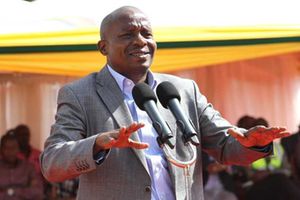
Photo credit: Nation Media Group
Kenyans have no clear favourite to occupy State House if a presidential election were held today, with the incumbent and his closest challenger likely to face off in a run-off, a new survey shows.
None of the potential presidential candidates, including President William Ruto, would garner more than half of all the votes cast to win the presidency outright in the first round, the Infotrak poll suggests.
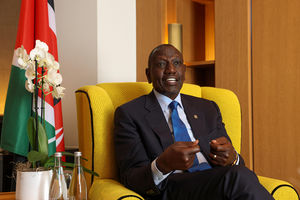
Kenya's President William Ruto attends an interview with Reuters on the sidelines of the G7 summit in Evian-les-Bains, France, June 17, 2026.
Photo credit: Denis Balibouse | Reuters
Besides polling at least 50 per cent plus one of the votes, a candidate must get at least 25 per cent of the votes cast in each of more than half of the counties (24) to be declared President-elect.
If no candidate secures an outright victory, the Constitution provides that a fresh election shall be held within 30 days after the previous election, pitting the top two candidates.
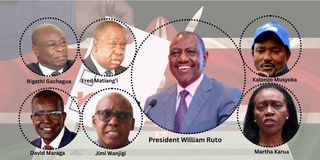
The survey also points to a fragmented opposition support base after Wiper Patriotic Front leader Kalonzo Musyoka polled a distant second with 13 per cent, while Nairobi Senator and Linda Mwananchi faction leader Edwin Sifuna polled 12 per cent, tying for third place with Jubilee deputy leader Fred Matiang’i.
Democracy for the Citizens Party (DCP) leader Rigathi Gachagua speaks to the media at the party offices in Nairobi on July 10, 2026.
Photo credit: Bonface Bogita | Nation Media Group
Only four per cent of the respondents would back Democracy for the Citizens Party (DCP) leader Rigathi Gachagu a for the top seat, while Embakasi East MP Babu Owino polled three per cent, followed by former Chief Justice David Maraga at two per cent.
People’s Liberation Party leader Martha Karua , who has also declared her presidential bid, enjoys one per cent support, according to the survey.
People’s Liberation Party leader Martha Karua.
Photo credit: Wilfred Nyangaresi | Nation Media Group
The survey suggests that the opposition only stands a chance against President Ruto if both the United Opposition and Linda Mwananchi join hands to front a single candidate.
Having multiple candidates is likely to split the vote, either handing Dr Ruto a narrow victory or forcing a run-off. The findings show that if the fragmented United Opposition and Linda Mwananchi were to consolidate behind one candidate, they would garner 47 per cent of the vote, ahead of President Ruto, but still short of an outright win.
In rallies, the opposition has repeatedly talked of working on strategies to manage its ambitions and competing interests to avoid the mistakes that befell the original Ford movement in 1992.
The giant Ford movement, which had led the country in the struggle to free Kenya from Kanu’s one-party rule, could not field a single candidate to take on then President Daniel Moi. In the end, Moi triumphed. There was, however, no requirement for 50 per cent plus one vote in that election.
Wiper leader Kalonzo Musyoka addresses the media at SKM Command Centre in Nairobi on December 30, 2025.
Photo credit: Wilfred Nyangaresi | Nation Media Group
Within the opposition, the poll revealed Mr Musyoka as the most popular presidential candidate, polling 27 per cent, just one percentage point ahead of Dr Matiang’i.
Mr Sifuna emerged as the third preferred candidate in the opposition with the support of 19 per cent of the respondents, while Mr Gachagua trails with nine per cent. Mr Maraga attracts three per cent support among respondents.
On the preferred opposition ticket, 23 per cent of the respondents think that a Kalonzo-Sifuna combination would be up to the task of challenging President Ruto, while 16 per cent prefer a Kalonzo-Matiang’i ticket.
Former Chief Justice and 2027 presidential hopeful David Maraga delivering a speech at Ufungamano House in Nairobi on June 16, 2026, during his “State of the Nation" address as the flagbearer for the United Green Movement (UGM) Party.
Photo credit: Evans Habil| Nation Media Group
Support for a Matiang’i-Kalonzo ticket stands at 15 per cent, while a Kalonzo-Gachagua ticket stands at five per cent. The poll also indicated that pairing Gachagua and Kalonzo would attract only four per cent of voters, similar to a Gachagua-Matiang’i ticket. This suggests a presidential ticket with Gachagua does not excite the opposition base, although he has emerged as one of the most visible and outspoken figures within the opposition ranks.
The Kalonzo-Sifuna ticket remains strong among young voters at 31 per cent, while the Western region leads in support of the ticket at 36 per cent.
According to the survey, Dr Ruto also needs to gain significant additional backing to avoid a run-off, which is more unpredictable. ODM, allied to party leader Raila Odinga , has since declared support for Dr Ruto’s bid for another term. But, going by the survey findings, the broad-based government must gain additional ground, possibly through new alliances, to secure victory.
Analysis of the survey shows that Dr Ruto enjoys strong backing in North Eastern at 59 per cent, Rift Valley (46 per cent) and Nyanza (40 per cent). This suggests that ODM strongholds in Western and the Coast may be drifting away or are not in agreement with the party’s decision to back the President. The findings show that the Western region would be a two-horse race, with President Ruto attracting 35 per cent and Senator Sifuna 26 per cent.
Mr Musyoka, on the other hand, remains popular in his Eastern region bastion with 40 per cent on presidential preference. Of interest is Mt Kenya, which remains largely undecided ahead of the 2027 race. None of the preferred candidates commands more than 20 per cent support. It is unclear to what extent uncertainty over a possible joint opposition flagbearer is influencing voter preferences.
Jubilee Presidential hopeful Dr Fred Matiang'i in Borabu, Nyamira County on April 24, 2026.
Photo credit: Ruth Mbula | Nation Media Group
Nairobi County also emerged as a battleground for the presidential aspirants, with about 24 per cent of voters remaining undecided. President Ruto attracts 19 per cent support, followed by Dr Matiang’i at 16 per cent and Mr Sifuna at 14 per cent, while Mr Musyoka enjoys nine per cent support among city voters.
The survey, conducted between June 22 and June 26, covered all 47 counties and interviewed 3,000 adults. It also placed Deputy President Prof Kithure Kindiki as the preferred running mate for Dr Ruto.
According to the poll, Prof Kindiki had a clear lead, with 34 per cent of respondents supporting him as President Ruto’s running mate.
Some 11 per cent backed Homa Bay Governor and Orange Democratic Movement (ODM) national chairperson Gladys Wanga as the President’s preferred running mate.
Siaya Senator Oburu Oginga also attracted five per cent support, while Mining Cabinet Secretary Hassan Ali Joho polled four per cent as a potential running mate.
Kirinyaga Governor Anne Waiguru during an interview at her official residence in Kutus on December 17, 2025.
Photo credit: Evans Habil | Nation Media Group
Notably, Prof Kindiki’s candidature as running mate is largely supported in North Eastern (44 per cent), Rift Valley (43 per cent) and Eastern (39 per cent), while his support in the Central region stands at 22 per cent.
Among respondents in Mt Kenya, 41 per cent prefer Prof Kindiki as President Ruto’s running mate, while 14 per cent favour Governor Waiguru. Another 33 per cent remain undecided.
Homa Bay Governor Gladys Wanga appears before the Senate County Public Accounts Committee (CPAC) chaired by Homa Bay Senator Moses Otieno Kajwang' at Bunge Tower, Nairobi on June 16, 2026.
Photo credit: Dennis Onsongo | Nation Media Group
In Nyanza, 35 per cent of respondents think Governor Wanga would strengthen the President’s ticket, while 25 per cent support Oburu Oginga.
The Western region believes Mr Mudavadi would be the best person to bolster President Ruto’s support, with 28 per cent backing him, while 22 per cent favour Mr Wetang’ula. Another 53 per cent remain undecided.
Mr Joho enjoys a commanding lead of 60 per cent as the preferred running mate in the Coast region. Four per cent of respondents in the region also prefer Prof Kindiki.
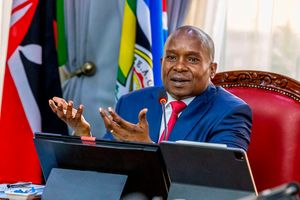
Deputy President Kithure Kindiki.
Photo credit: DPCS
On the state of the broad-based government, 79 per cent are aware of the arrangement, with 37 per cent opposed to it. Some 33 per cent support it, while 27 per cent neither support nor oppose it.
Among those opposed, the main reasons cited were limited development, self-interest among politicians, failure to address corruption, weakening of the opposition and the promotion of tribalism.
Those in support said the arrangement had promoted peace, political stability and inclusivity.
The broad-based government emerged as the preferred political formation, attracting 27 per cent support, followed by Linda Mwananchi with 24 per cent, while the United Opposition stood at 20 per cent.