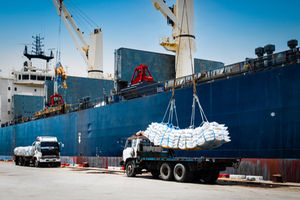
Barely a year after an import scandal saw its CEO, Pamela Mutua, fired, the Kenya National Trading Corporation (KNTC) has hired four firms to ship in 250,000 tonnes of white rice under unclear circumstances, elbowing out 16 others that were initially contracted.
The government revised its valuation of grade one white Pakistani rice to $460 (Sh59,409) per metric tonne, which means the consignment the four contractors will import is valued at approximately Sh14.8 billion.
Import duty will be waived for the imports, an annual ritual through which Kenya usually seeks to plug a rice deficit of nearly 800,000 tonnes.
But the KNTC’s decision to contract Zyan Agencies, Ecoview Commodities, Njema Commodities and Solid Commodities has attracted controversy, as the four firms were not among the 60 companies that the State corporation was initially to pick from.
By edging out the initial 16 bidders, the KNTC could have exposed itself to court action, with the risk of paying millions to firms that expected to import rice after being notified that the State corporation would contract them.
It has also emerged that KNTC dismissed lobbying by the Pakistan High Commission to give an edge to Islamabad-registered firms which were angling for the annual multibillion-shilling rice import programme.
Islamabad had, through its High Commission in Nairobi, written to KNTC CEO Lucy Anangwe with the request, and to seek clarification on the procurement process for the rice deals.
“In this regard, the High Commission of Pakistan requests your esteemed corporation’s favourable consideration in granting preferential treatment for the allocation of rice imports in the just-granted 250,000 MT duty-free rice quota, for the period ending October 31, 2025,” a Pakistan High Commission official said in a letter to Ms Anangwe on September 12.
“The High Commission further seeks clarification on the specific procedures and guidelines governing the issuance and administration of this quota, to enable Pakistani exporters to engage with the Kenyan market with confidence and clarity. This will not only serve to further strengthen the existing robust trade relations but also demonstrate the continued value placed on this vital partnership,” the official added when lobbying business for Pakistani rice dealers.
On September 9, KNTC sent emails to 16 firms informing them that they were the successful bidders, and that the process would be done on the Agriculture, Food and Fisheries Authority (AFFA) procurement portal.
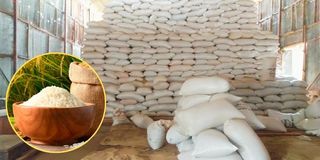
Bags of rice ready for the market at Mwea Rice Growers Multipurpose Cooperative Society stores at Wang'uru in Kirinyaga County on June 24, 2021.
Photo credit: Joseph Kanyi | Nation Media Group
“You are hereby advised to proceed with your importation by applying for: 1. Pre-shipment approval on AFA-IFMIS 2. A cereal master permit on the TFP 3. Consignment Cereal Import Clearance permit. Kindly note that the consignment should be imported into the country on or before October 31, 2025,” read a letter to one of the 16 bidders.
The following day, KNTC officials called the 16 firms and informed them that the State corporation had chosen to go a different route.
Ms Anangwe, who succeeded Ms Mutua at the KNTC corner office, did not pick up calls or respond to text messages sent to her known mobile phone number.
KNTC Board chairperson Evans Kidero had also not returned calls or responded to text messages by the time of going to press.
Aside from inquiring about the procurement process used to select the four firms, the Nation had sought to establish the quotas allocated to each of the importers.
Records from the Business Registration Service indicate that Ibrahim Murie Ibrahim owns all the 1,000 shares of Zyan Agencies, which was incorporated on November 30, 2018. The BRS records show that the company is based in an undisclosed building along Nairobi’s Standard Street.
When the Nation dialled the phone number attributed to Mr Ibrahim in the BRS records, a woman picked the call but said she neither knew Mr Ibrahim, nor Zyan Agencies.
Njema Commodities was incorporated on May 31, 2021. The company is owned by Abdinasir Siyad Mahamud (70 shares) and Muhudin Ibrahim Hassan (30 shares).
Mr Abdinasir picked our calls, but insisted that he could only respond on Wednesday. We sent him a follow-up text message asking him whether Njema Commodities had bid for the import quota allocation, but he did not respond.
Aden Abdullahi Hussein owns all 1,000 shares in Ecoview Commodities. The firm was incorporated on October 18, 2023.
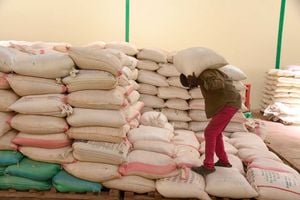
Workers at the National Cereals and Produce Board-Nanyuki Depot offload bags of rice and beans.
Photo credit: File | Nation Media Group
Solid Commodities is owned by Haroon Omar Bachoo, who holds all the 100 issued shares. The company was incorporated on October 29, 2024. Njema Commodities, Ecoview Commodities and Solid Commodities are all based in Mombasa County.
KNTC initiated the procurement process in September after High Court judge Edward Mureithi allowed the State corporation to import 250,000 tonnes of grade one white rice by October 31, 2025.
Former PS Irungu Nyakera’s Farmers Party had filed a case at the Kerugoya High Court on August 7, seeking to quash a gazette notice published by the National Treasury and which waived import duty on imported white rice under the KNTC rice import programme, for a period of six months which was to end on December 31.
The Farmers Party argued that the imports scheme would hang local growers out to dry, as imports would flood the market.
Justice Mureithi pronounced himself on August 19, cutting the allowed imported quantities to 250,000 tonnes, and set a new October 31 deadline.
The judge held that his decision was informed by the State’s argument that the imports were aimed at averting a looming shortage, as the locally produced grain was insufficient to satisfy the Kenyan market.
The KNTC imports scheme last year saw Ms Mutua and other officials working at the State corporation charged with violation of procurement laws after investigations found that some of the contracts were awarded to politically connected individuals.
Purma Holdings, Charma Holdings, Enterprise Supplies and Evertec General Trading Company – then owned by Athi Water Works Development Agency Board chair Mary Wambui Mungai – were awarded contracts worth Sh6.85 billion for the supply of rice, beans and edible oils in 2022 and 2023.
Dubai firms Lone Trading FZE, Multi-Commerce FZE and Invest Africa were also awarded contracts for the supply of rice, beans, edible oils and fertilisers.
Last month, Principal Magistrate Charles Ondieki allowed prosecutors to drop cases against other KNTC officials, leaving Ms Mutua alone in the dock. None of the contractors was charged.