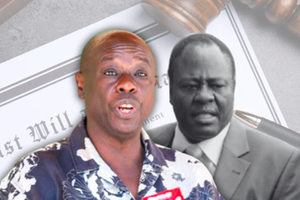
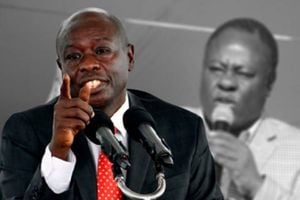
Former Deputy President Rigathi Gachagua and his brother Nderitu Gachagua who died in February 2017.
The nine-page Will that was signed by former Nyeri Governor Nderitu Gachagua a week to his death is officially out.
The Gachagua family chairman, 79-year-old lawyer Johnson Kibara Gachagua, has also emerged, demanding an apology from at least five relatives.
As that happens, copious newspaper space has been bought to explain how the multibillion property that Nderitu left after his 2017 death was distributed.
It is all part of a full-throttle fightback against a narrative recently advanced by President William Ruto, who alleged that his former deputy, Rigathi Gachagua, manipulated Nderitu’s Will “to disenfranchise and disinherit widows and orphans”. Dr Ruto has publicly said that he will help them get back what he claims they lost unfairly.
That narrative was accentuated by a widely-circulated March 23 letter in which Nderitu’s first wife, Margaret Nyokabi Nderitu, and her children – Susan Kirigo, Mercy Wanjira, Jason Kariuki and Ken Gachagua – wrote to Dr Ruto through the Attorney-General, seeking the President’s assistance to “finally find justice, closure, and restoration” due to “suffering and hardship following the passing of our beloved patriarch”.
They claimed that they have faced grave injustice since Nderitu’s death; that they have been up against a relative who has “relentlessly sought to disinherit” them; that the Will was labelled a draft yet it was relied on as the final document; that Nderitu’s Will was signed when he was “bedridden and profoundly grounded”; that the funds due to them had been misappropriated; among others.
They asked the President to have an “independent and impartial” investigation into the forgery of a Will and the “irregular interference, fraudulent dealings and unlawful intermeddling” of the late Nderitu’s estate.
They also asked for a return of “all irregularly transferred assets and properties” of Nderitu’s, listing Olive Gardens in Nairobi and Vipingo Beach Resort in Kilifi as examples.
Nderitu died on February 24, 2017, at Royal Marsden Hospital in London after a battle with cancer. On February 17, 2017, he had executed a Will – a copy of which is in our possession – stipulating the way he wanted his wealth shared.
Perhaps to assert his authority, stated that if any of the beneficiaries challenged the manner in which he had given out his property, “he or she shall be disqualified automatically from inheriting any part of my estate”.
At the time of his death, Nderitu was the governor of Nyeri at the cusp of completing his first term.
A paid-up newspaper advertisement was part of his family’s fightback. It shows that the highest cash inheritance pocketed by a single inheritor was Sh64.8 million, while the lowest was Sh1.3 million. It further illustrates that some Sh648.8 million obtained from selling Nderitu’s assets was given out to 23 beneficiaries, while nearly Sh1 billion was spent in settling his outstanding debts at the time of demise.
“I direct the executors of my Will and the administrators of my estate to liquidate all the assets and upon settlement of my liabilities, distribute the net proceeds,” Nderitu had written.
At the same time, a Tuesday press address by the family chairman fought back against some of the issues raised about the succession.
In our analysis of the fightback, we singled out four questions that the Gachagua family leadership is asking.
Former Nyeri governor Nderitu Gachagua.
1. Why didn’t anyone challenge the court process that gave rise to successors?
As per the Will, the people who were given powers to administer Nderitu’s estate were Senior Counsel Njoroge Regeru, quantity surveyor and lawyer Mwai Mathenge and Rigathi. Legally, they are called executors.
“I appoint [them]...as the joint executors of my Will and administrator of my estate,” wrote Nderitu.
The executors, in a paid-up advertisement drafted by Musyimi and Company Advocates, gave a timeline of what happened from the death until Nderitu’s property was distributed to 23 persons listed in his Will.
The key dates were March 11, 2017 when the Will was read “in the presence of the deceased’s beneficiaries, including the widows and all adult children”; July 10, 2017, when the grant of probate was issued and March 21, 2018 when the grant was confirmed.
The executors write in their advertisement: “All beneficiaries signed the application for confirmation of the grant. The consents of minor beneficiaries (of whom there were five) were signed by their legal guardians.”
They add that in 2021, three years after the grant was confirmed, two challenges were filed in court. One was an application for substitution of executors, and another was an application for dependency.
Both applications, they say, were dismissed by the High Court on the grounds that it found that the executors “have been diligent in managing the estate and paying out the liabilities of the estate.”
“None of the aforementioned applications challenged the validity, content or form of the Will,” they say.
In Tuesday’s briefing, the family chairman said that there were three stages where the successors could have complained, but they didn’t do so in any.
“Once the grant is confirmed, the court orders the lawyers or the executors to give a six-month report on the progress, whether there are any problems or anything, and also the beneficiaries, if there is anybody against anything on the Will. So, the first six months, no complaint. The next six months, there was none, until this year,” he said.
2. What is the motive for challenging the Will now?
When he spoke with a local TV station in late March, Rigathi said the issue of succession had been brought about because President Ruto had failed to get any dirt on him.
“I’m a popular leader, and Kenyans trust me. He wants to destroy my character and my integrity so that Kenyans stop listening to me. He has sent DCI [the Directorate of Criminal Investigations] to try to look for crimes I’ve committed in Kenya. There’s nothing,” claimed Rigathi.
At that interview, Rigathi insisted that only a number of fixed assets were given directly to heirs. The rest, the Will said, were to be sold and the cash be subdivided in ratios that Nderitu specified.
The newspaper advertisement lays down the ratios and the properties that were divided. It shows that a house in Karen was given out to Nderitu’s first wife, Margaret Nyokabi; two houses (in Karen and Nyeri) were given to his second wife, Margaret Waithiegeni; and that the ancestral home that comprised a four-acre plot with a house was given to his eldest sons, Kenneth Gachagua and Jason Kariuki in equal shares.
Nderitu also gave his shares in his Mweiga homes to Rigathi.
Except for those assets, all other properties were to be sold, the advertisement says. Sale prices of some of the properties are listed: Olive Gardens (Sh412 million), Queensgate (Sh590 million), and Vipingo Beach Resort (Sh250 million).
The advertisement said Nderitu’s estate “was highly indebted” to the tune of almost Sh1.07 billion.
Former Deputy President Rigathi Gachagua and his brother Nderitu Gachagua (background), who died in February 2017.
“These debts, due to banks and other creditors, were settled out of the sale proceeds and other estate income,” it said.
In the press briefing, Kibara said the motive for raising controversy over the matter at the moment is due to politics.
“My thinking is that information was given to Ruto so that Ruto could use that information to reduce the popularity of my brother in Mt Kenya,” he said.
He demanded an apology from the five who wrote to President Ruto, especially the mother.
“The family is totally disappointed in what she did,” he said. “We are demanding a public apology from her. If she does not publicly apologise to the family, the family will disown them.”
3. How come the Will is being praised out there?
The Gachagua family says the Will was written much earlier and that the only thing Nderitu did a week before his death was sign it. Kibara noted that the claims that Nderitu was too weak to sign don’t hold water because there were witnesses.
“On 17th, all Nderitu did was to sign,” said Kibara. “The Will had already been prepared. Actually, it was prepared here [in Kenya] by Njoroge Regeru.”
“There was a clause that a Will be witnessed by two people who are not beneficiaries. This was done. I think there were two nurses who signed the Will. If the person was incapable, surely, they would not have signed the Will,” he added.
Nderitu’s Will has received praise in Kenya’s legal circles for offering an example of how to distribute property to a complex family.
“It was an exceptional kind of Will,” said Kibara. “When that Will has been glorified like that, how can somebody then come and say this Will was forged?”
In his interview last month, Rigathi described it as “the most advanced Will ever done in the Republic of Kenya that has taken care of everybody”.
4. Are the complainants aware of the estoppel law?
There is a legal principle against going back on one’s word. By accepting to take money, land, cars and other assets left behind by Nderitu, the family argued that they had their hands tied.
“They took or acquired the properties issued in the Will, yet they are coming to say that the thing was forged. Legally, if something is forged, you can’t take it. You can’t take advantage of that. They never did anything,” said Kibara.
In the advertisement, the Gachagua family added that there are some assets that were never sold but given out wholesome to the beneficiaries in the set out ratios. They include houses valued between Sh10 million and Sh70 million.
Follow our WhatsApp channel for breaking news updates and more stories like this.