For critics, however, the bigger conversation should not be about designing another development blueprint but fixing governance failures that have prevented previous plans from succeeding.
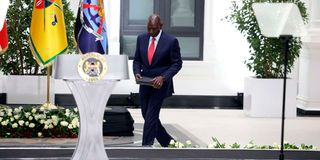
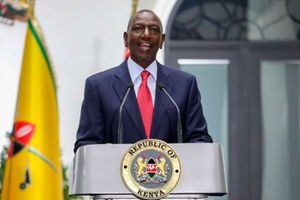
President William Ruto delivers his special national address from State House, Nairobi on July 30, 2026.
Photo credit: Dennis Onsongo | Nation Media Group
The tension between those two perspectives captures the stakes behind the August 12 launch, following proposals by five experts – Japanese political scientist Hiroyuki Hino, Kisumu Governor Anyang Nyong’o and three experts from the University of Nairobi – Michael Chege, Karuti Kanyinga and Peter Wanyande.
When President Mwai Kibaki unveiled Vision 2030 in June 2008, he sought to insulate Kenya’s long-term development agenda from the disruptive fiveyear electoral cycle.
Nearly two decades later, President Ruto wants to build on that foundation by replacing a government-owned planning framework with a constitution-anchored National Development Charter that he says will belong to Kenyans and endure beyond administrations.
The process is expected to bring together political parties, devolved governments, universities, businesses, faith organisations, professionals, workers, civil society, innovators and young people to define Kenya’s development priorities beyond 2030.
Prof Nyong’o has defended the proposed National Development Charter, saying Kenya’s pursuit of long-term development planning is not new but a continuation of efforts that were never fully realised.
Prof Nyong’o described it as “the first steps towards the preparation of the plan of the transition to the first world”. He recalled that in the 1980s, the then-Ministry of National Planning and Regional Development, with support from Canada, came up with a long-term development programme.
“However, it failed to take off because of the structural handicaps and declining living standards Kenyans experienced during that period,” he said. The governor added that Kenya got another opportunity to reset its development agenda after the National Rainbow Coalition (Narc) won the General Election in 2002. “I had the privilege of being the Minister for Planning and National Development in President Kibaki’s government from 2003 to 2005,” he said.
Kisumu Governor Prof Anyang' Nyong'o. Two people sued Prof Nyong'o over short-listing of 10 chief officers. They want the positions re-advertised.
Photo credit: File I Nation Media Group
“With the right policies and full political backing, Kenya can make rapid economic recovery.” Prof Nyong’o pointed to the country’s economic performance during the Kibaki presidency, saying GDP growth rose from about three per cent to a record eight per cent by 2007.
Yesterday, State House Spokesperson Hussein Mohamed said President Ruto’s initiative should not be interpreted as an abandonment of Vision 2030 or the Bottom-Up Economic Transformation Agenda (BETA).
“BETA remains the government’s long-term development framework and continues to deliver its commitments,” Mr Mohamed said.
State House Spokesperson Hussein Mohamed during a press briefing at Harambee House, Nairobi on May 19, 2024.
Photo credit: Lucy Wanjiru | Nation Media Group
He added that having stabilised the economy and established institutions such as the National Infrastructure Fund and the Sovereign Wealth Fund, the country is ready for the next generation of transformation.
According to Mr Mohamed, August 12 is significant since it marks “not the launch of a finished blueprint, but the beginning of a national conversation through which Kenyans will collectively determine the country’s next long-term development charter”.
Unlike when Vision 2030 was developed, he said, Kenya now has the 2010 Constitution, which defines governance and embeds public participation, making it possible to anchor the next national vision in a citizen-driven process.
“It is about building on its successes, learning from its challenges and ensuring Kenya’s longterm development journey is constitutionally anchored, nationally owned and enduring across generations,” he said.
He added that the charter would be shaped by counties, universities, businesses, workers’ organisations, faith communities, professional bodies, the civil society and young people. The government’s broader objective, he said, is to change the nature of political competition. “Let Kenyans first agree on the destination.
Thereafter, democratic competition should be about which leaders, ideas and policies can take us there faster, more effectively and more inclusively,” he said.
Mr Mohamed said Kenya cannot afford to miss “Africa’s moment” as the next frontier of global economic growth. With the continent’s youthful population, expanding consumer market, abundant renewable energy resources, strategic minerals and opportunities presented by the African Continental Free Trade Area, he said Kenya must position itself to lead rather than follow Africa’s next wave of economic transformation. This is the test facing the August 12 initiative.