President William Ruto on Thursday launched the 371km SGR extension from Naivasha to Malaba, betting on trade and regional integration even as questions mount on its financing as he also leans on the mega project to shore up political support in vote-rich Western and Nyanza Kenya.
Dr Ruto, who presided over the launch at Narok Teachers Training College, described the extension to Kisumu and eventually Malaba as a game changer that will unlock Kenya’s potential as a commercial hub in East Africa.
He said the railway will transform the economic fortunes of counties along the route, including Narok, Bomet, Kericho, Nyamira and Kisumu.
However, while acknowledging the scale of investment required, the President did not disclose how the government plans to fund the project, estimated to cost up to Sh502.9 billion, or whether a concrete financing plan is in place.
“We are fully conscious that this is a major investment. This project will require significant resources, running into billions of shillings, at a time when we are managing our debt prudently and consolidating our fiscal position. Let me assure Kenyans that we have thought through this project and its financing. That is why this railway will be built for performance,” said Dr Ruto.
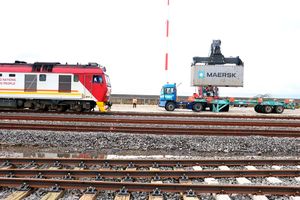
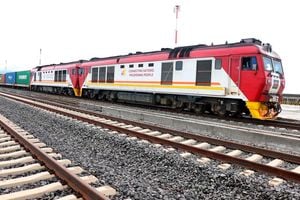
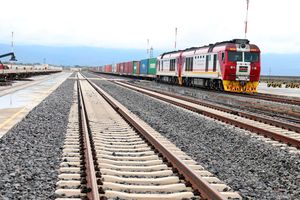
An SGR train at the Naivasha Inland Container Depot.
Photo credit: Dennis Onsongo | Nation Media Group
The President said the extension will lower transport costs, increase cargo volumes, spur economic activity, create jobs and ease congestion on major highways.
“By linking production zones directly to the rail network, we transform the SGR into a two-way economic system moving not only imports inland but also exports outward,” he said.
He noted that thousands of trucks currently ply the Nairobi–Kisumu highway daily, contributing to road damage, accidents and high transport costs, challenges the railway is expected to address.
Despite these assurances, details on financing remain unclear. The last official update came in November last year when Roads and Transport Cabinet Secretary Davis Chirchir announced plans to issue a Sh390 billion bond backed by the Railway Development Levy Fund (RDLF) to partly finance the project.
He also indicated that the railway line would be tolled to help repay the debt, addressing earlier concerns by China over the project’s commercial viability.
China, through the Exim Bank, had initially financed up to 90 percent of the earlier SGR phases from Mombasa to Nairobi and later to Naivasha. However, the lender withdrew from funding the extension, citing concerns over Kenya’s rising debt and the project’s viability.
Following negotiations during President Ruto’s visit to China last year, the lender reportedly agreed to finance 30 percent of the project, with Kenya expected to raise another 30 percent and the remainder sourced from private investors.
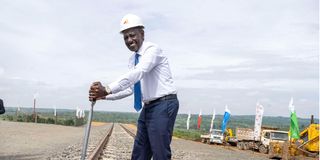
President William Ruto and China Communications Construction Company Chairman Song Hailiang launch the landmark construction of the Naivasha-Kisumu-Malaba Standard Gauge Railway line in Narok.
Photo credit: PCS
Treasury Cabinet Secretary John Mbadi later indicated that the government was exploring the issuance of a Panda bond—denominated in Chinese yuan—to bridge the funding gap.
However, neither the Panda bond nor the proposed RDLF-backed bond has been issued, raising fresh questions about how construction will be financed.
Leaders present at the launch focused on the project’s economic potential, largely sidestepping concerns over funding.
Mr Chirchir described the railway as a transformative project for a transport corridor currently dominated by road haulage.
“This is a significant project that will open up the regional corridor and reduce reliance on trucks,” he said.
The project comprises of two (2) sections: The Naivasha – Kisumu section and the Kisumu – Malaba section.
The Naivasha – Kisumu section starts from Emurtoto, in Narok County to Kisumu, with an approximate length of 264km, and a branch line of 8.69km to the proposed new Kisumu Port. The railway line will traverse through Narok, Bomet, Nyamira, Kericho, and Kisumu Counties.
The Kisumu – Malaba section starts from Kisumu and extends to Malaba with an approximate length of 107km. The railway line will traverse through, Kisumu, Siaya, Vihiga, Kakamega and Busia counties.
President William Ruto during the launch of the landmark construction of the Naivasha-Kisumu-Malaba Standard Gauge Railway line in Narok.
Photo credit: PCS
Narok Governor Patrick Ole Ntutu said the railway would lower logistics costs, stimulate industrial growth, expand agricultural value chains and attract investment in sectors such as warehousing, cold storage, fisheries and manufacturing.
The launch comes amid rising demand for efficient transport, with the Kenya Ports Authority reporting that cargo throughput at the Port of Mombasa hit a record 45.45 million metric tonnes in 2025—a 10.9 percent increase from 2024.
Transit cargo alone reached 7.37 million tonnes in the first half of 2025, with nearly 70 percent destined for Uganda.
According to the President, SGR freight operations currently generate more than Sh1.3 billion monthly, while passenger revenue has grown by 40 percent to exceed Sh4 billion annually.
“In December 2025 alone, passenger revenue reached Sh602 million. These figures show that the railway is working and delivering for the economy,” he said.
President Ruto is expected to host Ugandan President Yoweri Museveni on Saturday for the groundbreaking of the final phase of the railway from Kisumu to Malaba.
Once complete, the line will link the Port of Mombasa to Nairobi, Naivasha and Kisumu, with onward connections to Uganda, Tanzania, Rwanda and South Sudan, positioning Kisumu as a key logistics hub.
The project will feature passenger trains running at 120 km/h and freight trains at 80 km/h, with multiple stations across the route, including Narok, Bomet, Sotik, Sondu and Ahero.
The line will include 79 bridges, eight tunnels and hundreds of culverts, and will accommodate freight trains of up to 4,000 tonnes.
The SGR currently terminates at Suswa in Narok County, where construction stalled due to financing challenges.
The Naivasha–Kisumu section (Phase 2B) covers approximately 262.1 kilometres, while Phase 2C will extend the line to Malaba at the Kenya–Uganda border. Together, the two phases are estimated to cost about Sh582 billion, making financing the biggest hurdle to completion.
The National Lands Commission has said affected residents will be compensated before construction begins, with Kisumu County expected to have the highest number of affected landowners.
National Lands Commission Director Joel Ombati said Kisumu county has the highest number of affected residents and that a digital platform will map parcels and ownership data to complete compensation within eight months.
Mr Ombati has urged residents to have valid identification and active bank accounts, noting that documentation gaps have delayed previous projects.
Any grievances will be handled through consultations with local leaders and the NLC to avoid lengthy court disputes.