The State opted for a southern corridor for the Standard Gauge Railway (SGR) extension to Kisumu, shelving alternative routes through Nakuru or Eldoret on account of a technical assessment report and a projected cash saving of Sh99.68billion($772.7million).
The approved plan favoured the Nairobi-Naivasha-Kisumu-Malaba route—called the southern route—that will traverse Narok, Bomet, Kericho, Nyamira, and Kisumu counties. This leaves out two other routes that had been proposed in earlier conceptual discussions.
The decision to snub Nairobi-Nakuru-Eldoret-Malaba (northern route) or Nairobi-Nakuru-Kisumu-Malaba (middle route) was arrived at after planners cited engineering feasibility, cost efficiency, the economic potential, and long-term regional development considerations as decisive factors.
“Three broad route corridors were comparatively evaluated based on engineering feasibility, environmental and social considerations, cost implications, and alignment with national development strategies,” notes the study.
The planners said the southern route presents an alignment that offers the best balance between terrain, cost, and regional development potential. For instance, this route requires about $772.7 million less investment compared with the northern option.
Details contained in the Environmental and Social Impact Assessment report show that although the operating costs of the southern route are similar to the central route, it makes more sense when it comes to the economic hubs, engineering geology, and investment requirements.
“The route has several advantages: it crosses only 133 kilometres of high seismic intensity zones, being 80 kilometres less than the middle route, encounters fewer fault-affected areas in the Rift Valley, is 31 kilometres shorter, and requires approximately $772.7 million less investment,” says the blueprint.
“Its main limitation is that while it connects key towns such as Narok and Kisumu, its economic centres are slightly smaller in scale compared to those along the middle route.”
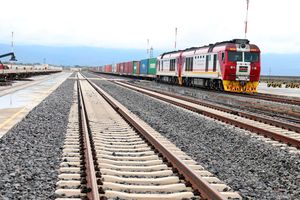
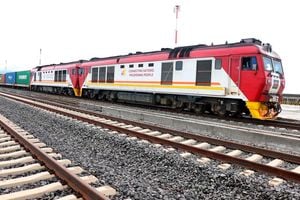
The project, called SGR Phase 2B, is an extension of the Mombasa-Nairobi SGR and will operate freight and passenger trains running at speeds of up to 80 and 120 kilometres per hour, respectively. The trains’ speeds are expected to cut travel time between towns along the corridor.
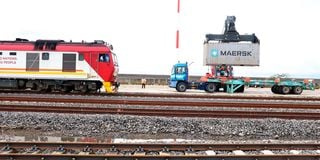
An SGR train at the Naivasha Inland Container Depot.
Photo credit: Dennis Onsongo | Nation Media Group
The favoured southern route will cover 489.57 kilometres through Nairobi – Ngong – Kiambu – Mai Mahiu – Suswa – Narok – Bomet – Sondu – Ahero – Kisumu and Malaba.
The length of the southern route is shorter when compared with 525.2 kilometres under the snubbed Nairobi–Naivasha–Nakuru–Nandi–Kericho–Kisumu–Malaba middle route or the 638.2 kilometres under the northern route.
Picking the northern corridor alternative would have required 505.2 kilometres of mainline from Nairobi to Malaba and an additional 133.2 kilometres for the Eldoret–Kisumu branch, adding 133.2 km, making it the longest and most costly of the assessed options.
The planners said that although the northern corridor route connects major economic centres such as Nakuru and Kisumu, it requires significantly higher construction and operational investment.
Further, the northern option follows the old metre-gauge corridor, which planners said “does not align with Kenya’s current development strategy” and passes through “geologically complex” Rift Valley sections with dense fault lines.
“Overall, this [northern] option is longer, more expensive, and more technically challenging compared to the southern route,” says the blueprint.
While the middle route passes through major economic hubs in northern Kenya and therefore offers strong potential for passenger and freight transport, the terrain was found to be less suitable from an engineering and safety perspective.
Experts said a significant section—about 233 kilometres —lies within a high seismic hazard zone where ground instability poses risks such as structural damage, track distortion, and alignment failures.
The line will operate on diesel traction. However, all infrastructure, including bridges, tunnels, clearances, and trackside installations, has been designed with future electrification in mind.
“This future-proofing approach accommodates Kenya’s long-term railway modernization goals without requiring extensive reconstruction,” notes the study.
The study adds that electric traction was considered, but this would increase project costs by about $299.95 million (Sh38.68 billion), excluding transmission line costs.
The adopted option has a single-track design and diesel traction with provision for electrification, automatic inter-station block control, and clearance for future double-deck container operations.