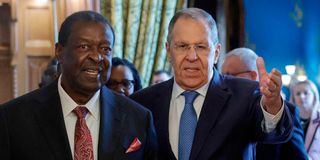
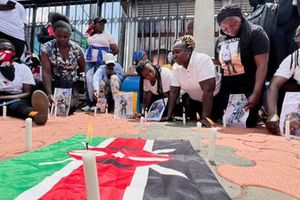
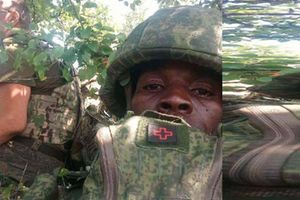
At least 84 Kenyans recruited to fight for Russia in Ukraine have been killed or remain missing, Prime Cabinet Secretary Musalia Mudavadi has told Parliament.
He spoke as claims of official complicity in the hiring of Kenyans by the Russian military came under new scrutiny.
Mr Mudavadi, who is also the Foreign and Diaspora Affairs CS, told a parliamentary committee on Thursday that the government has records of 354 Kenyans involved in the war.
The disclosures come amid scrutiny following the 2026 US Department of State Trafficking in Persons Report, which says Kenyan officials colluded with hiring agencies and Moscow to facilitate the hiring of more than 1,000 Kenyan men into the Russian military.
The allegations raise questions on who recruited the men, what they were promised and if public officials helped facilitate their deployment to a foreign battlefield.
There have been no reports of women recruited to fight, though earlier reports indicated African female scientists were helping in wartime technology.
Mr Mudavadi said 77 Kenyans are on the frontline, some 38 are in camps, 52 are in unknown or unclassified locations and 34 are in hospital.
Sixty two have been repatriated, five are prisoners of war in Ukraine, one is in detention and one completed a military contract.
The 84 reported dead or missing in action represent two distinct categories, with the government saying it cannot confirm a death without evidence.
“We use the term missing in action. If we say they are dead, we are obligated to produce the body,” Mr Mudavadi said.
The figures, compiled from information obtained through Kenya’s diplomatic missions and affected families, could change as more cases are verified.
They, however, raise questions on the scale of casualties and the ability of the government to account for those serving in the Russian military.
“There is enough information to show the numbers by the Ministry of Foreign Affairs are not accurate. When I submitted the documents that are now in your possession, I attached a list of approximately 841 Kenyan recruits,” said Mr Peter Kamau, a petitioner and representative of the affected families.
Billboards advertising the Russia-based Alabuga Start programme have been erected in Nairobi, offering young people a chance to relocate to Russia for employment.
Photo credit: Shutterstock
When Mr Mudavadi flew to Moscow in March, he said Russia and Kenya agreed to halt recruitment into the military. Russia, however, also said those already contracted must serve their terms of hiring.
At the centre of the crisis are claims that Kenyans were lured by promises of lucrative civilian jobs, only to end up in the military.
Recruits and their kin describe offers of security guards, drivers, construction workers and technicians, often accompanied by attractive salaries and bonuses.
Some recruits are said to have discovered after arriving in Russia that their jobs involved military service. Others say their passports were seized, they were pressed into signing contracts they did not understand and that they were sent to the battlefield after limited training.
If the US report is substantiated, the allegations would extend the scandal beyond rogue recruitment agents to misconduct by public officials.
“When those entrusted with protecting citizens become complicit in their exploitation, accountability is no longer optional; it is a moral and institutional imperative,” the report says.
The claims do not establish individual liability or prove that the government directed the recruitment.
In a new briefing, Amnesty International said economically vulnerable people from poor countries are being lured into the Russian military through false pledges of civilian jobs, lucrative salaries and opportunities to obtain Russian citizenship.
Amnesty says some recruits are targeted while already in Russia, particularly migrants and refugees in precarious legal situations.
“Recruiters have developed a system of coercion, fraud and deception, including false promises of civilian employment, to enlist foreigners in the military,” Amnesty Secretary-General Agnès Callamard said.
“Russia’s Armed Forces are bolstering their ranks with economically vulnerable foreigners and using them as cannon fodder in the war,” Ms Callamard said.
She added that the level of exploitation and coercion led Amnesty to conclude that it amounts to human trafficking in many cases as defined under the UN’s Palermo Protocol.
The findings are contained in a briefing based on interviews with people from Brazil, Colombia, Cuba, Egypt, Sierra Leone, Sri Lanka, Somalia and South Africa who were held in two Ukrainian prisoner of war camps between 2024 and 2026.
The Russian embassy in Nairobi has in the past denied that authorities in Moscow engaged in illegal recruitment of Kenyans to fight in Ukraine, maintaining that foreigners can voluntarily enlist in the armed forces.
Investigators now face the task of establishing who hired the men, what they were promised, how travel was facilitated and if any official assisted in the recruitment.
Government figures have also raised questions in families desperate to establish the whereabouts of relatives who went to Russia.
841 Kenyans unaccounted for
During the parliamentary proceedings, petitioners said 841 Kenyans remain unaccounted for, a figure substantially higher than the government’s records of those reported dead or missing.
The petitioners’ estimate concerns people whose whereabouts they say remain unknown, while the government’s tally covers Kenyans in several categories, including those serving, hospitalised, repatriated or detained.
Mr Mudavadi acknowledged the difficulty in tracing some recruits, saying several travelled without informing their families or the government of their plans.
“These are the painful truths, but they are Kenyans and we have to look for them,” he said.
Following Mr Mudavadi’s visit to Russia, the government announced that Russia agreed to place Kenya on a military recruitment “Stop List”.
“The Embassy of Kenya in Moscow has confirmed that no additional Kenyans have been enlisted in the Special Military Operation following the implementation of the Stop List,” Mr Mudavadi said.
The two countries agreed to facilitate consular access, support the repatriation of remains and allow Kenyans seeking to leave the military to request disengagement from their contracts.
The CS said requests to terminate military contracts would be considered individually by commanders of the Russian units.
Kenya is also engaging Ukrainian authorities over the five citizens held as prisoners of war. Mr Mudavadi said Kenya lacks capacity to enter the war zone and rescue its citizens, leaving diplomacy the most important route to their return.
“Our mission is to help as many Kenyans as possible to return home,” he said.
A central question is whether the Kenyans who ended up fighting for Russia voluntarily enlisted or were victims of trafficking.
The distinction has legal and humanitarian implications. Recruitment through fraud or coercion raises different concerns from freely choosing to enlist in a foreign army.
Mr Mudavadi told MPs that circumstances surrounding the recruitment of Kenyans could fall within the definition of international human trafficking.
The government wants Kenyans held as prisoners of war in Ukraine to be considered potential trafficking victims during negotiations over their release and repatriation, a position that could help them access international assistance.
The claim of official involvement makes investigations consequential. Authorities must establish if public officers facilitated recruitment, improperly processed travel documents, ignored warnings or gained from the networks.
For families still waiting for news, the demands are immediate – establish the truth, trace the loved ones and bring home those still alive.