A former US envoy has sensationally claimed the then US Ambassador to Kenya Meg Whitman arranged the deal to deploy Kenyan police to Haiti then got President William Ruto’s support.
It’s the latest claim by Mr Daniel Lewis Foote, who served as US special envoy to Haiti in 2021, following his other controversial statement last year that Kenya was only in it for the money.
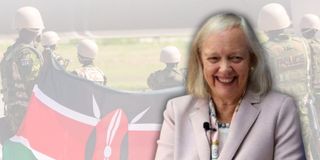
Mr Foote claimed it was Ms Whitman - who served as US ambassador to Kenya between 2022 and last year - who drafted the security deal between Haiti and Kenya that saw the later agree to lead the Multinational Security Support (MSS) mission.
“From what I can tell, the US Ambassador to Kenya, Meg Whitman, came up with this idea on her own,” Mr Foote said in an interview on the Michael Patrick Leahy Show.
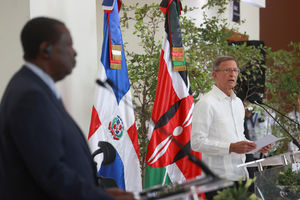
President William Ruto shakes hands with Kenyan police officers when he arrived in Port-au-Prince, Haiti.
Photo credit: PCS
Kenya deployed its first police contingent to Haiti in June, last year.
The MSS mission in Haiti was authorised by the United Nations Security Council on October 2, 2023.
“That’s always great to have people making Latin America foreign policy from Africa. She (Whitman) got interest from President William Ruto of Kenya and it’s a cash cow for peacekeeping countries, particularly poor ones, which is why you see countries like Bangladesh, Pakistan, Uruguay or some of the bigger peacekeeping countries in the world, so the Kenyans agreed, ‘Okay, we’ll lead it.’ President Ruto wants to have a more international platform, etc., and the US is like, ‘great!’,” Mr Foote said.
The Nation contacted the US Embassy in Kenya through email asking about the claim that Ms Whitman was the brains behind the MSS mission but we never received any comment by time of going to press.
Asked about the claim that Ms Whitman arranged the Kenya and Haiti agreement, Foreign Affairs Principal Secretary Dr Korir Sing'oei dismissed the allegation as 'baseless. '
Ever since Kenya kicked off plans to send its troops to Haiti for the peacekeeping mission, Mr Foot has been making controversial claims as he attempts to downplay the operation.
From warning Kenyan officers that the mission would not be a walk in the park, claiming Kenya picked the assignment for the money to alleging the operation was not well planned, Mr Foote has consistently sought to discredit Kenya’s role.
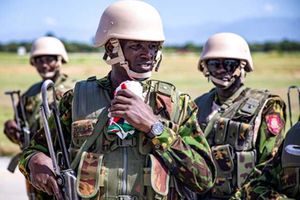
Kenyan police officers hold a Kenyan flag after disembarking, in Port-au-Prince, Haiti June 25, 2024.
Photo credit: Reuters
Prior to deployment of Kenyan police officers, the retired career diplomat had claimed money had motivated Kenya’s interest in the mission.
“You see the reticence on the part of the Kenyan public to send these guys and that makes me nervous. I believe that this is more of a cash grab by President Ruto, whose country is going to receive a lot of money in doing this,” he claimed in March 2024, three months before Kenya deployed its first contingent to Haiti.
At the time, the then US President Joe Biden had promised to sponsor the mission with Sh13 billion.
Mr Foote also raised the language barrier concerns, saying it would be difficult for the Kenyan officers to engage the Haitians during the mission.
Meanwhile, US Secretary of State Marco Rubio has said that there is a need for the Organisation of American States (OAS) to stand up and assist Kenya in fighting the gangs to restore peace in the Caribbean nation.
Rubio told the Senate Foreign Relations Committee that it was time OAS steps forward and lead the MSS mission.
"If ever there was a regional crisis for which an organization like the OAS should exist, it is the one Haiti is going through today," he said.
According to him, Kenya had done so well leading the mission but the initiative alone is not enough to ensure that order is restored in Haiti.
He said that there was a need for countries within the American region to join hands and ensure that Haiti gains its stability.
This week, Kenya said that it was aware of the plans to deploy officers from OAS which kicked off five months before the Kenya-led mission comes to an end and a decision is made whether it will be a fully-fledged United Nation (UN) mission or not.
Kenyan police offices stand at the airport after disembarking, in Port-au-Prince, Haiti June 25, 2024.
Photo credit: File | Reuters
“Yes, we are aware. That is a greater involvement of Caribbean countries and it will serve to make the Haitian stabilization effort a collective international effort enhancing its likely success,” said Dr Korir Sing’oei who is the Principal Secretary, Foreign Affairs ministry.
Mr Rubio told the Senate Foreign Relations Committee that the US was making great financial contributions in the region and its expectation is for other countries to intervene in a security situation similar to what is going on in Haiti.
"This does not mean that we are withdrawing from the OAS; on the contrary. We want to encourage our allies to play their full role. The OAS must provide a coordinated, multinational response,” he said.
Mr Rubio also said that the US federal agencies had realised how firearms get into the hands of gangs in Haiti and they were working on how to stop the trafficking which takes place from the Port of Miami to Haiti, Jamaica, and Trinidad.
He recalled that the OAS also has a mandate to defend democracy on the continent, citing the cases of Nicaragua, Venezuela and Cuba, where authoritarian regimes are challenging democratic principles.
Should the countries in the Caribbean and Latin America agree to provide their troops, then the OAS will be made of officers from the US, Brazil, Uruguay, Costa Rica, Argentina, Bolivia, Paraguay, Colombia, Chile and Venezuela.
Kenya sent its first contingent of police officers to Haiti in June 2024 and has been consistent in making more deployment.
The US is a major donor to Haiti, providing a significant portion of its humanitarian aid funding.
Members of the first contingent of Kenyan police offers stand in formation after arriving in the Caribbean country as part of a peacekeeping mission, in Port-au-Prince, Haiti June 26, 2024.
Photo credit: Reuters
However, there have been some recent pauses or freezes in certain US funding, particularly related to the UN Trust Fund for the MSS Mission.
Other countries funding the mission include; Canada, France, Spain, Italy and Algeria.
The mission is scheduled to come to an end in October 2025. From there the UN Security Council will review the mission’s mandate and make a decision on the future of the mission including whether it will be transformed into a UN peacekeeping operation.