A protracted power struggle between civilian commissioners and police chiefs has stalled crucial human resource functions, including promotions, reportedly undermining morale among the rank and file of the National Police Service (NPS).
The National Police Service Commission (NPSC), which is responsible for human resource management within the NPS, has not met since last October because of the unresolved supremacy war. NPS commanders are led by Inspector General of Police Douglas Kanja, while the NPS comprises the Kenya Police Service, the Administration Police, and the Directorate of Criminal Investigations.
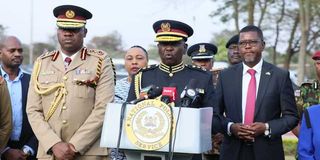
Inspector-General of Police Douglas Kanja.
Photo credit: File | Nation Media Group
The feud escalated following last October’s contested recruitment of 10, 000 officers in which police chiefs disregarded NPSC guidelines, alleging a scheme to usurp the IG’s powers. This prompted a court case that resulted in orders in February freezing promotions and firings until the petition was determined.
The lack of a functional commission has led to a near paralysis of police operations. Sources told the Nation many officers who have undergone promotion courses are still stuck in their old positions because the NPSC’s endorsement of the new ranks is mandatory. The commission is mandated to confirm officers from the rank of superintendent after attending promotion courses.
Officers transferred to new offices are also unable to discharge their mandate effectively, as some have yet to get the new ranks that come with new offices.
For example, at the General Service Unit headquarters, new commandant Johana Tonui has yet to be confirmed to his new rank of Senior Assistant Inspector General of Police following his appointment to command the GSU.
Mr Tonui, an assistant inspector general, takes over from Mr Ranso Lolmodooni, who has since retired. As a result, sources say the paralysis has caused disquiet within the police service and attracted the attention of higher authorities, amidst concerns that it could disrupt security preparations ahead of the next general election. Against this backdrop, Deputy President Kithure Kindiki last Thursday convened a meeting at his official residence in Karen between the factions in an attempt to broker a truce.
Sh60 billion police payroll
Among the unresolved issues is the tussle over the control of the Sh60 billion police payroll . An independent commission established under the Constitution, the NPSC, among other functions, took over the human resource management that was previously handled by the Public Service Commission.
Interior Cabinet Secretary Kipchumba Murkomen, Interior Principal Secretary Raymond Omollo, all service commanders, and civilian commissioners attended the Kindiki meeting. Also present were Mr Kanja and his two deputies Mr Eliud Lagat (Kenya Police) and Mr Gilbert Masengeli (Administration Police).
Deputy Inspector-General of Police Eliud Lagat.
Photo credit: Dennis Onsongo | Nation Media Group
Prof Collette Suda (vice chairperson), Ms Angeline Yiamiton, Ms Peris Muthoni, Mr Benjamin Juma Imai, and Mr Edwin Cheluget are the other commissioners. Their chief executive officer is Peter Leley, who has often clashed with Mr Kanja in official letters. Co-opted members include DCI director Amin Mohamed and NPS Secretary Administration/Accounting Officer Bernice Sialaal.
National Police Service Commission CEO Peter Leley.
Photo credit: File | Nation
The highly guarded meeting was called to reach a ceasefire between the uniformed police commanders and the civilian commissioners, with sources saying the agenda included persuading the commissioners to withdraw the case pending at the Court of Appeal. But after over five hours of discussions, the meeting did not reach an agreement on this proposal, the Nation established.
On February 27, the Court of Appeal suspended a judgment by the Employment and Labour Relations Court that gave the Inspector-General exclusive power over the promotion and dismissal of police officers. In a ruling, a three-judge bench comprising President Daniel Musinga, Mumbi Ngugi and George Odunga suspended the orders of the lower court pending the hearing and determination of the appeal. The lower court had held that the commission had no constitutional authority over recruitment, promotion and dismissal of members of the NPS.
The court declared that those powers fell under the independent command of the Inspector-General and the NPS. It also barred the commission from undertaking recruitment and nullified recruitment regulations published in September 2025. Dissatisfied with that outcome, the Law Society of Kenya in seeking to suspend the judgment, moved to the Court of Appeal, arguing that it disrupted the constitutional balance between the Inspector-General and the commission—established under Articles 245 and 246 of the Constitution. The LSK maintained that the matter raised serious constitutional questions that required full appellate consideration. The Independent Policing Oversight Authority and the NPSC supported the application, telling the court that the dispute affected police reforms and had wide public interest implications.
Mr Kanja and the NPS opposed the application. They argued that the Constitution clearly grants the Inspector-General independent command over employment matters and that recruitment of police constables had already been conducted, with training underway. They warned that halting the process would undermine public safety, especially as the country prepares for the 2027 General Election. The Court of Appeal found that the intended appeal raised weighty and arguable constitutional issues, including the interpretation of Articles 245 and 246 and the proper division of human resource powers within the service.
The judges said recruitment had already taken place and training had started, making it impractical to stop the process. They, however, said promotions and dismissals, if permitted before the appeal is determined, could create confusion and potentially irreversible consequences. As a result, the appeals court froze the exercise of powers relating to promotion and dismissal until the appeal is heard and determined. The judges also clarified that they were not transferring those powers back to the NPSC but simply suspending their exercise in the interim. The government wants this case withdrawn to allow the IG and his deputies to continue with their operations. But some civilian commissioners were adamant that their powers were being usurped, hence they opposed the withdrawal of the case. A source familiar with the deliberations told the Nation that the meeting ended without an agreement.
“We hope that they (NPSC civilian commissioners) will agree to have the matter withdrawn. Many issues are not moving because of the court case,” said a source who spoke on condition of anonymity.
The Nation reached out to individuals who attended the meeting, including the DP, for responses, but none had responded by the time of publication.
On Saturday, the Nation sent out messages to Mr Murkomen, Mr Kanja, Mr Lagat and Dr Komora seeking a comment on the outcome of the meeting. None had responded to calls, SMS and messages to their WhatsApp by press time yesterday. Neither did Police Spokesman Muchiri Nyaga respond to Nation’s queries.
The last time the NPSC had a full commission meeting was last October at the height of the protracted battle that threatened to paralyse the recruitment of 10,000 officers. At the time, a series of meetings following the intervention by top government officials, including Mr Murkomen and Head of Public Service Felix Koskei, helped break the impasse on recruitment.
The standoff also included the fight for control of the Sh60 billion police payroll. It delayed the admission of recruits to the police training college that had been planned for October 1. The final breakthrough to salvage the delayed recruitment had followed a lengthy meeting at the NPSC head office at CBK Pension Tower. Under the deal, the recruitment was to be conducted jointly by the IG and the NPSC. But the two parties soon fell out, again.