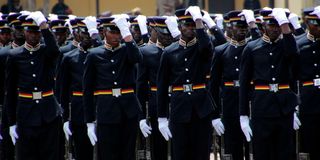
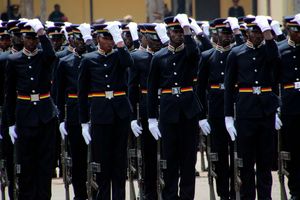
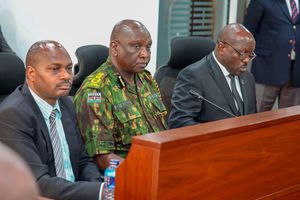
A House committee has given the National Police Service and the National Police Service Commission (NPSC) two days to resolve the impasse over recruitment.
On Tuesday, the National Assembly Constitution Implementation Oversight Committee gave the two sides until tomorrow to iron out their differences and announce the date when 10,000 constables will be hired.
The committee, chaired by Caroli Omondi (Suba South MP), directed NPSC chairman Amani Komora, the commission’s chief executive officer Peter Leley, and Inspector-General of Police Douglas Kanja to work together for the good of the country.
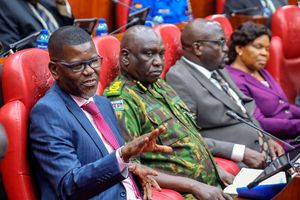
National Police Service Commission Chairperson Dr Amani Yuda Komora (left) Inspector-General of Police, Douglas Kanja (centre) and NPSC CEO, Peter Leley appear before the Committee on Administration and Internal Security at the County Hall Nairobi on Tuesday, September 9, 2025.
Photo credit: Dennis Onsongo | Nation Media Group
The NPSC and police service are also having problems with the management of the payroll. They were directed to find an amicable solution and report back within 60 days.
“We have agreed that the commission and the service will meet on Thursday to iron out their issues. After Thursday, they will announce the date of the recruitment of the police officers,” said Mr Omondi.
The committee rejected the commission’s proposal for an online recruitment process. This is after the NPSC said that the regulations are not yet ready.
“You cannot anticipate the law. The recruitment will be done as we direct,” Mr Omondi said.
Last week, Mr Leley told the National Assembly Committee on Administration and Internal Security that the NPSC submitted a recurrent budget requirement of Sh379 million for the recruitment of police officers. He said that the exercise was supposed to have started on September 11. The new recruits were expected to report for training in November.
Chief Executive Officer of the National Police Service Commission, Peter Kiptanui Leley.
Photo credit: File| Nation
However, Mr Leley said that only Sh75 million had been allocated for recruitment and that the National Treasury had sent the money directly to the service’s accounts, as referenced in a letter dated 10 June 2025.
“The budget for recruitment was directly allocated to the National Police Service,” he said.
Police officers are usually recruited by the service because the NPSC lacked the technical capacity to undertake the recruitment process itself.
However, Mr Leley told the House committee that this time round the NPSC is ready to undertake the exercise.
Apart from the millions involved in the recruitment, there is also the question of who will control the 10,000 positions that the NPSC and the police service are fighting over.
Police officers are normally recruited at the sub-county level. According to insiders, those overseeing the process decide on how the slots will be shared. But as a result of underhand deals, deserving candidates are not selected.
Those in positions of power, such as politicians and other influential individuals, are often favoured. Some recruits are selected regardless of whether they meet the academic and physical requirements.
For instance, the mandatory height requirement exists to ensure that recruits can perform their duties effectively and safely.
The minimum height requirement for men is 5.8 feet (173 centimetres), while for women it is 5.3 feet (160 centimetres). Potential recruits are informed well in advance to check the requirements listed in official NPSC advertisements.
Interior Cabinet Secretary Kipchumba Murkomen and IG Mr Kanja have both recently stated that police recruitment is often plagued by corruption.
“It is true that there is a lot of corruption in the recruitment of police officers, but we will fix this,” Mr Murkomen admitted.
Interior Cabinet Secretary Kipchumba Murkomen during a security forum at Sarova Woodlands Hotel in Nakuru on August 12, 2025.
Photo credit: Boniface Mwangi | Nation Media Group
Recently, Trans Nzoia Governor George Natembeya criticised the recruitment process, claiming that it was tainted by corruption.
“On the day of the pass-out parade, which marks the end of nine months of training, around 7,000 to 8,000 recruits graduate. Where do they all come from?” Mr Natembeya asked, adding that some of them are too short.
The governor claimed that some regions get more slots than those initially allocated to them, which is a violation of the constitutional requirement of ethnic diversity in public offices.
“If a region gets more slots than those allocated to them, they have been stolen from the other regions. I can tell you that, for instance, if you take the recently employed teachers and have their names published for Kenyans to see, it will cause a revolution,” said the governor.
During police recruitments, tens of youths, among them university graduates, turn up to try their luck owing to the high unemployment rate. But many are disqualified for being too short, among other reasons. Some leaders have urged the government to revise this rule.
Mr Leley said that shorter people are disadvantaged in combat and are deemed incapable of fighting criminals.
Earlier on June 29, 2023, the NPSC explained to a Senate committee why it does not recruit short people after the chairperson of the National Cohesion, Equal Opportunity, and Regional Integration Committee Mohamed Chute (Marsabit) sought to know the reason for the exclusion.
“With all due respect to short people, and I am not saying that they cannot do the job. But taller people are seen as capable of executing an arrest. They are able to pin down a criminal. How do you expect a 1GB person to pin down a heavyweight?” Mr Leley asked then.
He went on; “Most criminals are strong such that they can even fight off citizen arrest, as they are people who can put up a fight with a crowd. That is why we need heavily built officers.”
Mr Leley noted that it is “for this reason that they also have set a minimum weight for youth seeking to join the service.”
The minimum weight for men is 54.55 kilogrammes and women, 50.00 kilogrammes.
It is also a requirement that female candidates must not be pregnant at the time of recruitment and during the entire nine-month duration of training.