The Ethics and Anti-Corruption Commission (EACC) has asked the Supreme Court to strike out an appeal by two companies linked to the late businessman Francis Mburu, arguing that the case does not raise any constitutional question warranting the intervention of the apex court.
Huelands Limited and Afrison Export Import Limited moved to the Supreme Court against a Court of Appeal decision declaring illegal the Sh1.5 billion payment to them as compensation for 13.5 acres of land occupied by Drive-In Primary School and Ruaraka High School.
But in submissions opposing the appeal, EACC says the companies are attempting to turn factual and evidential disputes into constitutional questions to persuade the Supreme Court to re-examine findings already made by the Environment and Land Court (ELC) and upheld by the Court of Appeal.
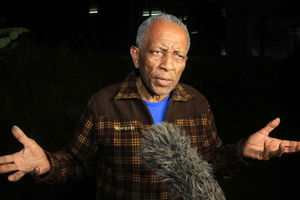
Afrison Export and Import Ltd and Huelands Ltd director Francis Mburu at the Ethics and Anti-Corruption Commission offices on July 19, 2018. He claimed ownership of the controversial land in Ruaraka, Nairobi.
Photo credit: File | Nation
The commission argues that such a move falls outside the Supreme Court's appellate jurisdiction under Article 163(4)(a) of the Constitution.
“Having made concurrent findings of fact on that issue, the petition of appeal seeks to invite this court to re-evaluate the evidence and interfere with those findings, contrary to its appellate jurisdiction,” EACC said.
At the heart of the dispute is whether the companies voluntarily surrendered the 13.5 acres for public use when seeking approval for subdivision of the larger parcel in the 1980s.
The companies argue that the courts erred in finding that the land had been surrendered, insisting that there was no formally registered instrument of surrender.
They contend that treating planning approval as a mechanism for surrendering private land effectively amounted to compulsory acquisition without compensation, contrary to constitutional protections of property rights.
The firms have also argued that the Court of Appeal failed to properly interpret Article 40(3) of the Constitution, which protects property from arbitrary deprivation.
It is their argument that the appellate court failed to distinguish between lawful planning controls and compulsory acquisition, and thereby allowed private property to cease being privately owned without a legally recognised process of transfer, surrender or acquisition.
The companies want the Supreme Court to overturn the findings of the lower courts and affirm their claim to compensation.
They maintain that the National Land Commission (NLC) lawfully initiated compulsory acquisition proceedings after establishing that the two schools stood on privately owned land. They further argue that the NLC had approved a further Sh1.769 billion compensation, which remains unpaid.
EACC, however, says none of the constitutional provisions now relied upon by the companies formed the basis of the dispute before the ELC or the Court of Appeal.
According to the anti-graft agency, the lower courts were primarily concerned with factual questions, including whether the companies had unequivocally surrendered the land as a condition for approval of a subdivision scheme lodged in 1982.
EACC says the ELC considered documentary evidence and the parties' submissions before concluding that the land had been surrendered. The Court of Appeal subsequently re-evaluated the record and affirmed that finding.
The commission argues that the Supreme Court cannot be invited to revisit questions such as whether there was a surrender, how the subdivision scheme was implemented, the weight to be given to documentary evidence and the evidential burden borne by the parties.
“These matters of fact and evidence already determined by the courts do not become constitutional questions purely because constitutional provisions have been cited in the petition,” EACC said.
The Court of Appeal had found that the land was surrendered for public use in 1984 and that the companies could not return decades later to demand compensation.
The judges relied on correspondence showing that after approval of a subdivision scheme, the Director of City Planning wrote to the Commissioner of Lands on February 20, 1984, asking that portions reserved for public purposes be transferred to the then Nairobi City Commission.
The Court of Appeal said the correspondence supported the conclusion that the land had been voluntarily surrendered.
It also noted that Drive-In Primary School and Ruaraka High School had been established on the land in 1984 and 1987 respectively, with the companies taking no action to reclaim the property for decades.
The appellate court consequently upheld the finding that the Sh1.5 billion compensation paid in 2017 was illegal.
The companies have separately moved to the High Court seeking to stop EACC from recovering the money pending the Supreme Court appeal.
The firms argue that allowing EACC to recover the money before the Supreme Court determines the appeal could effectively enforce the Court of Appeal judgment and render their case nugatory.