Cases of the possible existence of ghost pensioners or fraudulent pension payments have continuously been unearthed by the Auditor-General, who has questioned the credibility and integrity of pensioners’ data used by the Treasury to pay billions of shillings to retirees annually.
In the financial year ending June 2024, Auditor-General Nancy Gathungu raised a red flag over incomplete pension records, including the lack of pensioners’ names and national identity card details, raising fears that the Pensions Department at the Treasury may have paid billions of shillings to ghost pensioners.
In her report to Parliament, Ms Gathungu cast doubt on the accuracy of Sh118.55 billion pension payments, which includes Sh61.68 billion and Sh8.4 billion for civil and military pensions, respectively.
“However, as previously reported, the payroll provided for audit review had some missing pensioners’ details such as ID numbers, while some pensioner employee numbers had been recorded as ‘DUMMY’,” Ms Gathungu said.
“In the circumstances, the credibility and integrity of the pensioners’ data used for processing pension payments could not be confirmed.”
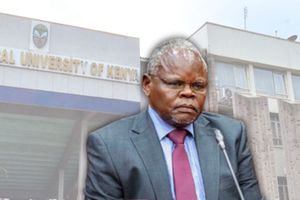
Auditor-General Nancy Gathungu.
Photo credit: File| Nation Media Group
Pension is money an employer pays on a monthly basis to an employee who is no longer in service upon attaining the mandatory retirement age, voluntary retirement at 50 years, injury, ill health or reorganisation of office, or to a deceased officer’s surviving dependants.
In her report, Ms Gathungu cited cases of fraud, noting that the June 2024 bank reconciliation statement reflected an amount of Sh15.64 billion with respect payments in the bank not recorded in the cash book, out of which Sh14.89 billion had been outstanding since 2008.
“Although management attributed this to fraudulent payments that were made through the CFS Pension and Gratuities bank account, and that after investigations and court proceedings the accused were acquitted, it was not clear why it had taken unduly long to clear the items from the bank reconciliation statement,” Ms Gathungu said.
Past reports by the Auditor-General reveal an upward trend in returned pensions (re-credited cheques), which rose to Sh7.1 billion in the financial year 2023/24 from Sh6.7 billion recorded in 2022/23.
“The balance has been increasing mainly due to the demise of pensioners or lack of claims by dependants,” Ms Gathungu said.
“Further, the department did not have the funds in the bank account to pay the returned pensions if they were to be claimed by the beneficiaries.”
Outstanding for more than a decade
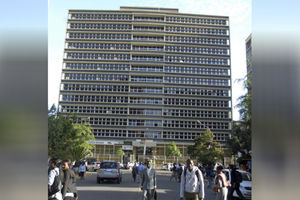
The National Treasury Building in Nairobi.
Photo credit: Pool
In the financial year 2023/24, Ms Gathungu also flagged pension payments of Sh118.55 billion against a budgeted amount of Sh154.5 billion.
She said that in the year under review, pension payments took an average of 195 days to process, compared to the National Treasury’s Service Charter, which provides that retirement benefits should be paid within 90 days of receiving a claim.
A recent performance audit by the Office of the Auditor-General blamed inefficiencies at the National Treasury’s pensions department for delays in the processing and payment of pensions to officers who have exited public service.
The report, tabled in Parliament, flagged the department’s failure to address issues such as late submission of claims and incomplete or erroneous claims by government agencies, which delay processing and payment.
The performance audit on the administration of the Public Service Pensions Scheme shows that processing and payment of terminal benefits is expected to take 21 days from the date a duly completed and supported claim is accepted at the pensions department, as per the Citizen Delivery Charter (CDC).
However, the audit revealed that some claims take years, meaning pensioners and dependants are unable to access their money in time to cater for their basic and other needs.
The Commission on Administrative Justice (CAJ), in a report of January 2016, accused the National Treasury of unresponsiveness, discourtesy, inefficiency, delays, refusal to pay, discrimination and abuse of power in the processing and payment of retirement benefits.
The payment of pensions and gratuity is governed by the Pensions Act and other related laws and aims to ensure a secure future for pensioners and dependants, enabling them to access basic services such as healthcare, shelter and education.
The pensions department is responsible for processing and paying retirement benefits—pensions and gratuities—to retired presidents and their legal personal representatives and dependants, MPs, military personnel, civil servants and teachers.
The Human Resource Policies and Procedures Manual for the Public Service (2015) provides that claims for normal retirement should be submitted at least nine months before an officer’s exit date to allow verification and correction of errors while the officer is still in service.