The Supreme Court has directed Attorney-General Dorcas Oduor to advise on a constitutional dispute over whether impeached State officers can contest in elections while challenging their removal in courts.
The apex court last Friday directed the AG to offer the advisory opinion within 21 days. The bench referred the issue to the AG as it delayed a potentially far-reaching ruling that could shape the forthcoming 2027 Presidential elections.
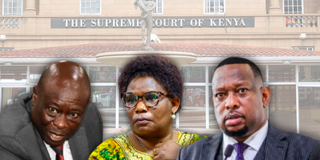
The case carries immediate political significance for former Deputy President Rigathi Gachagua, former Meru Governor Kawira Mwangaza and former Nairobi Governor Mike Sonko, whose removals from office have generated prolonged court battles.
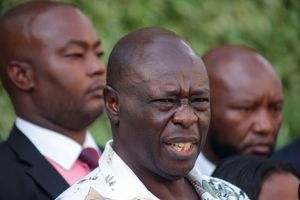
Former Deputy President Rigathi Gachagua at Milimani Law Courts in Nairobi on May 13, 2026.
Photo credit: Billy Ogada | Nation Media Group
At the centre of the case is whether leaders ousted from public office through impeachment may seek elective office before their appeals are concluded.
Mr Gachagua was impeached by the National Assembly in 2024 before mounting a sustained court challenge contesting the legality of his removal. The contest is ongoing at the Court of Appeal. He is among the Presidential frontrunners seeking to challenge President William Ruto's reelection in the August 2027 General Election.
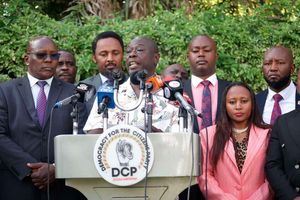
Kawira Mwangaza (center) with her husband Murega Baichu (left) at the Milimani Law Courts in Nairobi on December 18, 2024 when the High Court extended orders suspending her impeachment.
Photo credit: Wilfred Nyangaresi | Nation Media Group
Ms Mwangaza lost the Meru governorship in August 2024 after the Senate upheld the County Assembly's decision to impeach her, prompting separate court litigation over the process.
Mr Sonko was removed as Nairobi governor in 2020 and continued pursuing legal battles arising from his impeachment while remaining active in politics.
Following their impeachment they established different political outfits, with Mr Gachagua becoming leader of the Democracy for the Citizens Party (DCP), Ms Kawira Umoja na Maendeleo Party (UMP) while Mr Sonko leads the National Economic Development Party (NEDP).
Former Nairobi Governor Mike Mbuvi Sonko testifies during the hearing of a graft case against him at the Milimani Law Courts in Nairobi on February 5, 2026.
Photo credit: Billy Ogada | Nation Media Group
The case before the Supreme Court was filed by Meru County Assembly Speaker Ayub Bundi Solomon in April 2026 in form of an advisory opinion reference, asking the apex court to interpret Chapter Six of the Constitution alongside Articles 99 and 193 governing qualification and disqualification for elective office.
“This is a non-adversarial reference for an advisory opinion. The reference arises from the unresolved uncertainty at the heart of the leadership and integrity framework under Chapter 6 of the Constitution," he says.
In the application dated April 10, 2026, Mr Bundi argued that court orders suspending removals pending appeals have, in practice, allowed officials removed for integrity violations, including impeachment, to remain eligible for elections while litigation continues.
He explained that 15 years since promulgation of the Constitution 2010, "there remains no authoritative interpretation whether the Constitution establishes a coherent fit-and-proper standard for public leadership and especially how the standard applies to persons removed from office for breach of Chapter 6 through constitutionally prescribed processes such as impeachment."
He argued that this has created structural risk to the constitutional order, fostered inconsistent institutional practise, and encouraged divergent interpretations by state organs and courts.
Instead of addressing those constitutional issues immediately, the five-judge bench led by Deputy Chief Justice Philomena Mwilu directed Speaker Bundi to first obtain legal advice from the Attorney-General before the case hearing can proceed.
“The applicant is directed to seek the Hon. Attorney General’s advice, and such advice is to be given within 21 days from the date of this ruling,” the court ordered. The other judges in the bench were Smokin Wanjala, Isaac Lenaola, William Ouko and Mohamed Warsame.
Impeached or removed officials
The judges directed that the reference and ruling be served on the Attorney-General and that the matter return before the Deputy Registrar after compliance with those directions.
The ruling also postponed consideration of requests by the Independent Electoral and Boundaries Commission and the Ethics and Anti-Corruption Commission to join the proceedings.
Both commissions had sought admission because of their constitutional responsibilities over candidate qualifications and integrity requirements.
The Speaker had argued that seeking the Attorney-General’s opinion before filing the reference was unnecessary. His lawyers maintained that a separate Supreme Court's 2024 advisory opinion showed the process was not mandatory and that the structure of devolution made that route unsuitable in the circumstances.
“Rule 53 of the Supreme Court Rules 2020, together with the list of authorities cited by the applicant, clearly set out the requirement to seek the Attorney General’s advice before filing a Reference,” the court said.
The judges added that such advice “may resolve the question before us to the applicant's satisfaction, thus saving precious judicial time.”
They further held that the present dispute differed fundamentally from the previous advisory opinion because the Attorney-General had been the applicant in that case and therefore could not be expected to advise the office itself.
“We therefore find no justification for the applicant’s failure to seek the Attorney General’s advice in this case and his reliance on the Martha Karua case is obviously misguided,” the judges ruled.
The court also rejected arguments that the devolved system prevented the Attorney-General from advising on the dispute.
“The devolution system as presently designed does not also preclude the Attorney General from giving advice, particularly in a matter of public interest,” the judges said.
The Supreme Court did not express any view on whether impeached or otherwise removed officials may contest elections while appeals remain pending.
Instead, it confined itself to the procedural question before it and ordered the Attorney-General to advise first before any hearing on the substantive constitutional issues proceeds. The case is slated for mention on August 10, 2026.