Hello

Your subscription is almost coming to an end. Don’t miss out on the great content on Nation.Africa

Ready to continue your informative journey with us?

Hello

Your premium access has ended, but the best of Nation.Africa is still within reach. Renew now to unlock exclusive stories and in-depth features.

Reclaim your full access. Click below to renew.

the Rhamu Road
Caption for the landscape image:

The haves and the have nots of Kenyan roads: Murang'a, Kiambu have more rural tarmac than 16 other counties combined

Scroll down to read the article

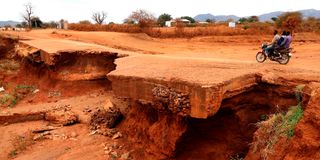
The Rhamu Road on a picture taken on July 26,2026 the road serves as a link between El Wak, Rhamu, and Mandera in north-eastern Kenya. 

Photo credit: Sila Kiplagat | Nation

It is hard enough being a resident of a marginalised region.

But living anywhere between Moyale and Mandera comes with specially packaged problems.

Whether in Kinisa, Takaba, Banisa or Rhamu, access to healthcare, education, water or even markets requires a delicate safety and economic balance that has left most suffering.

For generations, many Marsabit and Mandera residents have not had the privilege of knowing what a good road looks like, or the endless possibilities such infrastructure could provide.

Noor Adan Mohamed, lives in Yabalo, just about 20km from Moyale town.

Born and raised in this arid corner of Marsabit County, Noor recitals of challenges show just how lack of roads can stifle not just growth of physical places, but entire generations.

the Rhamu Road

The Rhamu Road on a picture taken on July 26,2026 the road serves as a link between El Wak, Rhamu, and Mandera in north-eastern Kenya. 

Photo credit: Sila Kiplagat | Nation

The 20km trip from Moyale to Mandera is a nightmare, one that residents have endured for decades. Earth drifts, furrows caused by overloaded trucks and ditches dug up by flash floods in the rainy season make it a short, but difficult trip.

“This is how the road has been forever, steep earth drifts, deep ruts and generally a state that makes it so difficult to travel. During dry seasons such as now, you are lucky to only deal with dust and the discomfort of bumpiness, during heavy rains you would have to wait for about three hours for water to clear after flash floods,” Noor says.

The Toyota Land Cruiser, one of the most reliable offroad vehicles ever built, is the cornerstone of public transport in those parts. It is one of the few vehicles that can navigate the rough terrain, without constantly being damaged.

People mostly travel in and atop Toyota Land Cruisers for the 380km journey from Moyale to Mandera, packed to the brim, with heads peeping on the sides.

Isiolo-Garba Tula Road

Locals travellers on a Land Cruiser along the Isiolo-Garba Tula Road which serves the northern Kenya transport corridor, linking Isiolo to Garba Tula, Modogashe, Wajir, and Mandera.

Photo credit: Sila Kiplagat | Nation

It’s a dusty road and along it, you will only meet motorbikes, camels and Toyota Land Cruisers.

On a well-tarmacked road, travelling non-stop at an average of 80 kilometres per hour, such a journey should take about five hours. It takes 12 hour to cover that same distance here.

“Travelling from Moyale to Mandera is not an easy journey, you travel for about 12 hours for the trip and irrespective of where you sit, the fare is Sh6,000. We have no matatus because they cannot endure the road’s status, it’s the land cruisers that ferry people.

“If you have an emergency such as pregnant woman who wants to give birth, you either pay Sh5,000 for a taxi to get you from Yabalo to Moyale, or she will travel on a motorbike and pay Sh1,000,” Noor says.

Youths like Noor have been forced to pick up basic motorcycle repair skills. Not for business, but to repair their own motorcycles because the closest mechanic is in Moyale town.

Isiolo- Kulamawe - Garba Tula

About 500km away, 48-year-old Ahmed Mohamed’s face lights up every time he visits the camel watering point in Gambela, about 10km from Isiolo town.

The construction of Isiolo - Kulamawe - Garba Tula road has been in top gear in recent months and residents have been unable to contain their excitement since construction started.

Dozens of culverts have been installed across several sections and now lay in wait of more works, Kenya National Highways Authority (KeNHA) jersey barriers are re-directing motorists to access routes, and tippers and earth movers are busy with work. There is every sign that bitumen is approaching.

Construction of The Isiolo - Garba Tula Road

Construction of the Isiolo - Garba Tula Road goes on. The road serves the northern Kenya transport corridor, linking Isiolo to Garba Tula, Modogashe, Wajir and Mandera.

Photo credit: Sila Kiplagat | Nation

“This road has never been tarmacked since I was born. We have always used motorbikes to travel to Isiolo where we get most services, but this construction means that it’s now possible to buy a probox for business and movement,” Mr Mohamed says.

The upgrade of this road will be a great relief for the residents of Isiolo and Garissa counties, since for years, the tarmac road stretched just about 4km from Isiolo town to the Isiolo Barracks gate.

“We have paid Sh1,200 from Merti to Isiolo, including those sitting at the roof of the vehicle,” one passenger says as they alight in Isiolo.

Land Cruiser along The Isiolo - Garba Tula Road

Locals travellers on a Land Cruiser along The Isiolo - Garba Tula Road which serves the northern Kenya transport corridor, linking Isiolo to Garba Tula, Modogashe, Wajir, and Mandera.

Photo credit: Sila Kiplagat | Nation

Merti is about 190km from Isiolo town. Nanyuki, Nyahururu and Mau Summit are all approximately 190km from Nairobi. It costs Sh600 to travel from Nairobi to Nyahururu by a 14-seater shuttle. To Mau Summit , Sh700.

The thousands of residents using roads such as the Moyale - Mandera and Isiolo - Garba Tula - Garissa roads not only have to endure safety risks in the way the travel and long travel times, but also higher fares.

While Kenya lacks comprehensive data on distribution of the 239,123km roads (tarmac, earth and murram) by counties, available data on distribution of the 28,150km rural roads shows that Northern Kenya residents have been neglected in construction of proper roads.

The haves and the have nots

Data by the Kenya National Bureau of Statistics (KNBS) shows that of the 5,163km tarmacked roads classified under Class C (rural roads), only 77km are in the six Northern counties of Turkana, Marsabit, Wajir, Samburu, Isiolo and Garissa.

The six counties contributed a meagre 3.4 per cent to Kenya’s economy over the past five years, despite carrying about 8 per cent of the country’s population.

In the transport sector particularly, the counties in 2024 contributed a mere 1.45 per cent (Sh51 billion), of the Sh3.5 trillion gnerated by the sector nationally.

More than half of the tarmacked road length, 2,634km, is concentrated in 10 counties, majorly in Mt Kenya and Rift Valley regions.

Majority of the roads we surveyed in Nyeri and Murang’a counties are tarmacked, though some have low traffic flows, including one of the Mau Mau road sections in Nyeri County, where we came across four vehicles in a distance of about 15km.

On the flip side, the bottom 16 counties in terms of tarmacked rural roads have a combined length of 385km, shorter than either Murang’a or Kiambu’s.

“The rural roads network plays a vital role in enhancing connectivity in rural areas, facilitating access to markets, social services and economic opportunities,” KNBS reckons in the 2026 Economic Survey.

The combined tarmac coverage in Kisumu, Nyamira, Vihiga, Isiolo, Kitui, Busia, Taita Taveta, Garissa, Tana River, Lamu, Samburu, Wajir, Marsabit, Kajiado, Turkana and Nairobi is less than that of Murang’a and Kiambu Counties.

Dwarfs of tarmac, kings of dusty roads


Kitui County might have just 36km of tarmacked rural roads but when it comes to the murram and other unpaved rural roads, it leads with a network of 1,222km.

The combined length of unpaved rural roads accounts for the top 10 counties is 9,622km (42 per cent) of all the unpaved rural roads in the country.

Ironically, the top dogs in unpaved rural roads are nowhere to be found in the list of counties that have high levels of tarmac roads.

It is worth noting that the roads classified into counties constitutes only those under Class C - rural roads which are managed by counties, and not national roads.

Overall, Kenya has a total road network of 239,123km, out of which 25,400km is tarmacked.

Of the tarmacked roads, 20,085km are classified as national roads while 5,327km are county roads - the ones distributed into counties.

More than three-quarters o

f the unpaved roads, however, (176,725km) are classified as county roads, with unpaved national roads summing to 36,986km.

Experts take

Economists reckon that imbalanced roads development across the country triggers disproportionate economic development, noting that roads have been known to inspire business where they pass.

“Road construction is best done at the County level to ensure unique local needs are taken into account. The national government should be limited to make national highways,” says Ken Gichinga, Chief Economist at Mentoria Economics.

The Institute of Economic Affairs (IEA) reckons that in urban areas, roads have opened up residential and commercial areas, while easing transportation of agricultural produce in rural areas.

The IEA observes that while residents of Nairobi and a few other regions benefit from availability of roads and other transport means such as railways, some parts of the country have been left behind by having bad roads with no alternative.

“Roads shouldn’t be based just on few areas of high productivity. This is what has led to marginalization and blocked some parts of the country from services and economic activities,” says IEA’s Programs Coordinator John Mutua.

Mr Mutua says that while roads are expensive to build, their development must be balanced between supporting regions with high economic activity and enabling citizens across arid and semi-arid regions access public services.

This is what will address economic inequalities that have made households in some parts of the country spend much of their income on transport, at the expense of more deserving needs such as education and health.

Follow ourWhatsApp channel for breaking news updates and more stories like this.

Tomorrow in the Sunday Nation: What ails Kenya’s roads