For years, residents living near dumpsites, factories, oil spills and abandoned exploration sites have complained about pollution, unsafe water and hazardous living conditions, often with little visible action from the authorities.
The neglect then forced them to move to court seeking protection and enforcement of their rights.
The courts have, in turn, given them positive responses, including declarations and directives to remedy the situation.
In a string of cases across the country, judges have ordered government agencies to clean up polluted sites, rehabilitate dumpsites, provide safer conditions and, in some cases, pay millions of shillings in compensation to the affected residents.
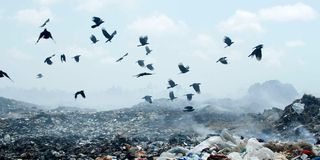
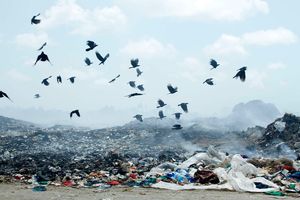
Justice Lucas Naikuni found that the Mwakirunge dumpsite had been allowed to operate for years despite complaints about smoke, foul odours, hazardous waste and other dangers to residents.
“The Mwakirunge dumpsite and the effects of pollution have been there for a very long time. Secondly, the Mwakirunge dumpsite is still operational to date, thus the residents’ right to a clean and healthy environment is continuously being violated,” Justice Naikuni said.
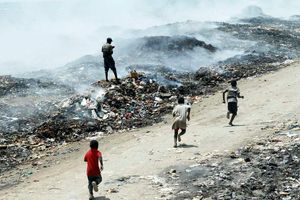
Children play near Mwakirunge dumpsite in Mombasa on October 4, 2021.
Photo credit: File| Nation Media Group
The court ordered Mombasa County to immediately begin construction of a concrete perimeter wall at least six metres high, fitted with razor wire and secure gates.
The court said access to the dumpsite must be controlled and security provided, with the works expected to be completed within 12 months.
The county government was also directed to develop modern waste management and solid-waste incineration facilities meeting international safety and health standards.
The families told the court that they settled in the area decades before the dumpsite was moved there in 2007.
The residents said waste was brought close to their homes without adequate consultation or compensation, exposing them to fires, medical waste, accidents involving garbage trucks and other hazards.
In 2007, the Kenya Civil Aviation Authority and Kenya Airports Authority warned that the dumpsite was within the approach path of the runway of the Moi International Airport and could attract birds, posing an aviation safety risk.
Studies commissioned by ActionAid Kenya and Kenyatta University students in 2015 documented pollution, fires, insecurity, disruption of children's education and health problems, and recommended that the dumpsite be relocated.
Justice Naikuni ultimately found that both the county government and Nema had failed to take adequate measures within their mandates to prevent and control the environmental harm.
The Kenya Metal Refinery Factory which was closed after fears it had have poisoned the residents of Owino Uhuru slum.
Photo credit: File | Nation Media Group
The award, which was later affirmed by the Supreme Court in 2024, apportioned responsibility among the State, the company that operated the factory and other parties.
Nema was assigned 40 per cent of the liability, with the court finding that its failures contributed to the environmental disaster.
The State was apportioned 70 per cent, Mombasa County five percent, Metal Refineries (EPZ) Ltd 25 per cent and Penguin Paper and Book Company five per cent under the respective findings on liability.
The court also ordered Nema to clean up contaminated soil, water and waste within 120 days. Failure to do so would attract a further Sh700 million for the clean-up.
Nema had escalated the matter to the Supreme Court, arguing that it could not readily meet its share of the award because it operates within government budgetary cycles and that immediate payment would cripple its operations.
The agency had also challenged aspects of the judgment, including the application of strict liability and the “polluter pays” principle.
But for the residents, the case was about more than money. It was about years of exposure to pollution and the failure of public agencies to intervene despite warnings.
In Nairobi’s Dandora area, more than 1,000 waste pickers were recently awarded Sh25.8 million after the court found that Nairobi County and Nema had failed to protect them from air pollution and hazardous working conditions.
A caterpillar at work at the Dandora dumpsite in Nairobi County. The site, one of Africa’s largest open-air landfills, spans about 30 acres.
Each of the 1,032 waste pickers was awarded Sh25,000.
The waste pickers sift through garbage, often with their bare hands, in search of recyclable material. They told the court that they had no other source of livelihood and were routinely exposed to toxic chemicals and gases.
A community health volunteer testified that he regularly referred waste pickers for medical attention, with medical personnel attributing their illnesses to the nature of their working environment.
“Taken together, this body of evidence establishes that the working and living conditions at the dumpsite are hazardous and that the Plaintiffs are routinely exposed to substances and processes capable of causing serious harm to human health,” the court said.
The waste pickers had also complained that studies dating back to 2011 had documented the dangers at Dandora, yet recommendations for rehabilitation had not been implemented.
Dandora dumpsite covers over 30 acres, and residents of Korogocho, Baba Ndogo, Mathare and Dandora eke a living from scavenging the waste but expose themselves to health risks. It filled up as early as 2001, and efforts to shut it down have not been successful.
Still in Nairobi, three residents of Umoja I successfully sued Nema and Nairobi County over an illegal and expanding waste disposal site along Umoja I and II roads.
The court in February this year ordered the county to clear all accumulated waste within four months and restore the affected area to an environmentally safe and sanitary condition.
Governor Johnson Sakaja's administration was further ordered to file a detailed compliance report setting out how the site had been cleared, how further illegal dumping would be prevented and what institutional arrangements had been put in place for continuous lawful waste management.
Each petitioner was awarded Sh30,000 and costs of the case.
In Makueni County, residents of Thange secured a Sh3 billion compensation against Kenya Pipeline Company over a 2015 oil spill.
The award has since been temporarily suspended by the Court of Appeal after KPC demonstrated that it had an arguable appeal and raised concerns about recovering the money if the judgment was overturned.
The residents maintain that more than a decade after the spill, they remain unable to safely use water from the Thange River and shallow wells for domestic use, irrigation and livestock.
KPC, on its part, argues that it has invested heavily in remediation and that tests show hydrocarbon contamination has fallen below levels requiring further bioremediation.
In Marsabit, a group of 299 residents has sued the government and British multinational BP over alleged pollution linked to oil exploration activities carried out in the 1980s.
The residents allege that toxic waste, including drilling muds and cuttings containing heavy metals, chemicals and hydrocarbons, was improperly disposed of in unlined pits, contaminating soil and groundwater.
They are seeking investigations into alleged pollution around former exploration sites at Kargi, Maikona, Kalacha, Turbi, North Horr, Bubisa and Dukana.
They want authorities to establish the extent of contamination of groundwater, soil, air, livestock and human health, and to provide safe alternative water sources if pollution is confirmed.