President William Ruto says the government has identified 9,000 acres in Lamu County for the project and is seeking another 3,000 as the development expands to include a refinery, a special economic zone (SEZ) and a “new big city”.
That puts the land being contemplated around 12,000 acres.
“We have already found 9,000 acres. We want to add another 3,000 to build the refinery and a special economic zone on 5,000 acres,” President Ruto said in an interview with a journalist at State House, Mombasa, on Wednesday.
“That place will have a big city which will build the economy of Lamu, the Coast and the country in general. That investment is 12 per cent of our GDP,”
The figure has added another dimension to an investment whose public debate has largely centred on its cost, its 700,000-barrel-a-day processing capacity and the 60,000 jobs and industries it is envisioned to generate.
The question is what land Kenya is putting into the project, whether the land is public or private, how affected households will be compensated and whether the value of the land forms part of the country’s contribution to the investment.
A group of 133 residents went to court over land earmarked for the Dangote refinery, saying it is ancestral land in which they have interests.
The Environment and Land Court ordered the status quo on the parcel to be maintained until the hearing of the application on October 14.
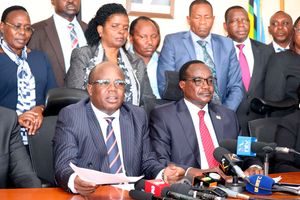
At the same time, opposition politicians are demanding disclosures of the agreements governing the investment, including the ownership structure, Kenya’s contribution and the land being committed to the mega-project.
The result is a three-way conversation around the refinery: the government presenting the land as part of its responsibility to facilitate a major investment; residents of Lamu challenging the status and acquisition of portions of the land; while politicians are demanding to be informed what Kenya is contributing to the project and what it will receive.
President Ruto made comparisons with the Dangote refinery in Lagos, Nigeria, which he said occupies about 7,000 acres.
The President added that the 5,000 acres would be used for the SEZ, with the wider development including an urban centre. This means the land requirement extends beyond the physical refinery.
The government is presenting the project as an industrial development zone that will support other businesses and services around the refinery.
According to the President, the land allocated to the project belongs to the government.
“The project is being undertaken on land that belongs to the government. No one will be evicted,” he said.
President William Ruto and President and Chief Executive Officer (CEO) of Dangote Group Aliko Dangote during the groundbreaking ceremony for the construction of an East African oil refinery in Lamu, Kenya, September 30, 2026.
Photo credit: PCS
“If there are families in areas earmarked for the project, they will be compensated by the government.”
Dr Ruto added that the government could not allow an investor identify landowners and negotiate for the thousands of acres.
“If you ask an investor to source for land and he doesn’t know who owns it, he will have challenges and we will lose him,” Dr Ruto said.
That position, however, is being tested by the 133 residents who have gone to court. The case concerns LR No. 13061 in Hindi/Manda Magogoni.
The court has not determined the ownership dispute. It has instead directed that the prevailing status quo be maintained, pending inter partes hearing on October 14.
Before the groundbreaking, some residents had also been demanding information on the precise location and size of the land meant for the project.
Kililana Farmers Association Organising Secretary, Mohamed Rajab, said locals had not been given details of the site.
“Why is the government leaving residents in the dark? We still don’t know the site for the intended oil refinery,” he said.
Nominated Senator, Shakila Abdalla, raised similar concerns.
Some residents have linked the refinery debate to earlier land acquisition for infrastructure associated with the Lamu Port South Sudan Ethiopia Transport (Lapsset) corridor, saying many compensation questions remain unanswered.
For the locals, the issue is about land rights, compensation and participation. For the government, the land is part of the public infrastructure and investment facilitation required for the project.
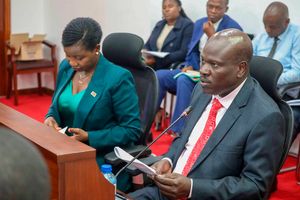
The land question has found its way into the Senate. Nairobi Senator Edwin Sifuna wants to know why Parliament has not been given access to the agreement governing the investment.
Mr Sifuna said investors could not dismiss concerns raised by Kenyans over projects undertaken in their country.
“I have heard him say that if you have problems with the project, he will deal with you. You cannot speak to us like that if you want to invest in Kenya,” Mr Sifuna said in the House.
He added that Parliament has not seen the agreement and lawmakers do not know the commitments Kenya made for the refinery to be built.
The Nairobi senator also pointed to the residents who have gone to court, saying their concerns should not be dismissed.
Kiharu MP and People’s Party of Kenya leader, Ndindi Nyoro, questioned the contribution of the government to the project.
Equipment on site at the Lamu Port on September 28, 2026 ahead of the Dangote East Africa Refinery groundbreaking ceremony set for September 30.
Photo credit: Pool
He demanded disclosure of the ownership structure, the size of land allocated and whether the value of the land will be converted into equity or shareholding.
According to President Ruto, Kenya will deploy land and other assets and use the National Infrastructure Fund to invest in the refinery.
Mr Nyoro wants details of that arrangement made public, including the list of shareholders and the division of shares.
He also wants to be informed if taxpayers are funding part of the project through land acquisition and other infrastructure.
Wiper Patriotic Front chief Kalonzo Musyoka said major investments should be subjected to scrutiny in an effort to establish if they serve the interests of the country and Kenyans.
“We are just demanding due process,” Mr Musyoka said.
He added that Lamu port and Lapsset were conceived under Vision 2030 and that successive governments contributed to the infrastructure that now makes Lamu attractive to local and foreign investors.
The government says its role is to facilitate investment, provide land where available and ensure projects that generate jobs and economic activity are not frustrated.
President Ruto has defended this position on many occasions. He says investors should not be forced to negotiate land acquisition themselves.
“We have agreed that at every step of the project, there will be public participation. We will fully involve the residents as we proceed,” he said.
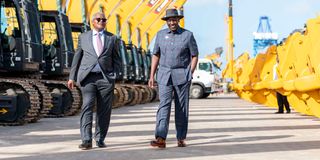
Kenya's President William Ruto and President and Chief Executive Officer (CEO) of Dangote Group Aliko Dangote walk amid heavy machinery on the day of a groundbreaking ceremony for the construction of an East African oil refinery in Lamu, Kenya, September 30, 2026.
Photo credit: PCS
Lamu Governor, Issa Timamy, has established a committee made up of agencies dealing with land, the environment and other issues related to the refinery.
Lamu Central Deputy County Commissioner, Kipkorir Tangus, says government officials have held meetings with county leaders, the clergy and elders and called a public participation forum in Mokowe.
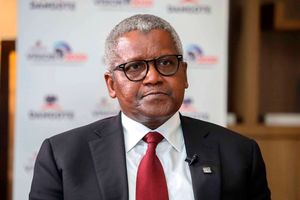
Mr Dangote says the refinery will be built within 40 months and has pledged to work with the relevant stakeholders.
For residents who have gone to court, the immediate issue is the land on which the project is being built and whether their interests have been recognised.
For Senator Sifuna, the central question is disclosure of the agreement and the commitments Kenya has made.
For Mr Nyoro, the question includes the value of the land and whether Kenya’s contribution is reflected in ownership.
The question raised by Mr Musyoka is on due process and public interests in major projects fronted by the government.
Contacted, Government adviser David Ndii said residents were compensated for the land set aside for the SEZ in 2015.
Dr Ndii added that the government released Sh1.3 billion for the first phase of the Lapsset project.
Even with all these questions that demand immediate answers, construction of the oil refinery has already been launched; equipment has arrived in Lamu and billionaire Dangote has set a completion target.