Deaths, injuries, violence and destruction dominated the nationwide strike by the public transport sector over soaring fuel prices as the country teetered on the brink of paralysis.
Schools were closed, businesses shut, operations in hospitals interrupted and chaos reigned on key transport corridors, with cities and towns turned into ghost territories.
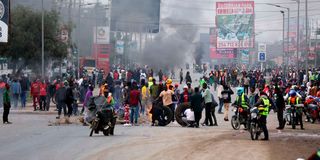
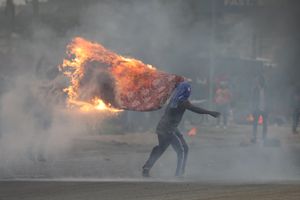
Fires, barricaded roads and looting were the order of the day as crowds engaged police officers in battles.
Protesters light lit bonfires and barricade a section of Dagoretti Road during national protests against rising fuel prices on May 18, 2026.
Photo credit: Billy Ogada | Nation Media Group
As the country was suddenly turned into a walking nation, President William Ruto’s loud silence on the situation painted a picture of an administration detached from reality.
From Coast to Central, Nairobi to Nyanza and Rift Valley to Eastern – the country was on the precipice as demonstrators left a trail of destruction in their wake.
A protester in Nakuru CBD was run over by a police vehicle while five people are nursing gunshot injuries at Nakuru Teaching and Referral Hospital.
A policeman in Machakos town was taken to the hospital after a tear gas canister exploded in his hands.
Treasury Cabinet Secretary John Mbadi added fuel to the fire by saying the protests were uncalled for.
The minister said Kenyans cannot solve a global problem through domestic means “since Kenya did not cause United States-Iran war”.
“I hear people saying fuel is cheaper in Uganda and Tanzania than Kenya. Where is that evidence? The cost of fuel in Kenya is much lower compared to our neighbours,” he said.
Wiper Patriotic Front leader Kalonzo Musyoka accused the government of being out of touch with reality. He also demanded the resignation of Energy and Petroleum CS Opiyo Wandayi.
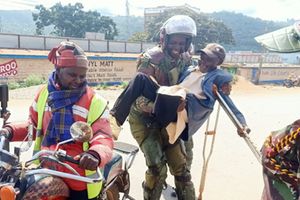
Police arrest a protesters outside the Kenya National Archives, Nairobi during national protests against rising fuel prices on May 18, 2026.
Photo credit: Lucy Wanjiru | Nation Media Group
“When the decisions of a regime make it economically impossible for transport operators to serve the public, the paralysis that follows must be laid squarely at the feet of those who govern – at the door of William Ruto,” Mr Musyoka said.
“President Ruto must direct his officials to open genuine and immediate dialogue with the Transport Sector Alliance. Their grievances are real, their members are suffering and stonewalling them is not governance; it is negligence.”
Addressing Jubilee Party delegates from Kiambu, former Interior CS Fred Matiang’i accused the Kenya Kwanza administration of mismanaging key sectors of the economy.
“The worst is yet to come. Brace yourselves. Even those of us who had misgivings about these leaders, we actually did not think it would be this disastrous,” Dr Matiang’i said.
“What you see is arrogance. We are in the middle of a crisis and if we continue like this, it will be a doomsday scenario.”
It took some minutes to 4 pm for Deputy President Kithure Kindiki to offer some semblance of respite.
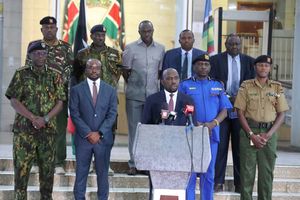
Prof Kindiki said the President, in an online meeting, directed Treasury, Transport, Energy and Interior ministers to meet oil marketers and transport stakeholders to look for ways of reducing fuel prices.
RIG Owners Association chairperson Cornelius Chepsoi dismissed the government’s narrative that the high fuel prices are caused by the war in Iran, saying pump price increases are hurting ordinary Kenyans.
Protesters in Kitengela light bonfires and barricade roads during national protests against rising fuel prices on May 18, 2026.
Photo credit: Dennis Onsongo | Nation Media Group
“You cannot punish us twice. You have given us poor quality fuel, and then you sell it to us at a high price. That is a double injustice to Kenyans,” Mr Chepsoi said on Monday.
Matatu Owners Association Chairperson Albert Karagacha added: “We have incurred losses of more than Sh500 million today but are willing to continue with the strike until petrol and diesel prices are reduced.”
Public transport services were paralysed across several Rift Valley towns, triggering chaos on highways.
In Eldoret, for instance, the disruption escalated into unrest, with angry young men barricading major roads.
Police officers were deployed to disperse demonstrators who had blocked sections of the busy Eldoret-Kitale highway in Huruma using boulders, logs and other objects.
The shutdown left commuters stranded at bus stops and business activities disrupted in one of the country’s busiest transport corridors.
“The situation is not good at all. If it persists, we are looking at a complete economic ruin,” said Mr Alex Kemboi, a matatu driver.
Anti-riot police officers disperse protesters at Shauri on the Eldoret-Huruma-Kitale road on May 18, 2026.
Photo credit: Jared Nyataya | Nation Media Group
The effects of the matatu strike were also felt in Kitale, neighbouring Trans Nzoia County, where services at the town’s main bus terminus were brought to a standstill.
By 10 am, the usually busy terminus, which handles more than 1,000 vehicles a day and serves routes to Turkana, South Sudan and parts of Uganda, had largely fallen silent.
At one point, service providers at the bus park resorted to playing football to pass the time as operations remained suspended.
Kitale-Kisii route matatu driver, Joakim Namache, said the strike would continue until the government addresses concerns over high fuel prices raised by Kenyans.
“We will not relent. We will push the government to listen to us. Matatu owners and operators are ready to continue with the strike until things improve,” Mr Namache said.
In Lodwar and other towns across Turkana County, transport operations remained subdued even without street demonstrations.
Matatu and shuttle booking offices in Lodwar were largely deserted as high fare charges discouraged passengers from travelling to Kitale, Eldoret and other towns.
The situation was also witnessed in the South Rift counties of Nakuru, Kericho, Bomet, Narok and Nyandarua.
Protesters in Kitengela barricade roads during national protests against rising fuel prices on May 18, 2026.
Photo credit: Dennis Onsongo | Nation Media Group
In Naivasha, however, shops were broken into and goods stolen by some protesters. A vehicle belonging to a Chinese road contractor was burnt.
Lorries, matatus and private vehicles kept off the road, forcing residents to walk for many kilometres to and from their workplaces. Many students failed to report to school.
Nakuru City’s main matatu terminus was turned into a playground as traders, touts, and motorists passed the time playing football. Most shops in the city were closed due to the protests.
Later, gangs lit fires on the Nakuru-Nairobi, Nakuru-Eldoret highways.
The protesters shouted anti-government slogans and demanded that petrol and diesel prices be reduced.
Security officers in Nyahururu town had a hard time protecting businesses belonging to pro-government traders.
Protesters attempted to break into Chieni Supermarket twice. The business belongs to Kieni MP Njoroge Wainaina.
In Mombasa, matatus and tuk-tuks remained parked at depots and petrol stations, while the few that attempted to operate were attacked and forced off the road by protesting crews.
The situation in Bamburi was tense as protesters positioned themselves at strategic points to intercept vehicles attempting to ferry passengers to town and other destinations.
At the Bombolulu matatu stage on the Mombasa-Malindi highway, demonstrators placed rocks and logs on the road. They also stopped private cars from picking up passengers.
“No vehicle has passengers. We must stand in solidarity with the rest of the Kenyans in protesting the high fuel costs,” Mr Jeff Kinyanjui, a matatu conductor, said.
The disruption extended to other regions of Mombasa County, including Mikindani, Changamwe and Jomvu, as well as the counties of Kilifi and Taita Taveta.
The strike paralysed freight operations at the port of Mombasa, where trucks were parked in long queues as drivers waited for the situation to stabilise.
Some drivers were seen resting inside their cabins, while others sat by the roadside monitoring the situation.
Protesters burn tyres in Kitengela during protests against the rising fuel prices on May 18, 2026.
Photo credit: Dennis Onsongo | Nation Media Group
Long distance bus companies also kept their vehicles away from their designated pick-up points on Mwembe Tayari Road for fear of confrontation with the protesting transport crews.
Businesses remained closed in many urban centres in Mt Kenya as matatu operators, boda bodas and other transporters joined the nationwide strike against increased fuel prices.
Major transport routes to Kiambu, Nairobi, Embu, Kirinyaga, Nyeri, Machakos, Kajiado and Nyandarua had ground to a halt by 9 am.
In Meru County, roads to and from various towns – Meru, Nkubu, Timau, Mikinduri and Maua – were barricaded with stones and fires, grinding transport operations to a halt.
Tuk-tuk, boda boda, and short-distance route matatus continued to operate in Murang’a County.
They reported to work early in the morning but were later forced to abandon work after running into hostile crowds.
At least four people sustained injuries in Karatina as business was paralysed for the better part of the day.
A protester was hit in the chest with a stone that had reportedly been thrown from a construction site belonging to Karatina University. The demonstrators had attempted to stop work at the site.
In Kirinyaga and Embu counties, hundreds of commuters were stranded when matatu operators parked their vehicles at home to protest the increase in fuel prices.
In Kirinyaga, the operators parked their vehicles at petrol stations in Ngurubani and Kutus towns.
They then took to the streets, demanding the reduction of prices. They barricaded the Kutus-Kagio and Embu-Mwea roads using fires and rocks.
Reporting by Collins Omulo, Brian Ocharo, Titus Ominde, Sammy Lutta, Evans Jaola, Mercy Koskei, Eric Matara, Waikwa Maina, Vitalis Kimutai, David Muchui, Mwangi Muiruri, Gitonga Marete and George Munene.